
JATAM Highlights Victory of President's Brother's Company in Natuna D-Alpha Oil and Gas Field
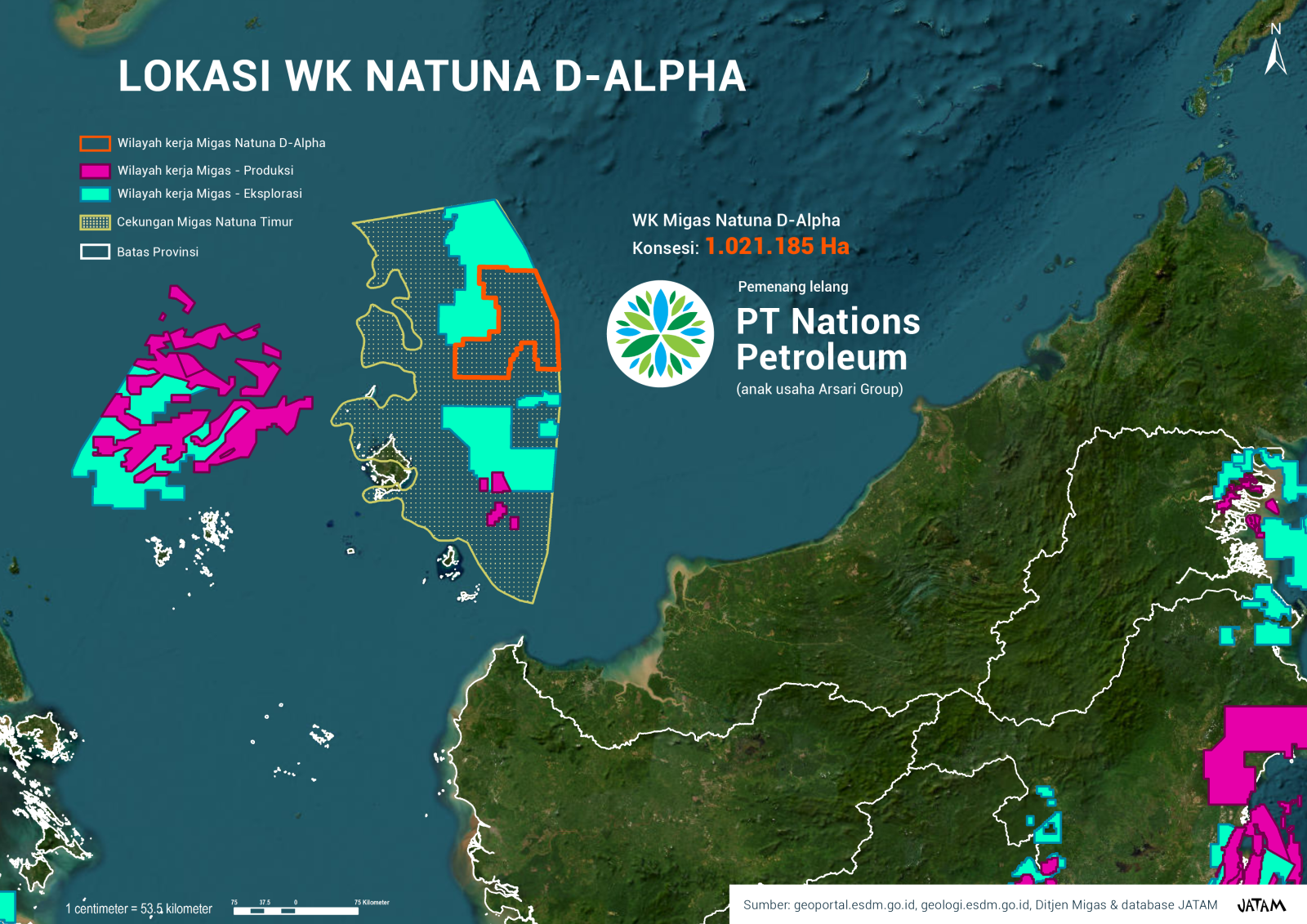
JAKARTA – The Mining Advocacy Network (JATAM) believes that the appointment of PT Nations Petroleum, a subsidiary of the Arsari Group owned by Hashim Djojohadikusumo, as the winner of the tender for the Natuna D-Alpha Oil and Gas Working Area (WK) raises serious concerns regarding conflicts of interest, the concentration of natural resource control by the political elite, and the direction of Indonesia’s commitment to facing the climate crisis.
Based on the decision by the Ministry of Energy and Mineral Resources (ESTM), PT Nations Petroleum won the management of the Natuna D-Alpha WK with an investment commitment of US$103.309 million, or approximately Rp1.83 trillion, for the first three years of exploration activities. This value is the largest compared to all winners of the Phase I 2026 Oil and Gas WK tenders. Additionally, the company is also required to pay a signature bonus of US$200,000 to the state.
“What is concerning is that the investment in Natuna D-Alpha accounts for about 73 per cent of the total investment commitment for all working areas tendered by the government in Phase I of 2026,” said Melky Nahar, Coordinator of JATAM, in a statement (21/9).
From a total investment value of US$141.512 million for six working areas, US$103.3 million comes from the project won by PT Nations Petroleum. Meanwhile, other winners, such as Eni Indonesia, Sinopec, PT Timur Hijau Investama, and Cinda Energy, contributed much smaller portions.
JATAM noted that such a large dominance cannot be separated from the fact that Hashim Djojohadikusumo is the biological brother of the President of the Republic of Indonesia, Prabowo Subianto. Under international anti-corruption governance principles, close family members of a head of state are categorised as Politically Exposed Persons (PEPs), a group requiring higher levels of oversight and transparency due to their proximity to the centre of power.
Therefore, according to JATAM, the victory of a company affiliated with the President’s family in the largest oil and gas project from this year’s tender naturally raises questions regarding the independence of the tender process, potential conflicts of interest, and equality of access in managing the state’s strategic assets. The issue is not merely about procedural legality, but also about governance integrity and public trust in the state.
This victory also presents a contradiction that is difficult to ignore. In addition to being a businessman, Hashim Djojojadikusumo currently serves as the Presidential Special Envoy for Climate and Energy. In this position, he should be part of Indonesia’s efforts to implement the Paris Agreement commitments and accelerate the transition towards clean energy.
However, at the same time, a business group affiliated with him has obtained the rights to manage one of the largest oil and gas projects announced by the government this year. This occurs despite the International Energy Agency (IEA) Net Zero Emissions by 2050 report, which emphasises that achieving the target of limiting global warming to 1.5°C requires no further development of new fossil fuel energy projects.
JATAM believes this situation poses a fundamental question: how can an official mandated to help face the climate crisis be in a position directly linked to the expansion of the fossil fuel industry?
The Natuna D-Alpha Oil and Gas Block was first discovered in 1973 by Italy’s Agip Oil and is claimed to be one of the largest unexploited oil and gas blocks in Southeast Asia. The Natuna D-Alpha block was previously developed, but in 201t, Exxon Mobil, as the developer, returned the management rights to the Ministry of ESDM because it was deemed uneconomical. Although it contains potential massive gas reserves of up to 46 TCF (Trillion Cubic Feet), the CO2 content is very high, reaching 72%. This is the reason why the exploitation of Natuna D-Alpha had stalled for 45 years.
Natuna D-Alpha, which is currently controlled by an entity of the Arsari Group, is projected to be developed within 3 years, whereas previously it required 6-10 years to truly produce commercially viable gas. Will this development bear fruit, or conversely, harbour various social-ecological dangers and risks? Particularly as there is a very high CO2 content that must be managed, both during exploration and when released into the atmosphere as emissions.
Furthermore, the Natuna D-Alpha project cannot be separated from the long track record of the oil and gas industry in Indonesia, which frequently leaves behind environmental pollution, public health disturbances, dispossession of living space, and human rights violations. History shows that the economic benefits promised by the oil and gas industry are often paid dearly by the communities living around the operational areas.
JATAM highlighted one of the most concrete examples as the Lapindo Mud Tragedy, which began from the drilling activities of the Banjar Panji-1 gas well owned by PT Lapindo Brantas. The disaster submerged 19 villages, flooded more than 10,426 houses, forced tens of thousands of residents to evacuate, and destroyed the socio-economic lives of the community for years. Research also found PAH compound levels in the area around the mud at up to 2,000 times above normal levels, while the increase in cases of ARI (Acute Respiratory Infection) and other health disturbances continues to haunt affected residents even two decades later.
In Bojonegoro, the Sukowati Oil Field demonstrates how these risks recur. For almost two decades, there have been hydrogen sulphide (H₂S) gas leaks, well blowouts, facility fires, mud eruptions, oil spills, and alleged pollution of agricultural land and irrigation channels. Thousands of residents have been forced to evacuate, and hundreds of others have experienced nausea, vomiting, shortness of breath, dizziness, and even fainting due to exposure to toxic gas. Even primary school students in the area of operation have become victims of health disturbances due to gas leaks.
JATAM emphasised that the oil and gas industry in Indonesia also has a serious record regarding human rights.