
Jasa Marga Accelerates Green Toll Road Management and Rest Area Transformation
Jakarta (ANTARA) - PT Jasa Marga (Persero) Tbk is strengthening its commitment to Green Toll Road management and the sustainable transformation of rest areas through various greening programmes, green corridor development, and the revitalisation of service facilities on toll roads.
Jasa Marga President Director Rivan A. Purwantono stated in Jakarta on Thursday that the implementation of sustainability principles is carried out through various initiatives, ranging from the development of green toll roads and more environmentally friendly rest area management to routine tree planting programmes. He added that these steps are part of the company’s efforts to promote environmentally friendly infrastructure development while providing added economic and social value for the community.
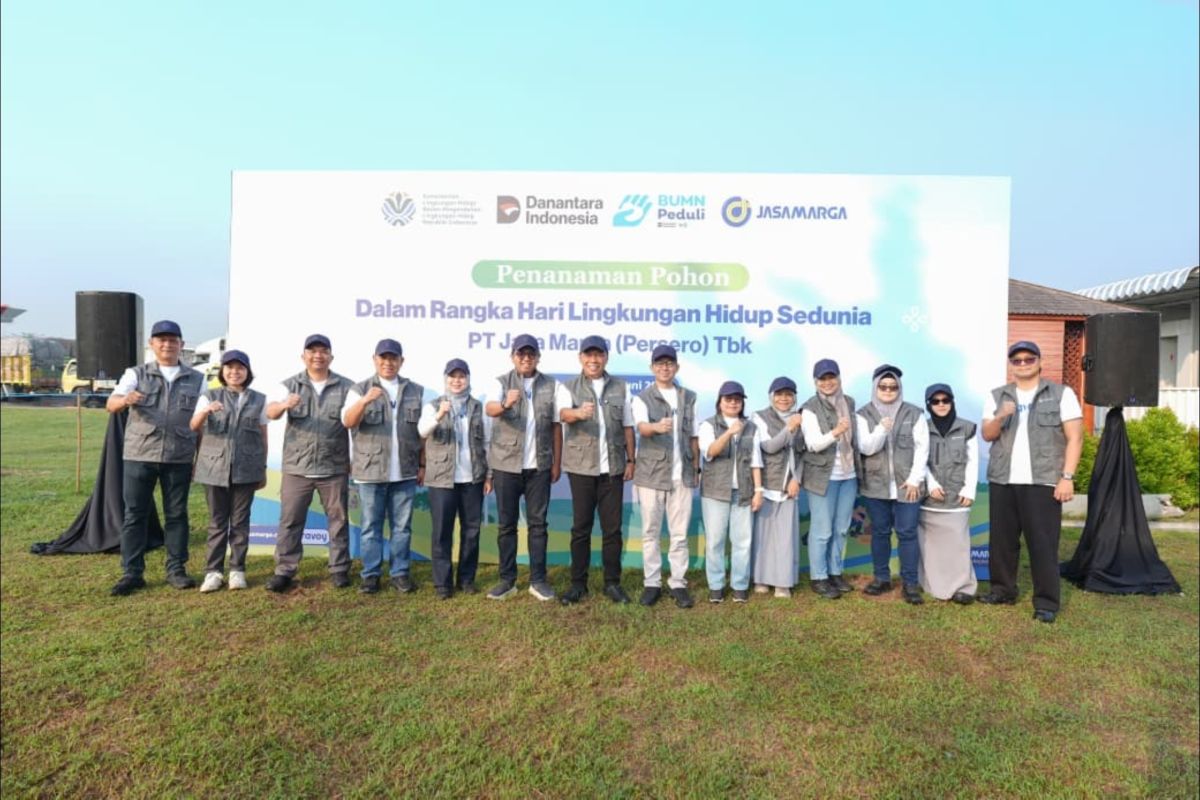
This commitment was demonstrated through simultaneous tree planting activities across all operational areas of the Jasa Marga Group throughout June 2026 to commemorate World Environment Day 2026. The ceremony was held at Travoy Rest KM 792A on the Gempol-Pasuruan Toll Road, East Java, on Wednesday (24/6). The company utilised the momentum of World Environment Day to strengthen sustainable toll road infrastructure development through the Green Toll Road initiative, the Green Corridor Programme, and the transformation of rest areas as part of the Jasa Marga Group’s green ecosystem.
At the Travoy Rest KM 792A programme, Jasa Marga planted 200 pule trees, selected for their strong carbon absorption and oxygen production capabilities, minimal leaf litter for easier maintenance, and a robust, deep root system. This activity is part of a programme to plant more than 7,000 trees across the Jasa Marga Group throughout 2026. The programme also serves to integrate the greening of toll road corridors with the arrangement of user service facilities.
According to Rivan, the greening programme provides measurable ecological benefits, including improved air quality, increased green open spaces, and enhanced water absorption. “The greening programme carried out has measurable benefits, including providing ecological benefits in the form of improved air quality, increased green open space, enhanced water absorption, and is able to provide more accurate environmental impact measurements as tangible evidence of the Company’s ESG implementation,” Rivan added.
To support more measurable environmental management, Jasa Marga in 2026 is introducing a digital monitoring system capable of measuring carbon footprint, periodically monitoring tree growth, and calculating carbon offset potential. This system serves as the foundation for the development of the Green Corridor programme, which will be implemented gradually across all Jasa Marga Group planting sites.
Historically, the company’s greening programme has shown consistent growth. In 2023, Jasa Marga planted 14,267 trees, increasing to 50,762 trees in 2024 and 31,130 trees in 2025. The company targets further increases each year, both along toll road corridors and within rest areas.
Beyond strengthening green corridors, Jasa Marga is continuing the transformation of rest areas into modern public spaces that are comfortable and possess higher economic value. The revitalisation of Travoy Rest includes the renovation of MSME tenant facades, updates to signage and landscaping, improvements to public facilities such as toilets and seating areas, and the enhancement of frontliner staff competencies. The area is also equipped with various supporting facilities, including retail areas, better-organised parking, petrol stations, electric vehicle charging stations, ATMs, a health clinic, green open spaces, places of worship, restaurants, and open gazebos with clean toilet facilities.
The Travoy Rest transformation is part of Jasa Marga’s strategy to optimise assets through experience-based area development while supporting the growth of other business revenues. In 2025, other business revenues from the rest area business were recorded at Rp783.2 billion, growing 21.7 per cent compared to the 2024 realisation of Rp643.6 billion. All these initiatives are also aligned with the mission of Danantara Indonesia to build state-owned enterprises that create sustainable value for the community.