
Japanese University Metabolomics Expert Introduces Health Food Innovation
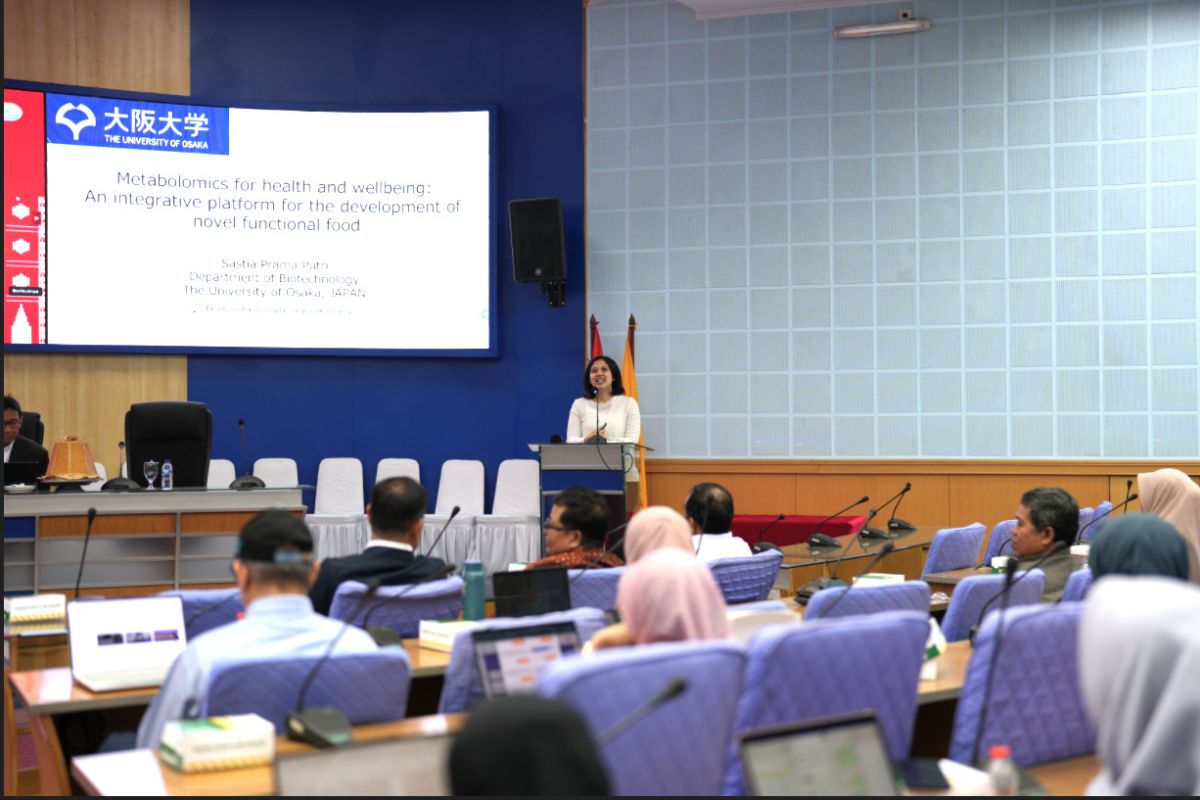
Professor Sastia Prama Putri, a metabolomics expert from the University of Osaka, Japan, has outlined methods for designing food that not only meets nutritional needs but also supports human health and wellbeing. Speaking in Makassar, the Principal Investigator of the Global Food and Agri-tech Laboratory explained that food consumed undergoes a series of metabolic processes. Metabolomics allows researchers to comprehensively measure and map metabolites to understand what occurs within biological systems.
“Our task is to conduct comprehensive metabolite examination and measurement. We cannot innovate if we do not know how this system works,” she stated during a public lecture titled “Metabolomics for Health and Wellbeing: An Integrative Platform for the Development of Novel Functional Food” at Hasanuddin University (Unhas).
Prof Sastia has focused her research on improving the quality of food and agricultural products in terms of nutritional content, sensory characteristics, and functional benefits. She noted that healthy food must also have an appealing taste to gain public acceptance, a challenge that is increasingly relevant amid high consumption of ultra-processed foods.
“Food innovation needs to bridge health benefits with sensory characteristics that consumers enjoy. The key is how we modulate food flavour so it remains appealing but healthy,” she said. She explained that Indonesia has significant opportunities in functional food development due to its tropical biodiversity, citing the use of banana peel as a source of fibre. Prof Sastia has even developed banana peel for use in products like pancakes as an alternative to wheat flour, an innovation that addresses low fibre consumption while opening opportunities to utilise underused materials.
Through the Food for Health and Wellbeing approach, food is viewed not only as a source of energy and nutrients but also as part of an effort to maintain health. This perspective opens opportunities for collaboration between biotechnology, food science, agriculture, health, microbiology, and metabolite analysis technology.
Meanwhile, Unhas Vice Rector for Academic and Student Affairs, Prof. drg. Muhammad Ruslin, stated at the opening of the public lecture that the activity represents a form of international research collaboration. “Scientific fields continue to evolve. We need strategic partners in science so that research can have an impact. We want to produce something that has a broader impact. Therefore, scientific collaboration is not limited to research but must also be directed towards downstreaming,” he said.