
Japanese Professors Visit Nusantara Capital City, Offer Unexpected Response
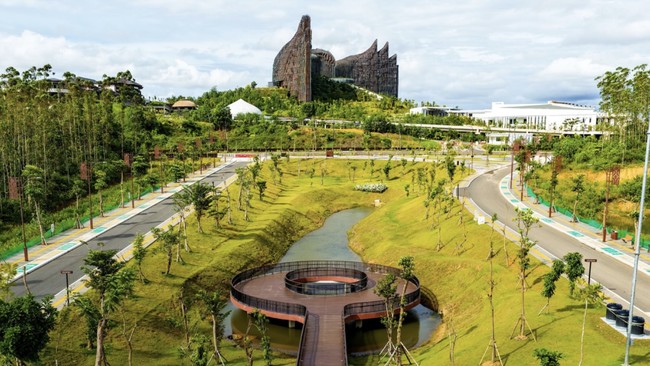
The development of the Nusantara Capital City (IKN) is beginning to show tangible impacts on economic growth in East Kalimantan and its surrounding regions. This was one of the topics discussed during the IKN Authority’s Friday Learning agenda for civil servants, themed ‘Regional Collaboration For Tri-City Development: Lessons From Global Experience (Sweden, Spain, and Italy)’ and ‘Regional Development through Inter-Municipal Collaboration: Key Success Factors for the Greater Nusantara Region’ on Friday (5 June 2026).
In the forum, the IKN Authority, together with academics from The University of Tokyo and Toyo University, discussed strategies for integrated metropolitan area development to ensure the benefits of IKN’s construction can be felt more widely by surrounding areas.
One of the main discussions focused on various inter-local government cooperation practices. From Japan, the Nara Model was presented as an example of flexible collaboration based on regional needs. This model allows partner regions around IKN to cooperate according to their respective needs, such as transport, logistics, labour, public services, and economic development, without having to form a new, rigid organisation.
The forum also discussed lessons from various European cases. One was Emilia-Romagna in Italy, which demonstrated how a regional institution can drive economic development by connecting global market demands with the capacity and innovation of local MSMEs. Meanwhile, the experience of Greater Jakarta (Jabodetabek) showed that legal frameworks and coordination forums need to be supported by effective implementation mechanisms for regional cooperation to run optimally.
As a city built through long-term planning, IKN is designed not only as a national government centre but also as a driver of new economic growth. In the early stages of IKN’s development, the presence of investment, infrastructure construction, and growing economic activity is creating business opportunities, jobs, and improved community welfare.
These impacts are beginning to be seen in the areas surrounding IKN. An Economic Impact Study conducted through the Funding Scheme Implementation Support facility shows that Penajam Paser Utara Regency experienced a 19.9% increase in economic growth and a 0.45% reduction in the poverty rate compared to before IKN construction began. The study also indicates that Balikpapan serves as the main investment gateway for IKN, while Samarinda and Kutai Kartanegara gain spillover benefits from IKN’s development.
IKN Authority Director of Macro Planning, Pungky Widiaryanto, explained that the benefits of IKN’s development need to be continuously expanded by strengthening inter-regional connectivity. According to him, Nusantara cannot develop optimally without the support and collaboration of surrounding cities.
‘We need the surrounding cities to become Greater Nusantara. People in a city need each other. That is why we call it Greater Nusantara development,’ said Pungky.
In the preparation of the Tri-City Development Plan (TCDP), a need emerged to expand the scope of regional cooperation to address increasingly complex development challenges and ensure the benefits of IKN’s development are felt more evenly. In line with this need, the Tri-City concept mandated in Law Number 3 of 2022 has evolved into Greater Nusantara, which encompasses IKN, Balikpapan, Samarinda, Penajam Paser Utara Regency (PPU), and Kutai Kartanegara Regency (Kukar). This expansion is based on the strong linkages of these two regencies with IKN, whether as labour providers, residential areas, urban service centres, logistics hubs, industrial zones, or part of the regional economic supply chain.
Professor Norihisa Shima from Toyo University stated that IKN’s development will have an increasingly greater impact if each surrounding area has a clear and mutually integrated role. ‘IKN will have a major impact on the surrounding cities, therefore it is very important for IKN to collaborate with the surrounding cities. Each city and regency needs to have its own function, and each function can be integrated with one another,’ said Shima.
Meanwhile, Professor Fumihiko Seta from The University of Tokyo expressed his appreciation for the development progress of Nusantara and assessed that metropolitan area management is an important factor for future growth sustainability. ‘I have visited several new capital cities, I am very impressed with the development of Nusantara. I am sure that in the future many people will come here. It is very important for Nusantara to manage the metropolitan area well,’ said Seta.
Through the development of the Tri-City concept, the IKN Authority continues to push for the benefits of Nusantara’s development to be felt more widely. With close collaboration between IKN and its surrounding regions, Nusantara is expected not only to become a new government centre but also a driver of inclusive and sustainable regional economic growth.