
Japanese Experts Reveal Secrets of 'Doomsday-Proof' Earthquake Technology
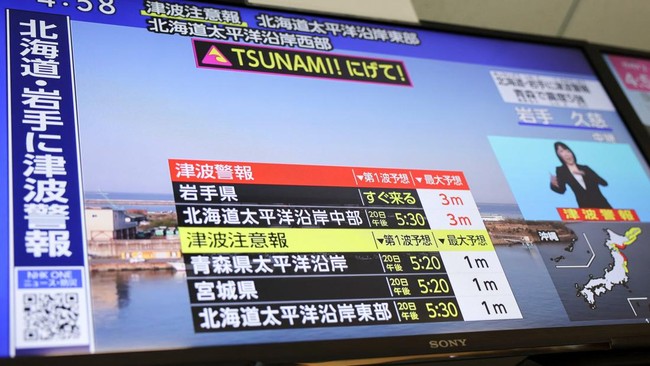
The National Research and Innovation Agency (BRIN) has highlighted Japan’s advanced earthquake-resistant technology. Adrin Tohari, Head of the Geology Disaster Research Centre at BRIN, stressed that rapid and accurate earthquake early warning systems are crucial for reducing casualties and damage during disasters. Mitsuyuki Hoshiba, a researcher from the Meteorological Research Institute of the Japan Meteorological Agency, revealed that Japan has developed an earthquake early warning system (EEWS). Hoshiba explained that the EEWS detects the initial seismic waves that occur immediately after an earthquake. These early waves travel faster than the main shockwaves, which typically cause strong shaking and damage. He noted that communication signals travel faster than seismic waves, allowing the system to issue alerts seconds before major shaking is felt. Although brief, this window is vital for taking protective actions. “Communication signals move much faster than seismic waves, so warnings can be sent out before strong shaking arrives,” Hoshiba stated on Monday, 1 June 2026. Japan has approximately 4,400 earthquake monitoring stations spread across the country. This sensor network operates 24/7 to detect seismic activity in real time, with data processed immediately to estimate the location and intensity of impending tremors. Hoshiba said Japan’s early warning system is widely used, not only by the general public but also in transportation and industry. Earthquake alerts are delivered via television, radio, mobile phones, and public address systems, while in transport and industrial sectors, the system connects directly with automated machinery. One example is the Shinkansen high-speed rail system. When sensors detect an earthquake, the system automatically cuts power and activates emergency brakes before major shaking reaches the tracks. All processes occur automatically without waiting for operator intervention. Hoshiba emphasised that the system is not a prediction tool for when earthquakes will occur. EEWS functions after an earthquake is detected, issuing warnings as quickly as possible to mitigate impacts. “EEWS is not earthquake prediction, but a system to issue warnings swiftly to reduce quake impacts,” he added. In addition to speed, early warning systems must be accurate. Japan has developed various methods to distinguish earthquake signals from other vibrations not caused by seismic activity, reducing the risk of false alarms that could cause public panic.