
Japan Sends Rocket to Retrieve Rock Samples from a Moon Orbiting Mars
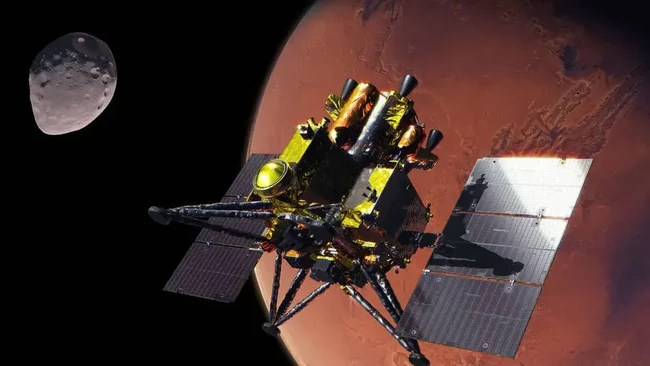
Japan’s space agency, JAXA, is preparing a historic mission: a spacecraft will land on one of Mars’s moons, collect rock samples and bring them back to Earth. If successful, it will be the first time material from the Martian system has been returned to Earth.
The spacecraft, named MMX (Martian Moons eXploration), was launched aboard an H3 rocket from the Tanegashima Space Centre on Monday, 19 October, local time. The journey to Mars is expected to take about 10 months. After reaching orbit around the Red Planet in August 2027, the spacecraft will not land immediately. Instead, it will spend several months orbiting Phobos, Mars’s larger moon, mapping its surface and selecting the safest landing site.
In late 2028 or early 2029, the spacecraft will descend slowly to Phobos’s surface. Its gravity is extremely weak, so the landing must be carefully managed to prevent the spacecraft from bouncing away. A small rover called IDEFIX will be deployed to observe the surface at close range, measure temperatures and map the soil’s composition.
The main spacecraft will then land to collect rock samples. Two different drilling tools will be used to ensure that at least 10 grams of material are collected and sealed inside the return capsule. It will then fly back into orbit before descending to a second site to gather additional samples.
After three years focused on Phobos, MMX will move on to observe the smaller moon, Deimos, in 2030. The aim is to compare the two moons and determine whether they share an origin or formed through separate events. This could help resolve whether Mars’s moons are captured asteroids or debris ejected from Mars in a massive impact billions of years ago.
At the end of 2030, the return module will separate from the main spacecraft and travel back towards Earth. The return journey is expected to take about eight months. The capsule containing samples from Phobos is scheduled to land by parachute in the Woomera region of Australia in 2031.
The project is being carried out in collaboration with NASA and the French and German space agencies. The returned samples will be divided among scientists from several countries for study.