
Japan Scorched by Extreme Heat, Farmers Now Work at Midnight
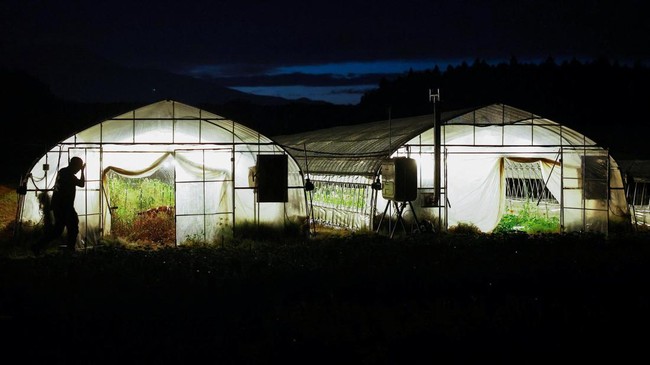
Extreme heatwaves in Japan have changed the way farmers work, from bringing forward working hours to operating at night in order to protect people, crops, and livestock. This situation shows that climate change is no longer merely an environmental issue, but has become a real threat to worker safety, agricultural productivity, and national income. With the majority of Japanese farmers elderly and temperatures above 35 degrees Celsius occurring more frequently, the need for agricultural technology, labour protection, and more adaptive working patterns is becoming increasingly urgent. In the end, farmers now not only have to adapt to the seasons, but also to the extreme heat that is slowly changing the face of agriculture.
Long after sunset, the greenhouse belonging to Motoaki Iijima in northern Tokyo is still brightly lit like a lantern. The flower farmer harvests pink and orange gerberas at night to avoid the midday sun, which is extreme enough to be life-threatening. Increasingly intense heatwaves are making summer in Japan a challenge for survival. Farmers, from flower and asparagus growers to egg producers, now have to change their working hours. The midday hours that were previously busy are now avoided because extreme heat can be life-threatening. Instead, work is done after sunset to protect crops, livestock, and the safety of the farmers themselves.
Iijima, 36, converted his family’s centuries-old rice farm in the city of Nikko into a flower plantation about a decade ago. Three summers ago, a part-time worker suffered heatstroke while picking sunflowers in his greenhouse. The incident prompted Iijima to drastically change his working patterns. Outdoor temperatures exceeding 35 degrees Celsius, a condition that is occurring more frequently in the region, can push temperatures inside the greenhouse above 40 degrees Celsius. Now, Iijima works throughout the night and only stops when the morning sun becomes scorching again.
“The time just before sunset is very precious. That is when we can be outside,” he told Reuters, wiping sweat from his forehead under a row of halogen lamps. “We are gradually becoming nocturnal. It is about protecting our bodies, and ultimately, our lives.”
From rice farmers in Vietnam to vineyard workers in Spain, farmers in various parts of the world are beginning to shift working hours to cooler nights or early mornings to cope with increasingly frequent and intense heatwaves. The data shows a worrying situation. Japan faces a fairly high risk. Around 70% of its farmers are aged 65 and over, a group that is more vulnerable to heat stress. High humidity levels also further increase the risk.
In 2024, 59 workers in Japan’s agricultural sector died from extreme heat, the highest figure ever recorded and more than double the number in 2021. A survey by the Japan Weather Association last year showed that around 60% of farmers aged in their 20s to 50s had experienced heatstroke or knew someone who had. Almost 60% of farmers have also started shifting their working hours to earlier in the morning or later in the afternoon.
The impact is also felt on productivity. Throughout 2024, heat exposure cost Japan’s agricultural sector 926 million working hours, that is, time when workers could not work safely in the fields, according to the Lancet Countdown, a research collaboration that monitors the health impacts of climate change. When calculated across all sectors, working hours lost due to heat were almost double the average in the 1990s. Lost income is estimated to reach around US$46 billion, equivalent to 1% of Japan’s gross domestic product.
To adapt, workers at Iijima’s plantation now start their activities up to two hours earlier. One of them is Miyoko Asada, a 68-year-old worker who arrives at the plantation shortly after sunrise. “We have to race against time,” she said while hurrying to cut purple asters with eight other workers across the wide field, before temperatures rise past the safe limit.
A few cities away, poultry farmer Tetsuya Usuba faces a different problem. Six summers ago, Usuba lost more than 500 laying hens to heatstroke after extreme temperatures hit for three consecutive days. The experience still haunts him. He and his father even had to use a forklift fitted with a large bucket to remove the dead chickens from the coop. Now, Usuba has a special routine every midnight. The lights in his two coops automatically switch on at 2.30 a.m., waking 4,400 chickens inside so that they eat before the heat reduces their appetite. He has also installed additional fans, sprayed water on the metal coop roofs, and added citric acid to the chickens’ drinking water. However, these efforts have not been fully able to overcome the impact of extreme heat. When temperatures suddenly soared above 35 degrees Celsius last month, 130 chickens died.
“Summer is now a new threat for producers like us, just as frightening as an outbreak of bird flu,” said Usuba, 48. While checking his livestock one afternoon, the thermometer showed 33 degrees Celsius. Many chickens were seen panting with their beaks open.
The Japanese government is beginning to take steps to address the situation. New labour rules introduced in 2025 require employers to protect workers from heat.