
Japan in a Dilemma: Interest Rates Hit 31-Year High, Yet the Yen Remains Weak
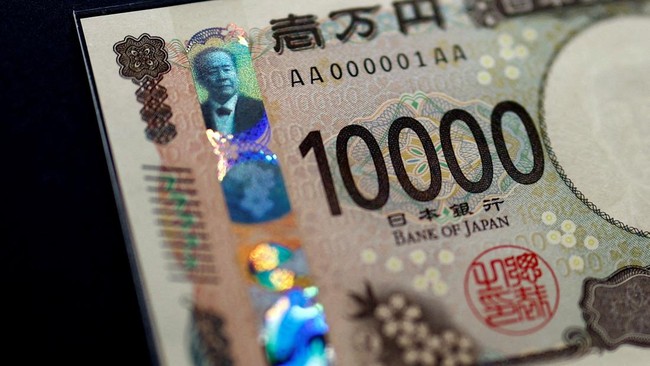
Jakarta, CNBC Indonesia – The Bank of Japan (BOJ) has left the era of negative rates behind and raised interest rates to their highest level since 1995. Yet the move has so far failed to lift the yen’s performance against the US dollar.
The Japanese currency fell to as low as JPY162.83/US$ in intraday trading on 1 July 2026, its weakest level since 1986. The yen remains deeply subdued at JPY162.49/US$ at the close of trading on Monday (20/7/2026).
The situation appears puzzling at first glance. Normally, higher interest rates should make yen-denominated assets more attractive and help strengthen the currency. In reality, that has not happened.
Economists Steve H. Hanke and John Greenwood, writing in a Fortune column, argue that markets are too fixated on interest rates.
“Monetary policy is fundamentally about changes in the quantity of money in circulation, not interest rates,” they were quoted as saying in Fortune.
That view offers a different explanation for Japan’s condition. Interest rates may have risen, but the quantity of money circulating in the economy has not grown strongly enough to sustainably boost spending, the economy, and inflation.
The BOJ Has Raised Rates Five Times
Kazuo Ueda took charge of the BOJ in April 2023. In March 2024, the central bank ended its yield curve control policy, long a fixture of Japanese monetary policy.
Since then, the BOJ has raised interest rates five times, from minus 0.1% to 1%. The latest increase was decided in June 2026 by a 7-1 vote.
Ueda believes rising wages, energy prices, and import costs will keep inflation around the BOJ’s 2% target. On that basis, normalising rates is deemed necessary after decades of ultra-low rates in Japan.
However, a 1% level remains low compared with other developed economies, especially the United States.
The US Federal Reserve is still holding rates in the 3.50%-3.75% range, leaving a rate differential with Japan of roughly 2.5-2.75 percentage points.
The wide gap keeps investors borrowing cheaply in yen and placing the proceeds in dollar assets offering higher yields — transactions known as carry trades.
As long as the returns from holding dollars remain far greater, the BOJ’s hike to 1% is not enough to reverse those capital flows.
Low Rates Do Not Necessarily Mean Loose Money
There is a common misconception that low interest rates always signal loose monetary policy.
In Japan’s case, years of low rates coincided with slow money supply growth, weak economic activity, and very low inflation.
From 2000 until just before the Covid-19 pandemic in 2020, Japan’s broad money supply (M2) grew at an average of only 2.6% per year.
Over the same period, Japan’s nominal gross domestic product (GDP) grew by an average of just 0.3% per year. Real economic growth stood at around 0.8%, while the GDP deflator fell by an average of 0.5% per year.
This persisted even though the BOJ carried out massive asset purchases through quantitative and qualitative easing (QQE).
The programme indeed expanded the Japanese central bank’s balance sheet. But the money created by the central bank did not fully flow into credit, spending, and investment in the real economy.
Banks may hold ample reserves at the BOJ, but if lending to households and companies fails to grow, the impact on economic activity remains limited.
When M2 Surged, Inflation Took Off
A different situation unfolded during the Covid-19 pandemic.
The BOJ at the time lent to banks at 0% interest, on the condition that the funds be passed on to companies. This programme got money into the real economy more quickly.
Japan’s M2 growth subsequently surged to a peak of 9.6%. The stock market rallied, the economy began to recover, and inflation eventually climbed to 4%.
According to Hanke and Greenwood, that period is evidence that changes in the money supply matter more than simply looking at the level of interest rates.
The trouble is that money supply growth has slowed again. Japan’s M2 growth is back to around 2.5%.
The latest BOJ data even show M2 grew only 2.2% year on year in June 2026, slowing from 2.4% in May.
That is far below the 9.6% recorded during the pandemic. The flow of money into the economy remains insufficient to generate sustained higher demand and inflation.
Japan’s Inflation Is Actually Slowing
The latest inflation data reinforces those doubts. Japan’s headline inflation was 1.5% year on year in May 2026.
Core inflation, which excludes fresh food, was only 1.4%, while inflation excluding fresh food and energy stood at 1.8%.
All three figures are below the BOJ’s 2% inflation target.
This makes the BOJ’s room to keep raising rates increasingly complicated. Raising rates too quickly could depress consumption, investment, and business activity precisely when inflation is slowing.
A Reuters survey in July also showed nearly half of Japanese companies are beginning to feel the negative effects of higher rates, chiefly through rising borrowing costs and postponed investment plans.
Yet if the BOJ stops raising rates, the interest rate gap with the US will remain wide and pressure on the yen could persist.
This is the central dilemma Ueda faces.
Low M2 growth indeed helps explain the weak domestic economy and falling inflation. But currency movements are not determined by one factor alone.
The yen’s exchange rate also depends on economic conditions and policies elsewhere, particularly in the United States.
Even though Japanese rates are at a 31-year high, US rates remain far higher. The American economy is also seen as stronger, while conflict in the Middle East and rising energy prices are pushing investors towards the dollar.
Japan is under added pressure because it depends heavily on energy imports.
When oil prices rise, Japanese companies need more dollars to pay for imports. Dollar demand rises, and the yen comes under renewed pressure.
Higher energy prices create another problem. A weak yen makes imports more expensive, while costlier imports in turn worsen the trade balance and increase the need for dollars.
The Japanese government has in fact tried to stem the yen’s decline through intervention.
Japan spent around 11.73 trillion yen between 28 April and 27 May 2026 intervening in the foreign exchange market. But the effect did not last long, and the yen again touched its weakest level in 40 years.
Intervention can slow the decline in the short term, but it is difficult to change a currency’s direction while rate differentials, capital flows, and import needs continue to weigh on the yen.
Source: jawawa.id (https://jawawa.id/newsitem/japan-in-a-dilemma-interest-rates-hit-31-year-high-yet-the-yen-remains-weak-1784611228)
Originally published by CNBC Indonesia (https://www.cnbcindonesia.com/research/20260721100803-128-752466/jepang-dibuat-pusing-bunga-naik-tertinggi-31-tahun-yen-tetap-keok), translated from Indonesian