
James Webb Telescope Finds Water Near Black Hole at Centre of Milky Way
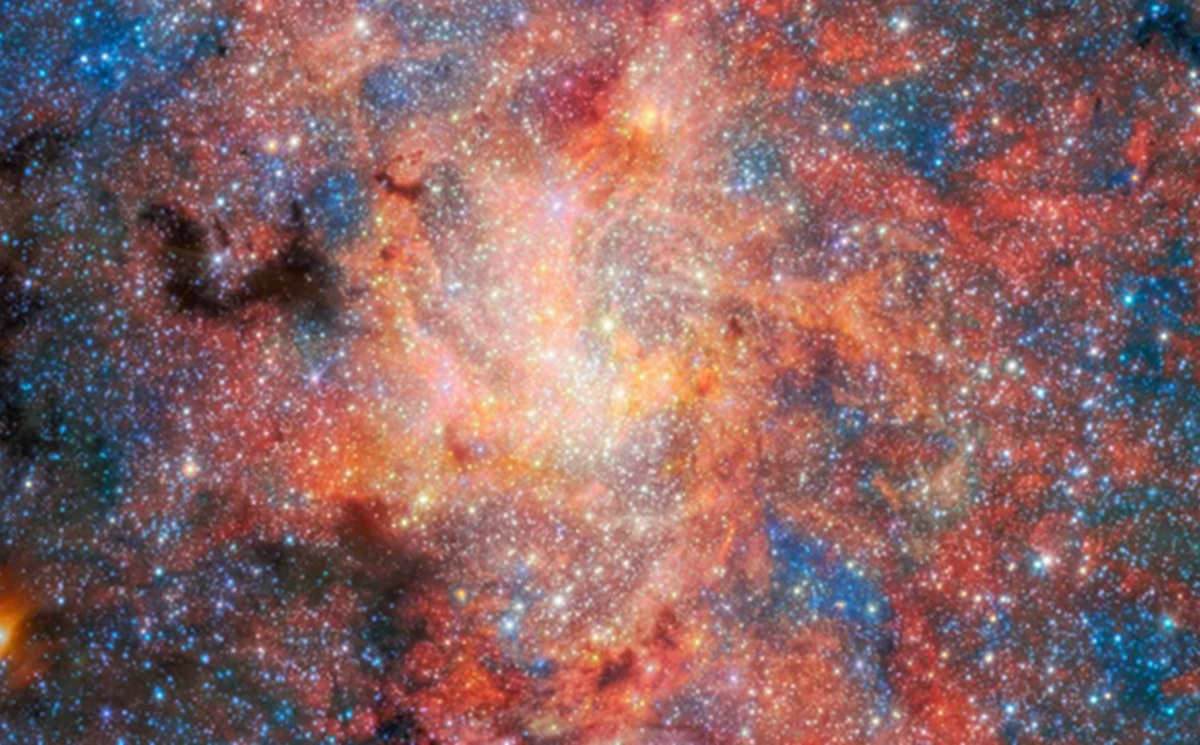
The centre of the Milky Way galaxy turns out to hold a more hospitable environment for the existence of water than astronomers previously estimated. Using the James Webb Space Telescope (JWST), researchers successfully detected the presence of water and cosmic dust around an old star located just 0.55 light-years from Sagittarius A* (Sgr A*), the supermassive black hole at the centre of our galaxy.
This latest study shows that water and dust can form and survive surprisingly close to a supermassive black hole. Intense radiation and extreme conditions in the region were previously thought to destroy such molecules. The research team used Webb’s Mid-Infrared Instrument (MIRI) to observe IRS 3, an old star in the dense environment surrounding Sgr A. According to the European Space Agency (ESA), Sgr A itself has a mass of about 4 million times that of the Sun.
“The galactic centre is one of the most extreme environments, so understanding whether stars there can continue to enrich their surroundings is an important question. With Webb, we can directly observe how stars behave under these conditions and see that dust production remains remarkably resilient,” said Florian Peißker, lead author of the study from the University of Cologne in Germany, in the official statement.
IRS 3 is one of the brightest mid-infrared sources at the galactic centre. The star belongs to the asymptotic giant branch category, the final stage of stellar evolution when it expels large amounts of gas and dust through powerful stellar winds. Such dying stars serve as cosmic recycling centres, returning material to space to form the next generation of stars and planets.
Even so, IRS 3 sits in a highly inhospitable region. The centre of the Milky Way is densely packed with stars and exposed to intense radiation, raising the question of whether new molecules and dust can survive.
Webb’s observations prove that they can. By combining the spectrum of IRS 3 with simulations of light travel, the researchers reconstructed a layered silicate dust envelope extending about 10,000 astronomical units (AU) from the star. The temperature of this envelope drops from around 927 degrees Celsius near the star to minus 173 degrees Celsius at its outer edge. The observations also confirmed the presence of water within the envelope for the first time.
“This detection of water is very exciting because it shows that molecular material can survive in an environment dominated by intense radiation,” said Macarena Garcia Marin, ESA astronomer and co-author of the study.
Although the exact amount of water cannot yet be determined, the finding proves that water and dust—key ingredients in the formation of stars and planets—can survive near the galactic centre. The results of the study were published in the journal Astronomy & Astrophysics on 11 August.
Source: jawawa.id (https://jawawa.id/newsitem/james-webb-telescope-finds-water-near-black-hole-at-centre-of-milky-way-1786776686)
Originally published by Media Indonesia (https://mediaindonesia.com/teknologi/922122/teleskop-james-webb-temukan-air-di-dekat-lubang-hitam-pusat-bima-sakti), translated from Indonesian