
James Webb Telescope Detects Methane in Atmosphere of Rare Earth-like Giant Planet
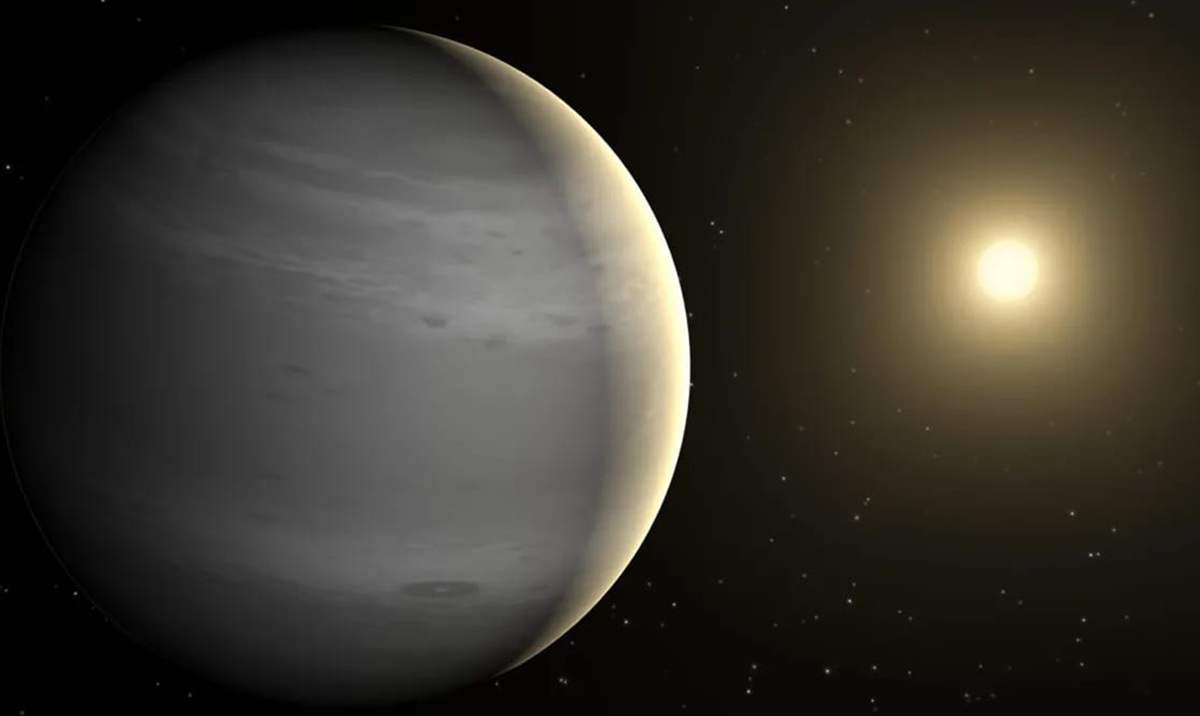
Astronomers using NASA’s James Webb Space Telescope (JWST) have successfully observed the atmosphere of a rare giant planet with a temperature relatively similar to Earth’s. The planet, named TOI-199b, is known to contain methane in its atmosphere, according to the latest research published in the Astronomical Journal.
The discovery has attracted the attention of scientists because most giant planets found so far exist in extreme temperature conditions. In the solar system, Jupiter and Saturn have very cold temperatures because they are far from the Sun. Meanwhile, many giant planets outside the solar system, known as ‘hot Jupiters’, have very high temperatures because they orbit very close to their host stars.
TOI-199b falls between these two categories. This planet belongs to a rare group of temperate giant planets and is one of the first objects whose atmosphere has been studied in detail.
The research was led by a team of scientists from Penn State University and NASA’s Jet Propulsion Laboratory (JPL) at the California Institute of Technology. According to research leader Renyu Hu, studying exoplanets like TOI-199b helps scientists understand the formation and evolution processes of planetary systems.
‘One of the main advantages of studying exoplanets is that we can observe various types of planets that do not exist in our solar system. This provides new insights into how planetary systems form and evolve,’ said Hu.
TOI-199b orbits a star located more than 330 light-years from Earth. The planet takes about 100 days to complete one orbit. Its atmospheric temperature is estimated to reach around 175 degrees Fahrenheit or about 79 degrees Celsius. Although still considered hot for humans, this temperature is much lower than the majority of giant planets studied by astronomers so far. For comparison, this temperature is almost equivalent to the temperature inside a car parked under the scorching sun during the day. This condition makes TOI-199b warmer than Jupiter and Saturn, but much cooler than hot Jupiters, which can reach temperatures of thousands of degrees Celsius.
To study TOI-199b’s atmosphere, the scientists used a technique known as transmission spectroscopy. This method utilises starlight that passes through the planet’s atmosphere when the planet transits in front of its host star. The James Webb Telescope then splits this light into various wavelengths, allowing astronomers to identify elements and molecules present in the planet’s atmosphere.
Lead author of the study, Aaron Bello-Arufe, explained that each chemical element leaves a distinctive light absorption pattern, much like a fingerprint. ‘When starlight passes through the planet’s atmosphere, certain molecules absorb specific wavelengths. This pattern allows us to identify the composition of the planet’s atmosphere,’ he explained. The research team collected about 20 hours of observations to obtain baseline starlight data. Meanwhile, the transit process of TOI-199b lasted about seven hours, much longer than the transit of hot Jupiters, which typically lasts less than an hour.
The analysis results indicate the presence of methane in TOI-199b’s atmosphere. This finding aligns with predictions from theoretical models regarding temperate giant planets. ‘When we compared the spectrum during transit with the baseline data, it was clear that some of the starlight was absorbed by methane in the planet’s atmosphere,’ said Bello-Arufe.
In addition to methane, the researchers also found indications of the presence of ammonia and carbon dioxide. According to Hu, follow-up observations will help scientists measure the abundance of each gas more accurately. This data can be used to refine models of planet formation and atmospheric evolution.
The researchers believe that studying TOI-199b is not only important for understanding exoplanets but can also provide new insights into the history of Earth’s atmosphere. The success of the James Webb Telescope in revealing the atmospheric composition of this temperate giant planet also opens opportunities for similar research on other exoplanets in the future. With more data becoming available, astronomers hope to determine whether TOI-199b is a unique case or represents a group of planets with similar characteristics in our galaxy.
Source: jawawa.id (https://jawawa.id/newsitem/james-webb-telescope-detects-methane-in-atmosphere-of-rare-earth-like-giant-planet-1781668256)
Originally published by Media Indonesia (https://mediaindonesia.com/teknologi/901314/james-webb-temukan-metana-di-atmosfer-planet-raksasa-mirip-bumi), translated from Indonesian