
Jambi and Bengkulu Prepare to Support the 2026 Economic Census
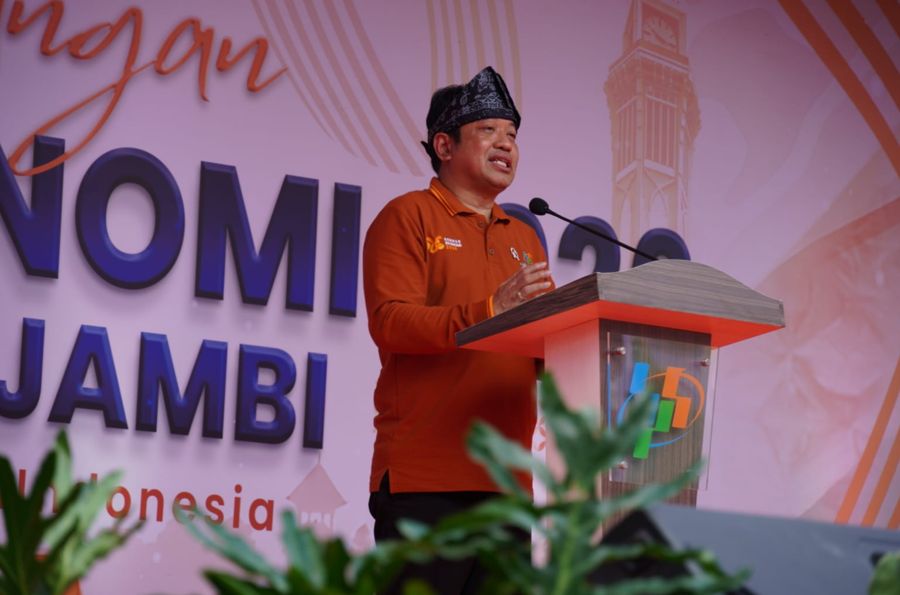
The Central Bureau of Statistics (BPS) is strengthening collaboration with regional governments to ensure the success of the 2026 Economic Census (SE2026). A day after launching the census in Bengkulu Province, Deputy Head of BPS RI, Sonny Harry Budiutomo Harmadi, inaugurated the programme in Jambi Province on Friday (26/6), urging local governments, business actors, and the public to participate in the largest economic data collection exercise, conducted once every decade.
The event at the BPS Jambi Province office was attended by Jambi Governor Al Haris, Deputy Chair of Committee IV of the Regional Representative Council (DPD RI) Elviana, Deputy Chair of Committee IV of the DPD RI Sinta Rosma Yenti, members of the Jambi Provincial Leadership Coordination Forum (Forkopimda), representatives of vertical agencies, regional apparatus organisations, and several business associations and actors in Jambi province.
In his remarks, Sonny emphasised that Jambi has significant potential for further development. In the first quarter of 2026, Jambi’s economy grew by 4.33 percent year-on-year, primarily supported by the agriculture, forestry, fisheries, and mining sectors, which contributed nearly half of the regional economy. Additionally, Jambi recorded an Incremental Capital Output Ratio (ICOR) of 4.89, which is better than the national target. He noted that this achievement demonstrates efficient investment and serves as a crucial foundation for promoting sustainable economic growth. “This is actually below the target of the Minister of Public Works and the President’s target. The President has set an ICOR target for Indonesia of below 6,” Sonny explained.
Sonny stated that this achievement shows investment in Jambi has been running efficiently. However, to ensure that development and investment policies are more accurately targeted, comprehensive and up-to-date economic data that captures the dynamics of all business activities is required. He also highlighted the growing tourism sector in Jambi, marked by an increasing number of star-rated hotels, room occupancy rates, and tourist visits. Behind this growth lies an economic chain involving MSMEs, transportation, culinary businesses, the creative economy, and various service sectors, all of which need to be comprehensively documented through SE2026.
Unlike previous censuses, SE2026 will not only record businesses with physical locations but also digital-based enterprises and household economic activities, providing a more complete picture of the economy. To support the implementation, BPS has assigned 3,467 enumerators who will collect data from approximately 428,000 business units across Jambi Province between 15 June and 31 August 2026.
On the same occasion, Jambi Governor Al Haris stressed that the quality of development policies is determined by the quality of the data the government possesses. “This data is extremely important for us; there is no discourse we build today without concrete data,” he said. He called on all district and city governments in Jambi Province to support the SE2026 implementation by educating the public to welcome census officers and provide accurate information. Sonny reminded the public of the importance of participation, stating, “If you are not counted, your hopes will vanish. Not wanting to be recorded means you do not exist.”
The previous day, Thursday (25/6), BPS had launched the SE2026 in Bengkulu Province. Held on the closing stage of the Tabut Festival at the Bumi Merah Putih Sports Centre, the launch leveraged a major cultural event to collaboratively engage the public in supporting the economic census. During the event, Sonny expressed appreciation for Bengkulu’s positive economic development. In the first quarter of 2026, Bengkulu’s economy grew by nearly 5 percent, with the agricultural sector as the main pillar. Meanwhile, the tourism sector recorded a growth of 19.73 percent, reflecting its increasing contribution to the regional economy.
Sonny stated that this progress must be supported by complete data so that the government can design development policies that match real conditions on the ground. He stressed that SE2026 is a national agenda conducted every ten years as mandated by law and is a practice also carried out by many countries to obtain the latest picture of economic structures and activities. “High appreciation and gratitude to the Bengkulu Provincial Government, especially the Governor, for the tremendous support given to BPS in making the 2026 Economic Census a success,” Sonny said. He added that the success of the census depends not only on BPS but requires the full support of regional governments, the business community, academics, and the public.
A total of 2,069 enumerators have been deployed to record around 231,000 pre-listed business units across Bengkulu Province. This figure represents an increase of approximately 15.5 percent compared to the 2016 data collection, indicating a growing number of business activities in the province. As a symbol of support for the SE2026 implementation, Bengkulu Governor Helmi Hasan presented a Tabot miniature to the Deputy Head of BPS RI. “With this, the Bengkulu Provincial Government declares its support and hopes for the success of the 2026 Economic Census, particularly in the Bengkulu Province region,” Helmi stated. The launch in Bengkulu was also attended by the Commander of the Army Special Forces Command (Kopassus), Lieutenant General TNI Djon Afriandi, the Head of the Indonesian Maritime Security Agency (Bakamla), Vice Admiral TNI Dr. Irvansyah, the Special Staff to the Minister of Tourism for Communications, Apni Jaya Putra, and regents and mayors from across the province.