
Jakarta's Waste Management Ambitions Clash with Public Apathy and Inadequate Infrastructure
One tendency that emerges when one occupies a position of power is viewing the public merely as objects to be commanded and mobilised to achieve a goal, without realising that those being instructed face diverse and complex situations. Failure to recognise this carries the risk that a policy may not be implemented optimally.
During university, we once served as enumerators conducting surveys across regions, streets, and households. We were surprised by the reality that citizens, often seen as research objects, were not so easily approached for information. These individuals had their own lives, busy with household chores, office work, street vending, or driving motorcycle taxis. They questioned the benefit of filling out our survey, viewing the time taken away from their more important activities as an opportunity cost with no clear advantage.
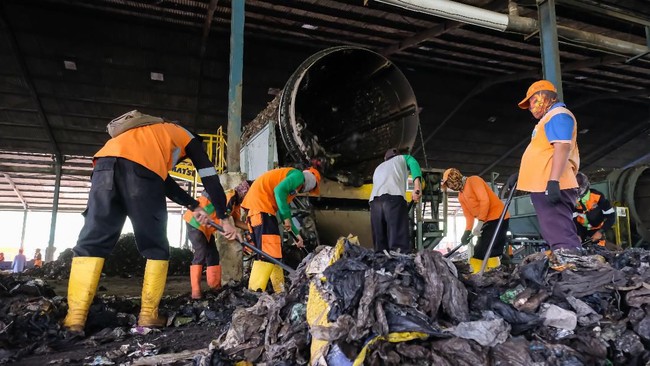
This is the challenge facing the Jakarta provincial government as it urgently seeks to improve waste management and encourage greater public involvement in cleaning up the city. Governor’s Instruction Number 5 of 2026 on the Waste Segregation and Processing Movement from Source has been signed. However, mobilising voluntary public participation will be difficult if the activity is perceived to offer no direct benefit.
The instruction calls on citizens to segregate and process waste at the source, with the provincial government providing support through its apparatus. From the regional secretary down to the sub-district level, officials are directed to offer socialisation, supervision, and the utilisation of disposal sites. Residents are encouraged to separate organic waste like food scraps, inorganic waste such as paper, household hazardous waste like used batteries, and residual non-recyclable waste. The sorted waste should then be taken to designated Reduce, Reuse, Recycle (TPS3R) sites or sent to maggot farms and biopore drums to be turned into compost.
On the surface, this movement sounds like a sound solution to the increasingly urgent waste crisis in Jakarta, especially after the landslide at the Bantargebang Integrated Waste Treatment Plant earlier this year sparked discussions about limiting or permanently closing the facility. The hope is to rally the entire community to reduce, and ideally eliminate, waste from the capital. The ambition is to solve the problem without creating new ones, but significant challenges remain. The call for communal cooperation may be disappointed by a public that is reluctant to voluntarily change its habits. The opportunity cost is weighed, particularly if the activity is seen as lacking material benefit. More critically, the sophisticated governance design collides with the reality of infrastructure that is far from adequate.
The idea of encouraging public participation in waste management is not new. The government official and environmental technocrat Emil Salim contemplated it as Indonesia entered the latter half of the 20th century. In his essay ‘Development with Environmental Management’, he explained that while the government must prepare the foundational policies, facilities, and infrastructure for environmental care, public participation is essential for any programme to be sustainable. The problem is that even the basic infrastructure needed to support public waste segregation and processing is still lacking. Before discussing disposal sites, the coverage of segregated waste bins remains uneven. They may exist on major thoroughfares like Sudirman-Thamrin, but the situation is different in residential areas. The availability of such bins in office buildings and shopping centres is also inconsistent.
Compounding this infrastructural deficiency, the public is not yet accustomed to cooperating in waste segregation and processing. Even on Jalan Sudirman, where segregated bins are provided, waste is often found discarded without regard to its category. It is quite possible we ourselves are guilty of this, despite the bins being equipped with labels and pictures indicating the types of waste. This anecdote points to a much wider problem. Data from the Jakarta Environmental and Cleanliness Information System (Silika) for the Household Waste Management Sector shows that only 13.61 percent of homes across Jakarta currently sort their waste. This indicates a difficulty, or perhaps a reluctance, to do so.