
Jakarta's transformation cannot rely solely on physical development
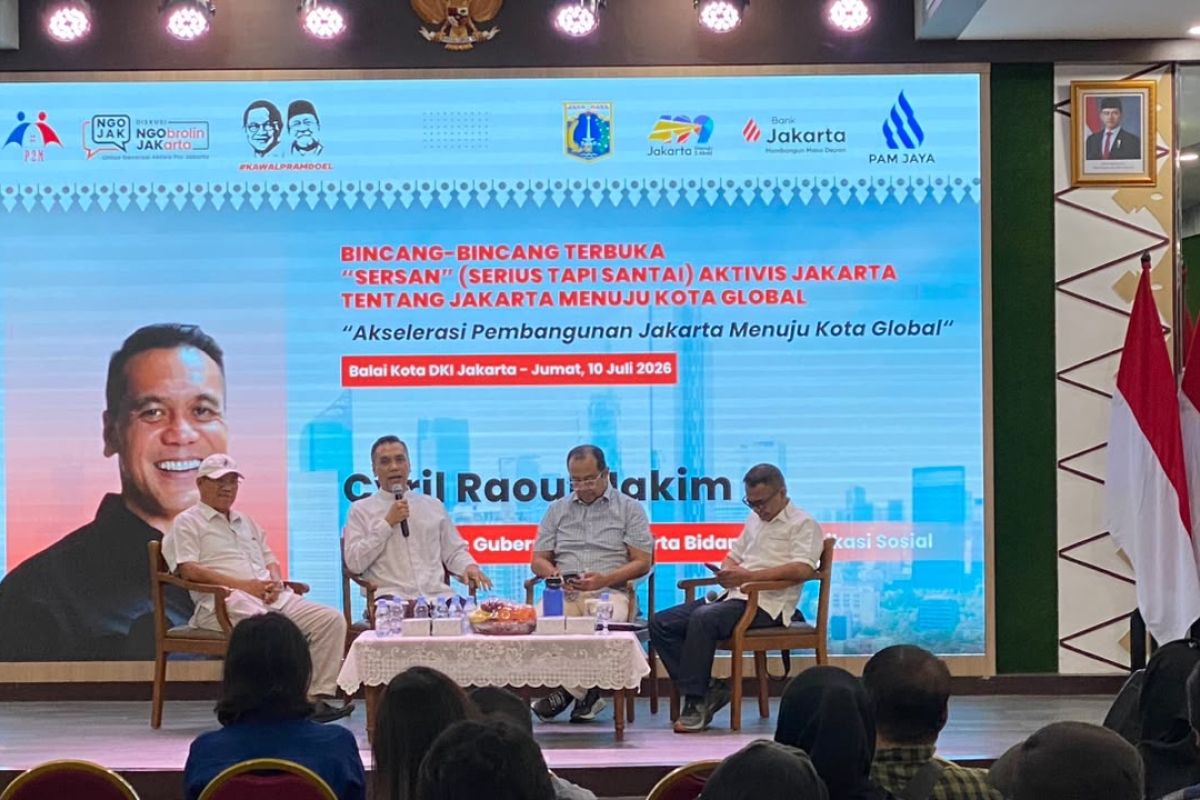
The Chair of the Coalition of People Concerned about New Jakarta (KATAR), Sugiyanto, has stated that accelerating the transformation of DKI Jakarta into a global city cannot rely solely on physical development and must be accompanied by other forms of progress. “Improving the quality of basic services, such as clean water, sanitation, the environment, transportation, innovation, and human resources, are key factors for Jakarta to enter the top 50 global cities by 2030,” Sugiyanto said during a discussion held by the Forum Lintas Aktivis Jakarta at DKI Jakarta City Hall on Friday (10/7).
The concept of Jakarta as a global city, he noted, already has a strong legal foundation through Law Number 2 of 2024 concerning the Special Capital Region of Jakarta (DKJ). This regulation establishes Jakarta as a national economic centre and a global city, reinforced by the National Long-Term Development Plan towards a Golden Indonesia 2045. “Global city status is measured through various international indicators, ranging from the quality of transportation, environment, and governance to economic competitiveness, innovation, and the quality of life of its citizens,” he said.
Jakarta’s current position is around 71st in one global city index. Therefore, accelerated development across various sectors is needed to achieve the target of entering the top 50. Sugiyanto highlighted that achieving 100 percent clean water service coverage, as outlined in the DKI Jakarta Regional Medium-Term Development Plan for 2025–2029, is an important indicator. In addition, emission control, improved sanitation, energy-based waste management, and technological transformation must also be the government’s focus. “All regional apparatus organisations, the business world, academics, communities, and the public must move together,” he said.
Special Staff to the Governor of DKI Jakarta, Chico Hakim, stated that the development of Jakarta as a global city must begin with strengthening the quality of human resources. To this end, the DKI Provincial Government is prioritising improved access to education through expanding the beneficiaries of the Jakarta Smart Card (KJP), the Jakarta Superior Student Card (KJMU), and scholarship programmes. “Jakarta is no longer competing with other cities in Indonesia, but must be able to compete with major cities of the world,” he said. He added that the transformation of Jakarta into a global city remains on the local government’s agenda through strengthening international cooperation, sustainable development, and increasing the city’s competitiveness across various sectors.
Meanwhile, the President Director of PT PAM Jaya (Perseroda), Arief Nasrudin, explained that the availability of clean water for residents is also part of Jakarta’s journey to becoming a global city. PAM Jaya’s piped drinking water service coverage in Jakarta has reached 82 percent. This achievement is equivalent to approximately 1.2 million house connections, or nearly 9 million residents who have enjoyed clean water services. According to Arief, this improvement is inseparable from the full support of the DKI Jakarta Provincial Government, ranging from accelerating the licensing process to strengthening regulations that speed up the development of the piping network. “When the support is not just verbal, but also regulatory and in other forms, ultimately the spirit becomes aligned,” he said. Arief is optimistic that this collaboration will accelerate the achievement of the target of clean water services for all Jakarta residents.