
Jakarta’s Land Subsidence Slows as Use of Piped Water Increases
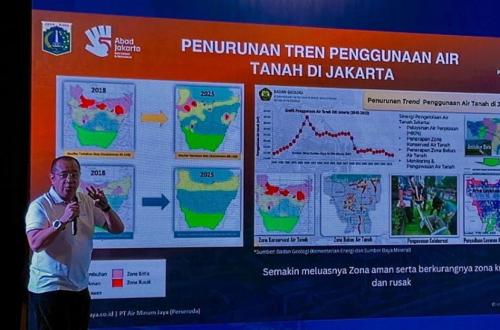
JAKARTA – The rate of land subsidence in Jakarta is reportedly beginning to slow as residents’ use of piped water increases. Wider access to clean water is seen as helping to reduce reliance on groundwater, which has been one of the factors contributing to the capital’s land subsidence.
PAM Jaya President Director Arief Nasrudin said signs of the slowdown were apparent in research by the Geological Agency of the Ministry of Energy and Mineral Resources (ESDM). The study, which compared conditions in Jakarta in 2018 and 2025, found a reduction in the area showing significant indications of land subsidence.
“Research by the Energy and Mineral Resources Ministry shows that Jakarta has managed to curb the rate of land subsidence. This indicates that many Jakarta residents have started using piped water,” Arief said on Saturday (31 October 2026).
According to Arief, increased use of piped water is one indicator that people are becoming less dependent on groundwater. Expanding the clean-water distribution network is expected to further curb groundwater extraction, which contributes to land subsidence.
Arief said the study showed that expanding piped-water services brings benefits beyond meeting demand for clean water. The development of drinking-water infrastructure also contributes to efforts to protect Jakarta’s environment.
“The fact that service coverage has reached 83 per cent is borne out by research that was not conducted by us. It was the Geological Agency that carried out the research,” Arief said.
According to PAM Jaya data, piped-water service coverage in Jakarta had reached 83.27% by September 2026. The utility had 1,222,484 household connections, serving around nine million people.
To support the service, PAM Jaya has a water supply capacity of 23,051 litres per second. Its distribution infrastructure includes 13,094 kilometres of pipelines across Jakarta.
Although coverage continues to grow, Arief said the development of clean-water infrastructure still needs to be accelerated. PAM Jaya aims to connect all Jakarta residents to the piped-water network by 2029.
By that year, the number of customers is targeted to reach 2,016,011 household connections, around 793,000 more than in September 2026. Water supply capacity is also expected to rise to 32,159 litres per second, while the pipeline network is projected to extend to 16,234 kilometres.
The infrastructure development will be supported by 28 water treatment plants to meet service demand. Expanding the network is expected to reach more people while reducing the need to use groundwater.
Arief stressed that signs of slower land subsidence must not bring efforts to expand piped-water services to a halt. Instead, the research findings should spur faster progress towards the clean-water infrastructure targets.
“Take that praise as a spur to keep working hard to meet these targets,” Arief said.
Source: jawawa.id (https://jawawa.id/newsitem/jakartas-land-subsidence-slows-as-use-of-piped-water-increases-1793519450)
Originally published by Republika (https://esgnow.republika.co.id/berita/tnsz3f416/penurunan-muka-tanah-jakarta-melambat-penggunaan-air-perpipaan-meningkat), translated from Indonesian