
Jakarta Waste Management Reform: Bantargebang to Accept Only Residual Waste
From 1 August 2026, waste in DKI Jakarta will no longer be collected and dumped at the Bantargebang Integrated Waste Treatment Facility (TPST), but must instead be sorted and processed at source. Gradually, only residue that can no longer be processed will be sent to Bantargebang.
This aligns with the overhaul of the waste management system by DKI Jakarta Governor Pramono Anung, moving from the previous collect-transport-dump pattern to sort-transport-process.
In his remarks, Pramono stated that the DKI Provincial Government is accelerating the transformation of waste management by strengthening processing facilities at the regional level. The move is a strategy to reduce the burden on the TPST Bantargebang and to phase out open dumping practices towards a zero open dumping target by 2029.
“Since the issuance of Governor Instruction Number 5 of 2026, a fundamental change has taken place. Previously it was collect-transport-dump; now it is sort-transport-process. From 1 August 2026, waste sent to TPST Bantargebang will be directed to comprise only residue. This policy is a concrete step to end open dumping practices in stages towards the target of zero open dumping by 2029,” said Pramono.
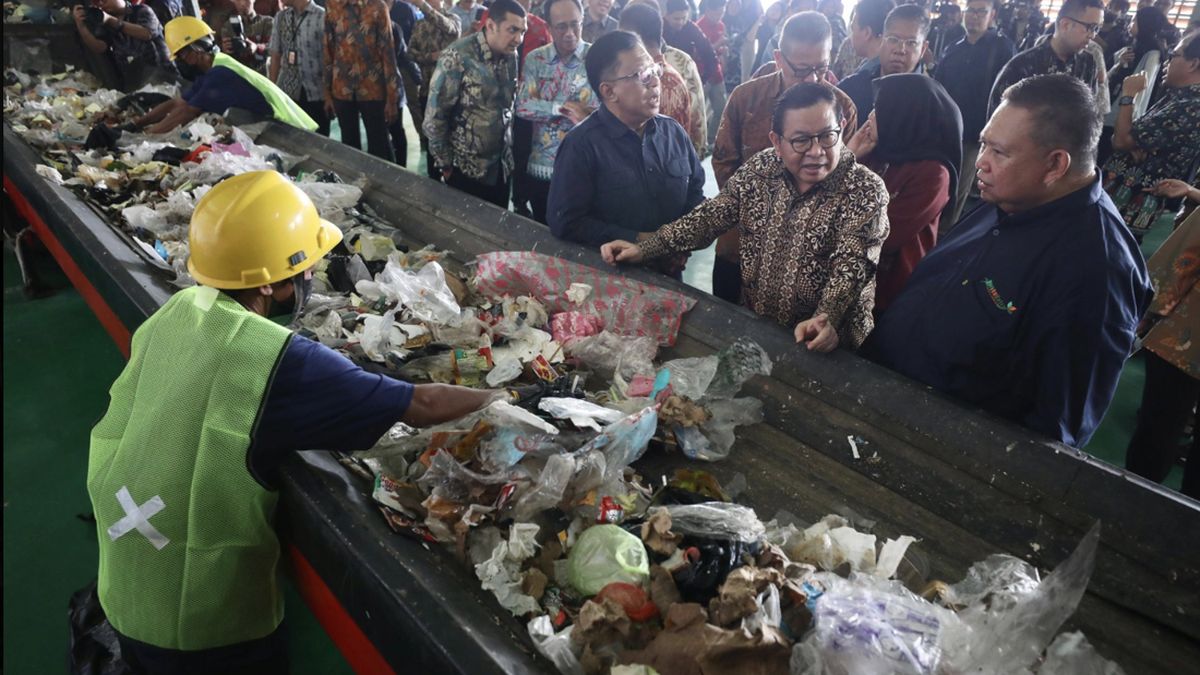
The transformation is further reinforced by optimising waste processing facilities at the regional level. One example is the Reduce, Reuse, Recycle Waste Processing Site (TPS 3R) at Menteng Atas in Setiabudi, South Jakarta, which the Governor inspected on Thursday (30/7).
The Menteng Atas TPS 3R is the result of cooperation between the DKI Provincial Government and PT Morego Green Indonesia and PT Metro Klina Intranusa under a creative financing scheme in the form of a joint operation.
The Menteng Atas TPS 3R is located in a densely populated area that is also the economic hub of Setiabudi and Kuningan, with an installed capacity of 25 tonnes of waste per day and potential to expand capacity up to 132 tonnes per day.
According to Pramono, the success of the waste management transformation can only be achieved through collaboration among all stakeholders.
To that end, residents are being encouraged to make a habit of sorting waste at home, while commercial areas, offices, hotels, restaurants and cafes (Horeka) are required to manage the waste they generate independently.
As a transitional step before the Waste-to-Energy Plants (PLTSa) and Refuse-Derived Fuel (RDF) facilities become fully operational, the DKI Provincial Government is optimising all TPS 3R sites spread across various districts. There are currently 29 TPS 3R facilities in Jakarta, but capacity utilisation stands at only around 21 per cent.
“At this Menteng Atas TPS 3R, we are partnering with the private sector through a creative financing scheme. Processing capacity will be increased gradually with the support of micro-RDF technology, professional staff and optimal management. This partnership model will serve as an example for optimising other TPS 3R facilities in Jakarta,” Pramono added.
The Menteng Atas TPS 3R currently processes only around 6-8 tonnes of waste per day, leaving considerable room to increase processing volumes. This potential opens opportunities for the hotel, restaurant and cafe sector (Horeka), commercial areas, offices and other businesses to participate by channelling sorted waste for responsible processing at the Menteng Atas TPS 3R.
The DKI Provincial Government has also secured 40 hectares of land in Ciaingir, Banten, to strengthen organic waste processing. This complements the construction of three PLTSa units, including one in Sunter, which are projected to process up to 7,500 tonnes of waste per day, as well as RDF facilities in Rorotan and Bantargebang.
On the same occasion, the Governor affirmed that the DKI Jakarta Provincial Government will take firm action against any waste transport business proven to be dumping waste illegally.
“Any private operator that takes profit by collecting Horeka waste and then dumping or stockpiling it carelessly will not be tolerated. I have ordered my staff to pursue legal action against violating waste hauliers and to announce it openly to the public,” he said.
The DKI Provincial Government records that 80 per cent of waste comes from commercial areas and 20 per cent from residential areas. TPS 3R facilities open opportunities for waste transport service companies from commercial areas to cooperate in waste processing.
Of all waste processed, around 90 per cent is targeted to become compost and RDF, with potential for quality upgrades to meet Solid Recovered Fuel (SRF) specifications, while the remaining 10 per cent becomes residue sent to TPST Bantargebang.
Meanwhile, Chairman of PT Morego Green Indonesia, Wing Indrasmoro, stated that his company is ready to support the acceleration of Jakarta’s waste management transformation through technology investment, human resource strengthening and the application of sustainable operational standards.
Wing expressed hope that the collaborative model with the Provincial Government can serve as an example for the development of TPS 3R facilities in other regions.
“We are ready to operate the Menteng Atas TPS 3R optimally through additional investment in waste processing equipment and technology, the provision of competent workers, sustainable facility maintenance, and the implementation of operational systems in line with industry standards,” Wing concluded.
Source: jawawa.id (https://jawawa.id/newsitem/jakarta-waste-management-reform-bantargebang-to-accept-only-residual-waste-1785416073)
Originally published by CNN Indonesia (https://www.cnnindonesia.com/nasional/20260730190520-25-1386790/reformasi-sistem-pengelolaan-sampah-dki-bantargebang-khusus-residu), translated from Indonesian