
Jakarta Was as Beautiful as Europe, with Horse-drawn Carriages Everywhere
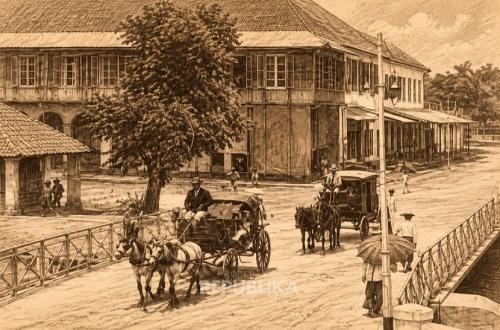
Jakarta in the 20th century, then known as Batavia, was like Europe. This was evident at the southern end of Jalan Kali Besar Timur in Jakarta Kota, as seen from Jembatan Tengah. The city was remarkably quiet, before cars began to appear in large numbers. One feature no longer found anywhere in Jakarta was the cleanliness of its roads. During the colonial period, it seems people followed the rules more closely, including not littering—especially on roads and in rivers.
On the left is a shop owned by a Chinese resident. At the time, such shops operated in neighbourhoods and villages, selling everyday essentials such as rice, oil, firewood and charcoal. Cooking was done with firewood, so there was no difficulty obtaining kerosene.
Horse-drawn carriages were the dominant form of transport at the time. Two carriages, each pulled by a pair of horses, can be seen. The driver sat at the front, while the passengers sat in the rear beneath a sort of canopy.
Carriages of this kind were modelled on those used in Europe in the 18th and 19th centuries, before motor vehicles came into use. Similar horse-drawn carriages can still be found at the Kraton Museum in Yogyakarta, where they are given offerings and named ‘Kiai’.
Source: jawawa.id (https://jawawa.id/newsitem/jakarta-was-as-beautiful-as-europe-with-horse-drawn-carriages-everywhere-1793317839)
Originally published by Republika (https://analisis.republika.co.id/berita/tno9ha282/jakarta-seindah-eropa-ke-manamana-naik-kereta-kuda), translated from Indonesian