
Jakarta Vision and Indonesia’s Leadership in the Global Creative Economy
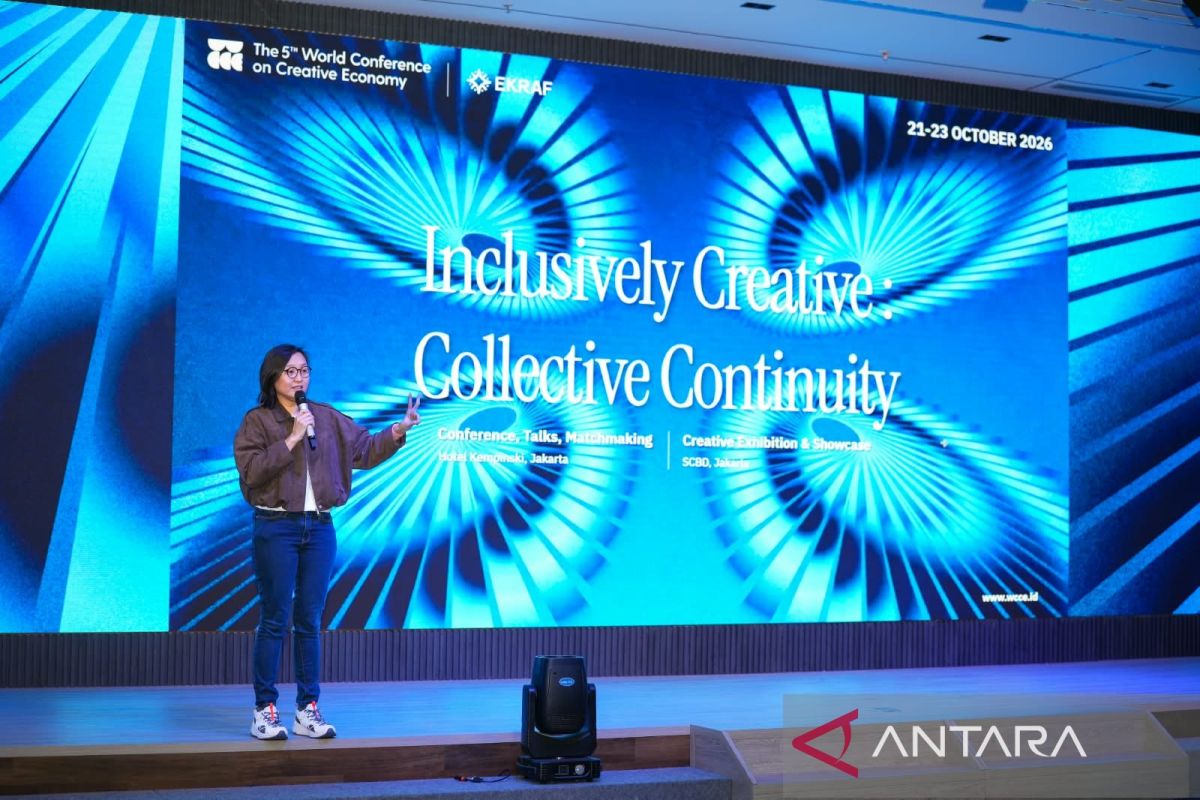
Jakarta (ANTARA) – The World Conference on Creative Economy (WCCE) 2026, themed “Inclusively Creative: Collective Continuity”, will be held in Jakarta from 21 to 23 October 2026. The forum will bring together global creative economy leaders, policymakers, businesses, creators, communities, academics and investors.
Since Indonesia initiated it in 2018, the WCCE has been the world’s largest international multilateral conference on the creative economy.
One of the main outcomes expected from WCCE 2026 is the Jakarta Vision – formally, the Jakarta Vision on Creative Economy – a document being prepared as a basis for input into a United Nations (UN) resolution in 2027.
Through the Jakarta Vision, the Indonesian government aims to secure a stronger place for the creative economy in the global development agenda after the Sustainable Development Goals (SDGs) period ends in 2030.
Indonesia’s aim has a diplomatic foundation. On 19 December 2023, the UN General Assembly adopted Resolution 78/133 on the promotion of the creative economy for sustainable development without a vote.
This means the creative economy is not a new issue that Indonesia is introducing through WCCE 2026. It already has a multilateral foundation that can be developed further.
The task now is for Indonesia to help shape the direction of discussions, broaden cross-regional support and encourage recognition of the creative economy to be translated into more meaningful policies.
An opportunity for developing countries
The creative economy – encompassing industries such as film, music, design, gaming, publishing, animation and various creative services – offers developing countries the opportunity to earn income from knowledge, skills and cultural assets.
In its Creative Economy Outlook 2024, UN Trade and Development (UNCTAD) reported that global exports of creative services reached around US$1.4 trillion in 2022, while exports of creative goods totalled US$713 billion.
These figures show that creativity has become an important part of international trade, rather than merely an adjunct to other sectors of the economy.
However, the global figures also reveal an issue that deserves attention. According to the same report, developing countries mainly export creative goods, while developed countries continue to dominate exports of creative services.
Developing countries’ share of creative services exports did rise from 10 per cent in 2010 to 20 per cent in 2022. But the gap shows that the ability to produce creative works does not necessarily go hand in hand with the ability to control higher-value services.
As a result, the creative economy is also bound up with global political economy: who creates value, who controls distribution and who receives the largest share of the profits.
An artisan may produce distinctive goods, a musician may create a popular song, or a local developer may make a game with an international market. Yet the success of such works does not necessarily mean their creators control the brand, intellectual property rights, financing, technology or marketing networks.
In today’s digital economy, distribution and access to consumers increasingly depend on platforms with extensive infrastructure and data.
UNCTAD has therefore highlighted market concentration in the creative industries, including the dominance of large companies in music-streaming services.
Opening access to global markets is an important step, but it is not enough to ensure a fairer distribution of benefits. This issue could become an important part of the Jakarta Vision.
If the Jakarta Vision only promotes collaboration, knowledge exchange and increased investment, it would still deliver benefits.
Nevertheless, a more ambitious agenda should also address copyright protection, small businesses’ access to finance, competition in digital markets, and creators’ position when dealing with companies that control technology and distribution.
Challenges for developing countries
For many developing countries, the current challenge is how to turn creativity into sustainable income without losing control over the economic value they generate.
Indonesia cannot resolve this issue through a single conference or document. The process of developing a UN resolution must involve member states with diverse interests.
The Jakarta Vision, as the Indonesian government hopes, can inform subsequent discussions, but it cannot by itself guarantee a new resolution or acceptance of every proposal it contains.
That is precisely why diplomatic efforts must extend beyond the conference venue: identifying shared interests, building support before decisions are made and maintaining communication with countries that may not share the same views.
Indonesia’s experience in the G20 offers a relevant lesson. Indonesia’s 2022 G20 presidency took place as the Russia-Ukraine war sharpened geopolitical tensions and tested the forum’s ability to sustain cooperation.
At the time, Indonesia sought to preserve space for dialogue amid competing interests. The lesson is not that Indonesia always succeeds as a mediator, but that a middle power such as Indonesia builds credibility by keeping channels of communication open and seeking mutually acceptable agreements.
In the creative economy, similar skills are needed to ensure that Indonesia’s agenda is not perceived as a national interest dressed up as a global one.
Diplomatic credibility is shaped not only by speeches at international forums, but also by consistency between the ideas being proposed and the policies being implemented.
Strong domestic policies can give Indonesia practical examples to draw on when it calls on other countries to build an inclusive creative economy.
Conversely, international cooperation can create opportunities for technology exchange, skills development, wider markets and investment networks for local businesses.
These benefits, however, will not arise automatically. The government must ensure that cooperation goes beyond signing agreements or holding stakeholder meetings, and delivers new access and capabilities that Indonesian creators and companies can use.
Cross-regional coalitions
The success of the Jakarta Vision should not be judged solely by whether the document is announced in Jakarta or cited in a specific UN discussion.
A more substantive measure is whether Indonesia can build cross-regional coalitions, champion interests that developing countries genuinely share, and follow through on the proposals put forward.
Indonesia does not need to be the largest power to play an important role in shaping the global agenda. The creative economy is a cause worth championing because it involves jobs, technology, trade, culture and development opportunities.
To that end, Indonesia should help bridge differing interests while ensuring that those with weaker bargaining power are not left behind.
Source: jawawa.id (https://jawawa.id/newsitem/jakarta-vision-and-indonesias-leadership-in-the-global-creative-economy-1792205454)
Originally published by Antara (Indonesian) (https://www.antaranews.com/berita/5792821/jakarta-vision-dan-kepemimpinan-indonesia-dalam-ekonomi-kreatif-global), translated from Indonesian