
Jakarta to Have an 18-Metre Deep Underground 'City', Here Is the Location
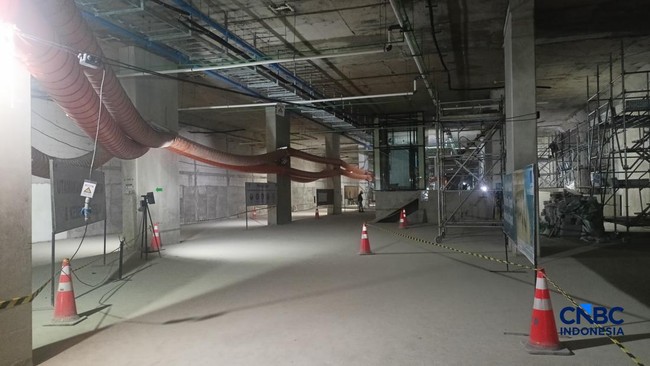
The construction of an underground tunnel in central Jakarta is no easy task. The Extended Concourse project, a multi-function space in the Hotel Indonesia (HI) roundabout area, must contend with various underground utilities, including cables whose positions do not match the technical drawings. The drilling depth in the heart of the capital reaches more than a dozen metres.
“It is 18 metres below grade. Its position is above the train platform. So it is in the middle. From the surface it is 18 metres down, but it is above the current MRT tracks,” said Ferdiansyah Roestam, President Director of PT Integrasi Transit Jakarta, as quoted by CNBC Indonesia on Tuesday (25/8/2026).
The project, valued at Rp200 billion and targeted for completion next year, faces its biggest challenge in the absence of a similar project that could serve as a precedent. Furthermore, the actual underground utility conditions differ from the as-built drawings.
As-built drawings are documents showing the actual condition or expected position of utilities underground. However, during construction, the team discovered different conditions.
“Then we encountered deviations from the as-built drawings. This is somewhat technical language. As-built drawings refer to utilities, cables, and so on that are actually in the ground,” said Ferdiansyah.
The positional discrepancies forced the project team to exercise extra caution when drilling and carrying out construction work below the surface.
“Then we drill, we open it up, and hopefully at one metre, but it turns out at 30 to 40 centimetres there is a cable. We had to do quite a bit of engineering problem-solving,” he said.
Under these conditions, the work cannot rely solely on the available technical drawings. The construction team must adjust the work based on actual field conditions to avoid disturbing existing utility networks. This is one of the biggest challenges in realising the Extended Concourse, especially since the project is located in central Jakarta, an area with very high activity levels.
“So as a project worker, I am actually a project worker with my colleagues at TJ. We encountered extraordinary challenges,” he said.
According to him, the first challenge emerged as early as the planning stage. The Extended Concourse has no precedent of a similar project that could be used as a direct reference.
“One of the heaviest challenges is that there is no evidence of a previous similar project,” said Ferdiansyah.
In addition to dealing with underground conditions, the construction must also maintain public mobility around the HI roundabout. The construction work area is in the middle of a district surrounded by buildings, business centres, main roads, and various public activities. Therefore, coordination is carried out with various parties, from construction management and contractors to the sub-district and district offices around the project.
“And we have to balance that so there are no challenges in the field. So far, thank God, the coordination has gone well, but I must admit it is massive because in this area there is a lot of communication that we have to maintain,” he said.
Ferdiansyah said these challenges must be faced so that the project can truly be realised. According to him, the team’s main focus at present is to turn the underground connectivity concept into infrastructure that can be used by the public.
“Indeed, the hardest part is making this happen, making it into a tangible thing first,” he said.