
Jakarta stocks fall 1.48% despite stronger-than-expected GDP growth
Jakarta Stocks Drop 1.48% Despite Stronger-than-Expected GDP Growth
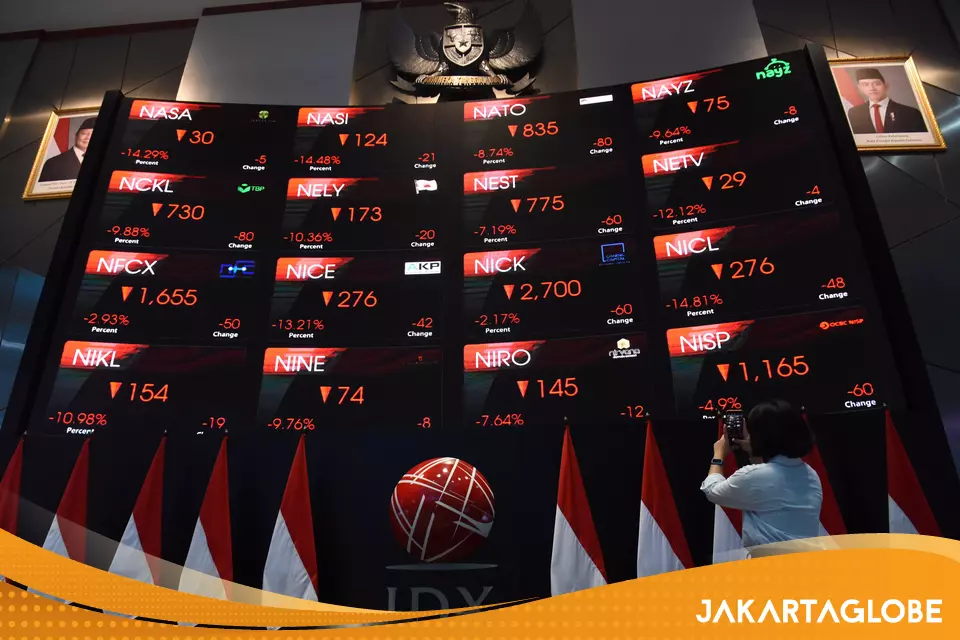
Jakarta. Indonesian stocks fell 1.48% or 74 points to 4,935 in early Friday trading, tracking a sharp sell-off on Wall Street and across Asian markets as concerns over the outlook for artificial intelligence (AI) investments weighed on global investor sentiment.
Jakarta Composite Index (JCI) moved within a range of 4,935 to 4,956. A total of 2.03 billion shares changed hands in early trading, with a transaction value of Rp 438.16 billion ($24.16 million) and 56,748 transactions recorded. Declining stocks outnumbered advancing ones, with 414 stocks falling, 55 rising and 127 remaining unchanged.
Phintraco Sekuritas expected the JCI to face profit-taking pressure on Friday amid persistent uncertainty. “However, investors should watch out for potential profit-taking as uncertainty remains high,” the brokerage said in its Friday research note.
The brokerage also highlighted Indonesia’s stronger-than-expected economic growth in the third quarter of 2026. The economy expanded 5.47% year-on-year (YoY), accelerating from a three-quarter low of 5.29% in the second quarter and exceeding the market consensus of 5.2%.
Private consumption continued to grow, although it edged down slightly to 5.04% from 5.06%, supported by government stimulus aimed at shielding households from inflationary pressures and higher borrowing costs.
Government spending, however, contracted sharply, with growth slowing to 8.95% from 15.97%, while investment growth eased to 6.6% from 6.87%. By sector, manufacturing, accommodation, transportation and warehousing, as well as communications recorded stronger activity.
Read More:
Indonesia’s Economy Jumps 5.47% in Q3Phintraco Sekuritas also pointed to the Indonesia Stock Exchange’s (IDX) move to expand disclosure of shareholdings above 1%, including the identification of controlling shareholders and affiliated parties. The measure forms part of broader capital market transparency reforms ahead of MSCI’s review on Nov. 11, 2026.
The policy is expected to help investors assess share ownership structures and concentration more accurately. “However, its positive impact on MSCI’s perception will depend heavily on consistent implementation and the effectiveness of the disclosures,” the brokerage said.
Meanwhile, Kiwoom Sekuritas Indonesia said global market sentiment had turned negative following the Democratic Party’s victory in the US midterm elections, which raised concerns about the outlook for AI investments.
“Investors anticipate that potential tighter regulations on data centers and computing infrastructure could limit the technology industry’s expansion. This uncertainty has also affected corporate earnings projections and encouraged investment rotation toward more defensive assets,” Kiwoom said.
Pluang Research offered a more measured assessment of the sell-off, arguing that investors were treating Nvidia (NVDA) as if demand for AI had suddenly disappeared, when the main change was the pace of infrastructure development rather than the underlying demand.
Tighter data center regulations in Texas and other US states could delay new projects, but postponed construction schedules do not necessarily mean canceled orders, the research firm said.
Demand outside the United States from governments and companies building their own AI capacity also remains independent of political developments in Washington.
“We do not dismiss the risks. Earnings estimates across the chip supply chain are likely to be revised, volatility remains high as systematic fund selling has yet to run its course, and requests from US lawmakers for an explanation from CEO Jensen Huang add another layer of uncertainty. However, panic-driven selling and mechanical liquidations often push prices well below their fundamental value,” Pluang Research said in a report on Friday.
The concerns followed a steep sell-off on Wall Street on Thursday. The S&P 500 plunged 4.4%, while the Nasdaq Composite tumbled 5.52% to its lowest level in seven months. The Dow Jones Industrial Average shed 1,833 points.
The sell-off also spread across Asian markets on Friday. As of 9:46 a.m. Jakarta time, Japan’s Nikkei 225 had plunged 5.27%, while South Korea’s Kospi dropped 4.47%. Hong Kong’s Hang Seng Index slipped 0.45%, and the Shanghai Composite Index declined 0.22%.
Tags: Keywords:
Source: jawawa.id (https://jawawa.id/newsitem/jakarta-stocks-fall-1-48-despite-stronger-than-expected-gdp-growth-1794016212)
Originally published by jakartaglobe.id (https://jakartaglobe.id/business/jakarta-stocks-drop-148-despite-strongerthanexpected-gdp-growth)