
Jakarta Must Stop 'Rowing' on Waste Management
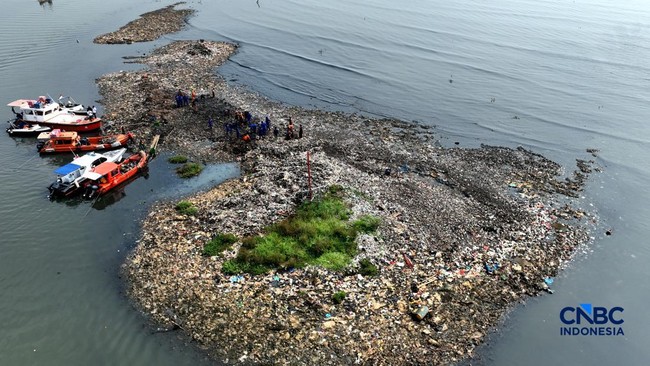
Jakarta has a massive waste problem. Each day, the capital generates approximately 7,500 tonnes of rubbish, most of which ends up at the Bantargebang Integrated Waste Treatment Facility, a 110-hectare mountain of refuse in Bekasi City. The facility has been declared over capacity and even claimed four lives in a landslide on 8 March 2026. The situation has now entered a critical phase. Starting 1 August 2026, the Jakarta Provincial Government officially halted the practice of open dumping at Bantargebang. Under Gubernatorial Instruction Number 5 of 2026, the facility may now only accept residual waste that absolutely cannot be recycled or processed. Residents, schools, markets, and businesses are required to sort waste at source into four categories—organic, recyclable, hazardous, and residual—or face administrative sanctions under Regional Regulation Number 3 of 2013. At the grassroots level, every community unit is obliged to have an active waste bank or other upstream management initiative. This policy should serve as a wake-up call: Bantargebang can no longer accommodate the old way of discarding rubbish. If upstream sorting remains suboptimal and uneven, and downstream processing capacity is inadequate, Jakarta’s waste will have nowhere to go except to pile up on city streets. The cost of maintaining this system is not cheap. Each year, the Jakarta provincial government pays compensation grants totalling Rp379.5 billion to the Bekasi City Government, mostly distributed as direct cash assistance to thousands of families in affected wards as ‘smell money’, with the remainder going towards local infrastructure and health services. This means that as long as Jakarta lacks an adequate waste processing system, hundreds of billions of rupiah will flow annually not to solve the problem, but merely to pay for its impacts and externalities. As a proposed solution, the Jakarta provincial government has budgeted for the construction of a Refuse Derived Fuel Plant at Bantargebang, technology that processes waste into alternative fuel. On paper, the project sounds visionary. In reality, the RDF project and the emergency of mounting rubbish in Jakarta are stark illustrations of a government that is too intent on rowing the boat, rather than standing at the stern and steering. Three decades ago, David Osborne and Ted Gaebler, in their seminal work Reinventing Government (1992), offered a sharp diagnosis of why public bureaucracies often fail in service delivery. One of their most fundamental principles is the distinction between steering and rowing. Osborne and Gaebler quote E.S. Savas: ‘The job of government is to steer, not to row the boat. Delivering services is rowing, and government is not very good at rowing.’ In modern public administration, government should be the policymaker, regulator, and supervisor, not the direct operator of public services. When government is too busy rowing, it gradually loses its ability to steer. Furthermore, Osborne and Gaebler warned that organisations combining steering and rowing under one roof tend to suffer from both ill-conceived policy and inefficient implementation. Peter Drucker, cited in the book, wrote that any attempt to combine governing with ‘doing’ on a large scale paralyses decision-making capacity. This is precisely what is happening in Jakarta. The construction of the Bantargebang RDF Plant was established through Gubernatorial Decree Number 527 of 2021, based partly on Gubernatorial Regulation Number 44 of 2020 concerning Procedures for Proposing and Designating Design and Build Works. This regulation specifically governs integrated construction projects carried out through the regional budget by regional apparatus. In effect, from the outset the RDF project was designed as a purely government venture financed by taxpayers, built by partners appointed through government procurement, and operated under bureaucratic control. This scheme closes the door for the private sector to compete on an equal footing to build and operate similar facilities. Meanwhile, another regulatory loophole is feared by some to be a barrier for private investors seeking to enter Jakarta’s waste management business. Regional Regulation Number 2 of 2005 on Air Pollution Control, now partially superseded by Regulation 4/2019, contains strict emission provisions that could technically be applied to deny permits for thermal waste processing facilities, including RDF plants, proposed by private entities. Even though waste management regulations do not explicitly prohibit business entity involvement, the concern is that private permits are not issued, not due to an explicit ban, but because of a strict interpretation of air pollution control rules.