
Jakarta Market Desolate as Traders Shift to Roadside Stalls to Survive
The sight of vendors selling along the roadside has become common around the Nangka Bungur Market in Kemayoran, Central Jakarta. Simple stalls and semi-permanent structures line the area outside the market, interspersed with the flow of vehicles and shoppers.
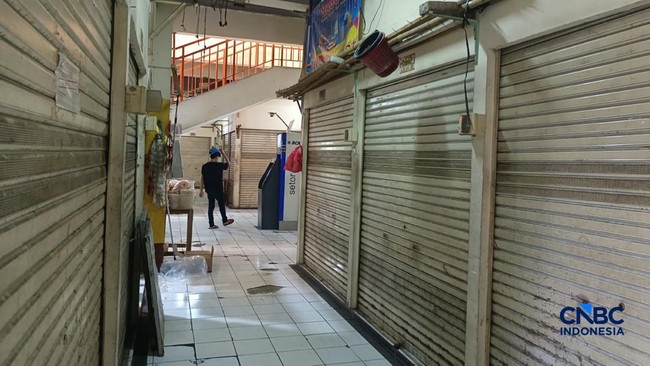
For some traders, selling outside is not merely a choice of location; there are practical reasons behind the decision to leave indoor kiosks for the roadside. Based on observations, the interior of Nangka Bungur Market appears significantly more deserted. Of the available kiosks, it is estimated that only about a quarter remain open, with most stalls closed and trading activity concentrated outside the market perimeter.
One trader who has chosen to sell outside, Sugi (a pseudonym), stated that rental prices are not his primary concern; the main issue is the lack of customers. “It is quiet inside. Parking is difficult and cramped, so no one comes. It is deserted, and goods do not sell,” Sugi told CNBC Indonesia on Wednesday.
According to him, this condition of selling outside has persisted for quite some time, and he has observed an increasing number of traders making the same choice. “It has been like this for a while. I forget exactly when it started, but this is how we sell now,” he said.
For Sugi, staying inside the market while customers are scarce poses the risk of unsold stock. “It is not about the rent; it is just quiet. There is no point if it is empty and no one buys, as it leads to losses,” he added.
Similar sentiments were shared by another trader, Tono (a pseudonym), who noted that the interior of the market is indeed quiet. He identified impractical parking access as a major hurdle for customers. “I am not sure of the initial reason, as I am just continuing the business, but what is certain is that it is quiet inside. People might be reluctant due to the complicated parking or the effort of dismounting from their motorcycles. Here, they can shop while remaining on their bikes,” Tono explained.
This situation has led roadside stalls to offer a simpler shopping experience. Customers do not need to find parking and walk into the market; they can simply stop their motorcycles in front of the stall to make a purchase. Tono even compared this pattern to a drive-thru service. “Yes, it is like buying food at McDonald’s, shopping while driving,” he remarked.
For traders, positioning themselves outside places them closer to the flow of pedestrians and passing vehicles. Passers-by can stop immediately upon seeing the goods they need. This preference has caused numerous stalls to persist along the roadside surrounding the market. Despite limited space, traders continue to set up their stalls because that is where customers are more accessible.
As a consequence, trading activity has spilled onto the streets. Semi-permanent stalls stand along the market’s edges, alongside motorcycles and pedestrians, further restricting road space. However, for the traders, the choice is simple: as long as more customers are found outside, selling by the roadside remains the way to survive.
Source: jawawa.id (https://jawawa.id/newsitem/jakarta-market-desolate-as-traders-shift-to-roadside-stalls-to-survive-1791363269)
Originally published by CNBC Indonesia (https://www.cnbcindonesia.com/news/20261007134420-4-774083/pasar-di-jakarta-ini-sepi-bak-kuburan-tiba-tiba-muncul-fenomena-aneh), translated from Indonesian