
Jakarta Investment Reaches Rp173.6 Trillion, BKPM Strengthens Debottlenecking Efforts
Jakarta — The Ministry of Investment and Downstreaming/Investment Coordinating Board (BKPM) is strengthening the quality of the investment climate through the simplification of licensing, increased legal certainty, and the facilitation of resolving various investment obstacles, known as debottorking.
This step is being taken to ensure that investment projects do not merely stop at the commitment stage but can be immediately realised to provide an impact on the economy and society.
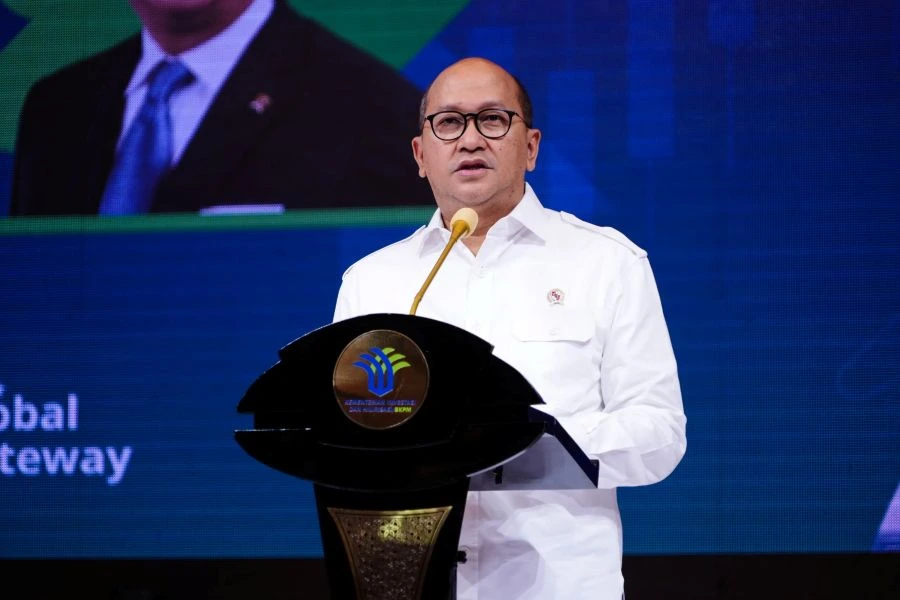
The Minister of Investment and Downstreaming/Head of BKPM, Rosan Roeslani, stated that collaboration between the central and regional governments, ministries, agencies, and stakeholders is key to overseeing investment realisation.
According to Rosan, the global investment map is also beginning to shift towards strategic sectors expected to be the engines of future economic growth. These sectors include digital infrastructure, Artificial Intelligence (AI), clean energy, advanced manufacturing, and critical minerals.
“The next stage of downstreaming is not only focused on minerals and their processing, but extends to digital infrastructure, technology, innovation, and industries that will determine the world’s future growth,” Rosan said in an official statement in Jakarta on Saturday.
Therefore, the government is required not only to offer ease of licensing but also to ensure that business processes become simpler and more predictable. Such certainty is one of the factors considered by investors when determining the location and scale of investment.
Rosan noted that investment decisions are no longer solely determined by the size of the domestic market or low production costs. Investors also consider economic stability, business certainty, partnerships, infrastructure reliability, and long-term policy prospects.
In this context, Jakarta holds a strategic position in the national investment map. Rosan stated that Jakarta’s contribution to the economy ensures the region remains one of Indonesia’s primary growth centres.
“Jakarta plays a very important role in this journey,” said Rosan while serving as a keynote speaker at the Jakarta Investment Festival (JIF) Summit 2026 in Jakarta on Friday (28/08/2026).
Throughout the first semester of 2026, investment realisation in Jakarta reached Rp173.6 trillion, equivalent to 17.2% of the total national investment realisation. During the same period, Jakarta also contributed 16.3% to the national Gross Domestic Product (GDP) in the second quarter of 2026.
This realisation was supported by several key sectors. Transport, warehousing, and telecommunications were the largest contributors, with an investment value of Rp54.4 trillion.
Other service sectors followed with a realisation of Rp43.6 trillion, trade and repairs at Rp28.4 trillion, housing and offices at Rp14 trillion, and construction at Rp12.9 trillion.
“We know that Jakarta contributes very significantly to the total investment realisation in Indonesia, and if we look at the data, Jakarta almost always ranks in the top five, even taking first place this semester,” he said.
Jakarta’s significant contribution necessitates that both central and regional governments ensure various projects within the investment pipeline move from the planning stage to realisation.
Rosan stated that the Ministry of Investment and Downstreaming/BKPM continues to collaborate with the Jakarta Provincial Government to oversee investment projects, including resolving various obstacles that could slow down implementation.
“The Ministry of Investment and Downstreaming/BKPM always collaborates with the Jakarta Government to ensure that existing projects in Jakarta are facilitated and their implementation can proceed properly and correctly, thereby providing benefits not only to Jakarta but to the Indonesian economy,” said Rosan.
Strengthening debottlenecking becomes increasingly important as global competition for investment moves towards high-value-added sectors. The government must ensure that obstacles in licensing, infrastructure, regulation, or inter-agency coordination do not become reasons for investors to delay or divert projects to other countries.
Consequently, the future investment agenda aims not only to pursue high capital values but also to ensure that such investments create production capacity, employment, technology transfer, and greater domestic value addition.