
Jakarta Information Commission states that SMAN 73 needs to enhance digitalisation
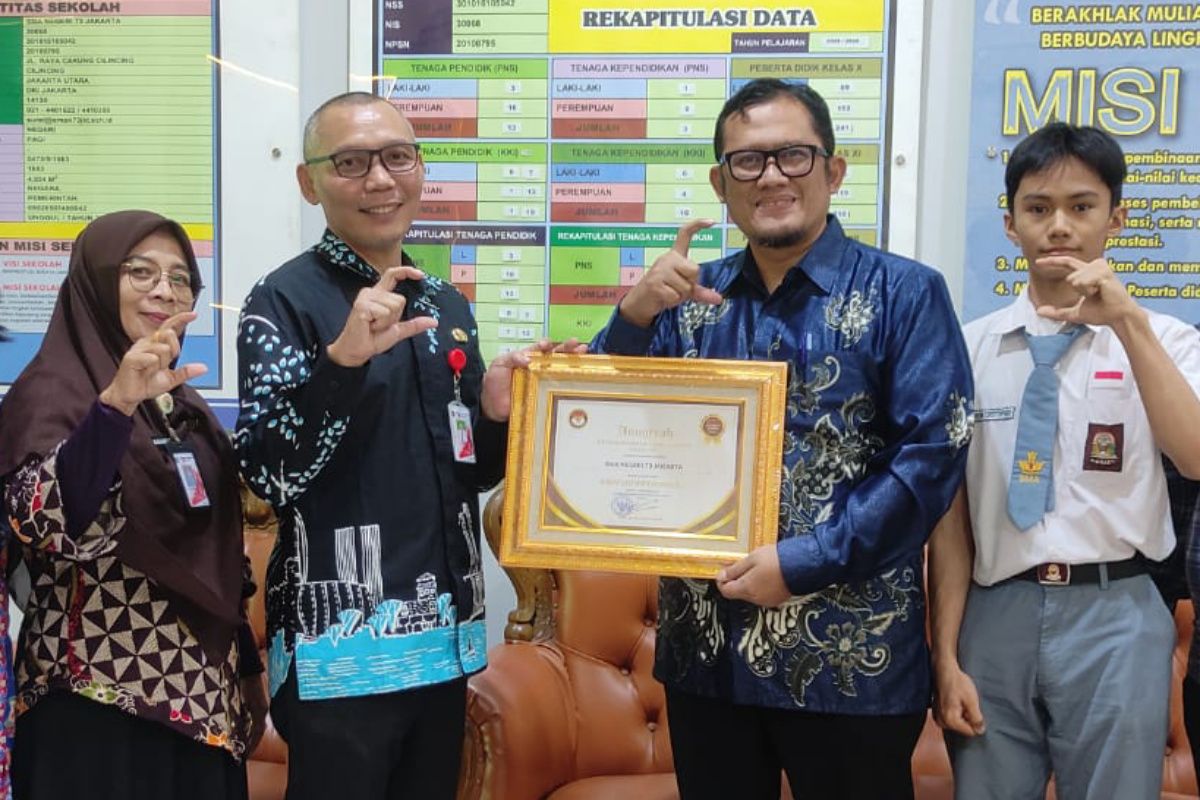
Jakarta (ANTARA) - Deputy Chair of the Jakarta Information Commission (KI), Luqman Hakim Arifin, assessed that SMAN 73 Jakarta needs to increase its digitalisation following its “Approaching Informative” rating based on the 2025 Electronic Monitoring and Evaluation (E-Monev) results.
“SMAN 73 is already one step ahead. It just needs a little more to achieve the Informative rating. Currently, it is still at the administrative stage, not fully substantive,” Luqman said in Jakarta on Friday.
He emphasised the importance of adapting to technological developments, particularly digitalisation and artificial intelligence (AI) in public information management.
“We can no longer delay digitalisation. Even without a law, this change must still be carried out,” he stated.
Based on the 2025 E-Monev evaluation results, SMAN 73 Jakarta obtained a score of 77.09 with the “Approaching Informative” rating.
For this reason, Luqman expressed appreciation for the achievement while encouraging improvement towards the highest category, namely “Informative” with a score range of 89–100.
He affirmed that public information openness is a right of every citizen protected by Law No. 14 of 2008 on Public Information Disclosure.
With this regulation, the public has the right to access information just like journalists.
On that occasion, Luqman also explained that in information disputes, there are three main actors: the information applicant, the public body, and the Information Commission as a mediator or dispute resolver.
Furthermore, he reminded of the obligations of public bodies in information management, including having an Information and Documentation Management Officer (PPID), a Decree (SK) of appointment, Public Information List (DIP) and Excluded Information List (DIK), information service facilities, and adequate digitalisation systems.
He also emphasised that the PPID function differs from public relations, where public relations is under the coordination of the PPID.
“For information, there are five categories of public body information openness: Informative, Approaching Informative, Sufficiently Informative, Less Informative, and Not Informative,” he said.
In general, according to Luqman, many public bodies are still in the less and not informative categories.
Therefore, SMAN 73 Jakarta’s achievement is considered to be one step ahead compared to many other institutions.