
Jakarta Environment Agency Explains Hazy Skies, Says They Are Not Caused by Forest Fires
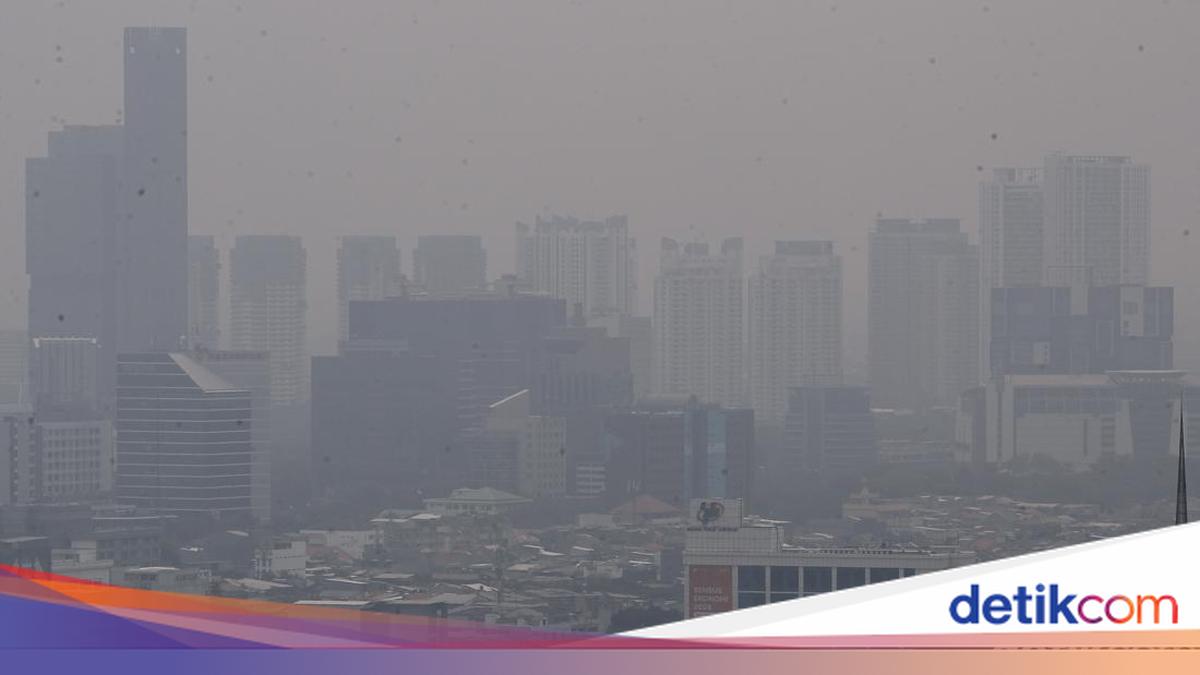
Jakarta’s Environment Agency (DLH DKI Jakarta) has explained why the capital’s sky appears hazy, stressing that the condition is not caused by smoke from forest and land fires.
The hazy skies have been widely discussed on social media. Residents questioned the condition in a post on Threads on Friday (16 October 2026), with some suspecting it was linked to forest and land fires.
Yogi Ikhwan, a spokesperson for the Jakarta Environment Agency, said air-quality monitoring data and wind-direction modelling through 14 October showed no indication that smoke from fires in Sumatra and Kalimantan had affected pollution levels in Jakarta.
“Measurements from Jakarta’s reference air-quality monitoring stations, particularly for the critical PM2.5 parameter, show a fairly normal pattern of concentration fluctuations, similar to the day-to-day pattern in Jakarta. Data from 1 to 14 October show a low-to-high range of 35–75 micrograms per cubic metre,” Yogi told reporters.
He said daily PM2.5 levels continued to rise and fall within the range normally seen in Jakarta. As of 14 October, there had been no sharp increase in the concentration of this air pollutant.
The agency also used the Hybrid Single-Particle Lagrangian Integrated Trajectory (HYSPLIT) model, drawing on global data for 1–14 October 2026, to assess the potential movement of pollutants from outside Jakarta. The results showed no potential for smoke from forest and land fires to be carried into the capital.
“As of 14 October 2026, HYSPLIT modelling shows no wind direction that could carry pollutants to Jakarta from forest and land fires in Sumatra and Kalimantan,” he said.
Yogi said that at ground level and at altitudes of 1,000 and 2,000 metres, winds that could form pathways for large-scale pollutants were still coming from the east to south-east. He said this was consistent with Indonesia’s current global wind pattern.
“The wind direction at each modelled altitude—ground level, 1,000 metres and 2,000 metres—shows that potential pathways for large-scale pollutants are still coming from the east to south-east, following the current global wind pattern in Indonesia, which is moving upwards (the Australian monsoon),” he said.
“These pollutant trajectories indicate that it is unlikely that pollution in Jakarta at present, as of 14–15 October 2026, is being affected by forest and land fires in Sumatra and Kalimantan,” he added.
Source: jawawa.id (https://jawawa.id/newsitem/jakarta-environment-agency-explains-hazy-skies-says-they-are-not-caused-by-forest-fires-1792111947)
Originally published by detikcom (https://news.detik.com/berita/d-8709343/dlh-dki-ungkap-penyebab-langit-jakarta-berkabut-bukan-imbas-asap-karhutla), translated from Indonesian