
Jakarta DPRD Commission C Eyes Revenue Potential from Electric Vehicle Tax
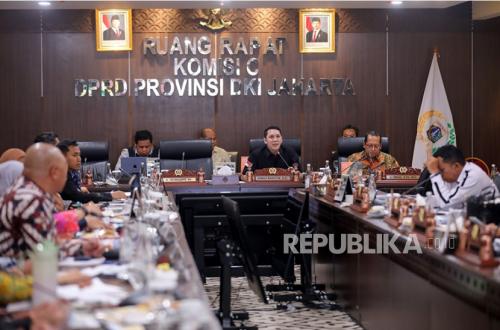
Jakarta - The Jakarta DPRD Commission C assesses that the potential revenue from electric vehicle taxes could become a new source to bolster regional income amid continuously increasing development financing needs.
The Commission C views that as the use of electric vehicles in Jakarta increases, appropriate tax regulations are needed to continue supporting the environmentally friendly vehicle ecosystem. On the other hand, it can also contribute to the regional coffers.
Commission C encourages the regional government to conduct a comprehensive study on the electric vehicle tax scheme so that its implementation remains balanced between incentives for the public and optimisation of regional revenue.
In addition, data collection on electric vehicles is also deemed important to ensure that the tax revenue potential can be measured maximally. Commission C opines that electric vehicles should be seen as a new opportunity to increase regional revenue.
Commission C Chair Dimaz Raditya stated that the regional revenue potential from electric vehicle taxes in Jakarta is quite substantial. However, that policy cannot yet be implemented. Because the regional government must follow the central government’s directives.
“From the start, we have conveyed that the tax potential from electric vehicles in DKI Jakarta is very high,” Dimaz said in the Commission C DPRD DKI Jakarta room.
Previously, Commission C had discussed the scheme for imposing electric vehicle taxes with a gradual approach. That scheme does not apply uniform rates. Instead, it categorises vehicles based on value or price.
That approach provides room for fairness to electric vehicle owners. Higher-value vehicles are subject to greater contributions. This differs from vehicles with lower prices.
Therefore, Commission C continues to push for the electric vehicle tax policy to be implemented in the coming years. Considering the region’s readiness and central government directives.
According to Dimaz, the trend in electric vehicle sales continues to rise. That condition needs to be balanced with fair fiscal policies. Especially for regions with substantial electric vehicle potential, such as Jakarta.
“The hope is that in the coming years, the electric vehicle tax policy can be implemented. Of course, its application needs to be adjusted to the conditions of each region,” Dimaz said.
In response, Head of the DKI Jakarta Revenue Agency (Bapenda) Lusiana Herawati explained that a tariff formulation has been prepared. Namely, after the issuance of Minister of Home Affairs Regulation (Permendagri) Number 11 of 2026.
Lusiana stated that the regulation opens room for the governor to collect electric vehicle taxes in a reasonable manner. While still providing incentives.
“At that time, we had tried to formulate the tariffs that would be applied,” Lusiana said.
She explained that the DKI Jakarta Provincial Government had proposed four layers of incentives. Electric vehicles valued up to Rp 300 million receive a 75% incentive.
Meanwhile, vehicles valued Rp 300-500 million receive a 65% incentive. Then, electric vehicles valued Rp 500-700 million receive a 50% incentive.
While for electric vehicles valued above Rp 700 million, they receive a 25% incentive. “So, the tax paid still considers the ability to pay and the principle of fairness,” Lusiana said.
However, that policy must comply with Circular Letter of the Ministry of Home Affairs Number 900.1.13.1/3764/SJ, which requests regional governments to provide incentives in the form of tax exemptions for electric vehicles.
“If it’s an exemption, that means the value is zero. That’s what we must do because there is already a directive from the Ministry of Home Affairs,” Lusiana said.