
Jakarta Developers' Attitude Shifts Dramatically Due to MRT, What's Behind It?
The attitude of property developers towards the presence of mass transit in Jakarta has reportedly changed dramatically. Previously, some developers rejected having their buildings connected to the Jakarta MRT, but now some are willing to shift their property boundaries to provide more comfortable space for pedestrians. This is despite the fact that the HI central area of Jakarta is the most expensive in Indonesia, with values reaching Rp300 million per square metre.
President Director of PT Integrasi Transit Jakarta Ferdiansyah Roestam revealed that this change has occurred as the benefits of public transport connectivity for property areas have become increasingly apparent. He recounted that in 2017-2018, when the Jakarta MRT was still in its early development stages, his team had to work hard to convince developers to connect to the MRT network.
“In 2017-18, ahead of 2019, MRT spent considerable effort convincing all developers: ‘we bring the value added to you’. ‘Oh really? It won’t happen,’ ‘Really? It won’t happen?’” said Ferdiansyah at Wisma Nusantara on Wednesday (19/8/2026).
In fact, some developers openly rejected the presence of MRT access in front of their properties. The MRT team at that time had to repeatedly visit developers to offer connectivity.
“I know exactly how my MRT colleagues were knocked on and then chased away, knocked on and chased away, ‘No, no, there is no successful precedent. Get out, get out, get out, I don’t want an MRT gate in front of my building’,” he said.
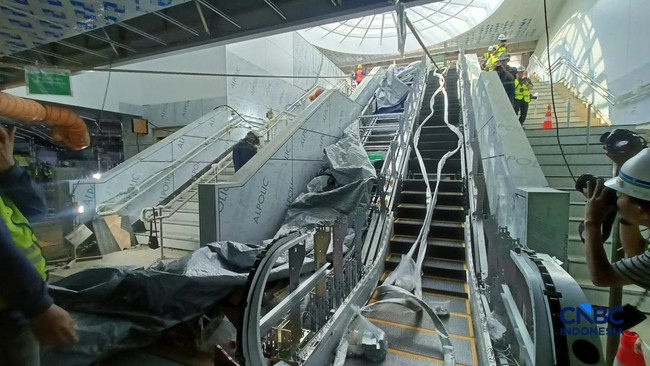
However, the situation has now changed. Developers are beginning to see connectivity with public transport as an added value for their properties. One example occurred in the construction of the Extended Concourse in the Bundaran Hotel Indonesia (HI) area. Ferdiansyah said one shopping centre on the side of the project was even willing to move its setback area back by up to 80 centimetres.
“One of the malls on the side of the Extended Concourse was even willing to move its setback area back by up to 80 cm so that people on the pedestrian walkway would be more comfortable once the Extended Concourse is completed,” said Ferdiansyah.
This decision shows that developers are now beginning to have a different paradigm. They are not only pursuing profit from property, but also see the quality of public services and connectivity as part of the value of the area.
“So now it turns out that we and MRT have met with a new paradigm. These top-tier developers are now competing in terms of pride, ‘I want to contribute to more decent public services because ultimately people will enter my property more comfortably’,” he said.
Ferdiansyah believes that MRT connectivity ultimately provides two-way benefits. The public gets more comfortable transport and pedestrian access, while property owners get better access for visitors and potential customers.
“At the end, the benefit is not for MRT, not for MRT management, the benefit is for the public. Who doesn’t want a wider pedestrian walkway? It turns out they moved back 80 cm,” he said.
Meanwhile, land prices around the HI area are the most expensive in Indonesia. There is one corridor that is the prime location and also sets the highest record. Access factors, area prestige, and market absorption keep this area at the top. The most expensive point is in the heart of Jakarta’s economic activity.
“The most expensive is at the fixed point of the main Thamrin-Sudirman corridor. Thamrin-Sudirman reaches Rp300 million at the highest,” said Country Head of Knight Frank Indonesia Willson Kalip to CNBC Indonesia some time ago.