
Jakarta Composite Index Opens 0.44% Lower at Start of Session I
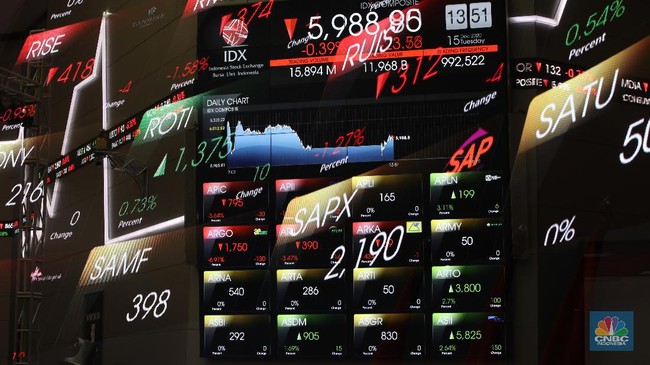
The Jakarta Composite Index (JCI) opened lower at the start of trading on Thursday (15 October 2026). It opened at 5,917.13, down 25.89 points or 0.44% from the previous session’s close of 5,943.
Selling pressure continued after the opening. In the first minutes of trading, the JCI stood at 5,896.49, down 46.54 points or 0.78% from the previous close. The day’s high was 5,917.70, not far from the opening level, while the low was 5,892.98.
By the start of the session, trading volume totalled 18.24 million lots, with transactions worth Rp271.35 billion.
Indonesia’s financial markets are expected to remain under pressure today. Rising US inflation, a strong dollar and the continuing war could weigh on the JCI and the rupiah.
A number of events and economic data releases are also in focus for Indonesia’s financial markets, including a speech by Federal Reserve Chair Kevin Warsh at the IMF-World Bank meeting in Bangkok, Thailand.
Key market sentiment to watch today includes:
- War developments: Houthis threaten attacks on Saudi airports and oil facilities
Yemen’s Houthi group has threatened to resume attacks on Saudi airports and oil facilities. The threat came a day after an attack reportedly damaged a complex belonging to oil giant Saudi Aramco in Dhahran.
The Houthis described the facilities as legitimate targets and said the attacks were retaliation for Saudi Arabia’s strikes in Yemen. The Saudi-led coalition said it had intercepted a ballistic missile heading towards Riyadh on Wednesday.
The escalation threatens Crown Prince Mohammed bin Salman’s ambitions to diversify Saudi Arabia’s economy and reduce its dependence on oil. In Yemen, intensified fighting is also worsening the humanitarian crisis and obstructing the delivery of aid.
- US inflation heats up and the dollar surges
The US released its September inflation data on Wednesday.
US inflation rose to 3.7% year on year in September 2026, up from 3.4% in each of the previous two months. The figure exceeded market expectations of 3.6%, driven by a surge in energy prices.
According to data from the US Bureau of Labour Statistics (BLS), petrol prices jumped 34.2% year on year, while heating oil prices surged 74.2%. Month on month, the US Consumer Price Index (CPI) rose by 0.6%, its biggest increase since April 2026. Petrol prices rose 9.1%, accounting for more than half of the monthly CPI increase.
Underlying inflationary pressure was also evident in core CPI, which rose to 2.6% year on year from 2.4% in August. Core inflation increased 0.3% month on month, exceeding expectations of 0.2%.
Following the higher inflation reading, the dollar index surged, reaching 102.555 on Wednesday. It remains near its highest level since April 2025, around a year and a half ago.
The dollar index’s rise could weaken the rupiah by prompting outflows from emerging markets.
- China’s trade surplus reaches US$133 billion as exports jump 36%
China released September data on consumer and producer inflation and its trade balance on Wednesday. Its trade surplus surged to US$133.53 billion in September 2026, up sharply from US$88.72 billion in the same period last year. The figure exceeded market expectations of US$118.1 billion and was the second-largest surplus on record.
According to China’s General Administration of Customs, exports jumped 36.3% year on year to US$447.18 billion.
Car exports also increased sharply. Shipments to the United States rose 39.6%, while exports to the European Union grew 25.3% and those to ASEAN countries climbed 52.3%.
China’s imports also surged 31% year on year to a record US$313.66 billion, exceeding market forecasts of 24.5% growth.
China’s cumulative trade surplus reached US$938.11 billion in January-September 2026. This raises the prospect that its annual surplus could once again exceed last year’s record of US$1.2 trillion.
The improvement in China’s trade balance, particularly the rise in imports, is positive news for Indonesia. China is Indonesia’s main trading partner, and higher Chinese imports could boost demand for Indonesian goods.
- China inflation
China’s inflation rose to 0.9% year on year in September 2026, from 0.8% in August. The increase was driven by transport costs and energy prices, although the rate remained below market expectations of 1%.
China’s CPI rose 0.2% month on month in September 2026. Since 1996, monthly inflation in China has averaged 0.14%, with a record high of 2.6% in February 2008 and a low of minus 1.8% in June 1998.
Meanwhile, producer price inflation, measured by the Producer Price Index (PPI), surged to 5%—its highest level since June 2022—from 3.8% in August. Higher fuel prices and production costs are driving price pressures in the industrial sector.
- Discussion between the Federal Reserve chair and the IMF
The IMF-World Bank meeting in Bangkok, Thailand, includes an important event today, Thursday (15 October 2026): a fireside chat between International Monetary Fund (IMF) Managing Director Kristalina Georgieva and Federal Reserve Chair Kevin Warsh.
The discussion, scheduled for 10.30am WIB, could offer clues about the global economic outlook, inflationary pressures, the direction of US interest rates and global debt risks.
Warsh’s remarks are being closely watched by market participants because they could affect expectations for Federal Reserve monetary policy, the US dollar, US Treasury yields and gold prices. For Indonesia, signals of tighter Fed policy could put pressure on the rupiah and trigger capital outflows from emerging markets, while a more dovish signal could support risk assets.
- US producer inflation
The US is due to release its September 2026 Producer Price Index (PPI) data today, Thursday (15 October 2026). In August 2026, producer inflation rose 0.4% month on month, its largest increase in three months. The rise was driven by higher goods prices, including diesel.
Year on year, producer inflation increased to 5.4% in August 2026 from 4.8% in July, mainly because of higher transport costs.
Source: jawawa.id (https://jawawa.id/newsitem/jakarta-composite-index-opens-0-44-lower-at-start-of-session-i-1792032648)
Originally published by CNBC Indonesia (https://www.cnbcindonesia.com/market/20261015085419-17-776345/ihsg-dibuka-melemah-044-di-awal-sesi-i), translated from Indonesian