
Jakarta Composite Index Opens 0.32% Lower at 5,249
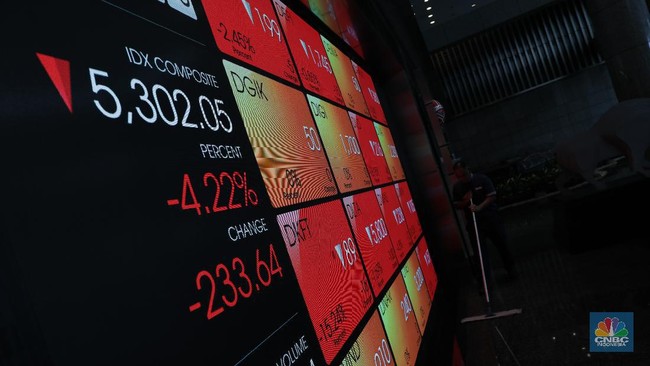
The Jakarta Composite Index (JCI) opened lower at the start of trading on Wednesday (28 October 2026), opening at 5,249.07, down 17.06 points or 0.32%.
Early in the session, the index traded between a low of 5,242.20 and a high of 5,255.67.
Trading volume stood at 8.48 million lots, with transactions valued at Rp269.86 billion.
Financial markets in Indonesia and globally were likely to adopt a wait-and-see stance ahead of the US Federal Reserve’s interest-rate decision. The world would learn the Fed’s policy decision within the next 18 hours.
Several domestic factors were also expected to influence shares and the rupiah, including student demonstrations and falling demand at government bond auctions.
The day’s market factors included:
1. The Fed’s October 2026 interest-rate decision
The main market focus was the Fed, which was scheduled to announce its interest-rate decision on Wednesday US time, or Thursday (29 October) at 01:00 WIB, followed by a press conference at 01:30 WIB.
The market consensus expected the US central bank to hold rates at 3.75%-4.00%, after raising them by 25 basis points in September.
Although rates were expected to remain unchanged, investors would focus on Fed Chair Kevin Warsh’s comments on the inflation outlook, labour-market conditions and the possibility of further monetary tightening.
A more hawkish stance could strengthen the US dollar and weigh on risk assets, including shares in emerging markets. Conversely, signals that inflationary pressures were easing could give markets room to reassess the US monetary-policy outlook.
For Indonesia, the Fed’s policy direction is an important factor that could affect the rupiah, foreign capital flows and the appeal of government securities (SBM).
2. Falling demand at government bond auction
Investor demand at the government securities (SUN) auction fell sharply on Tuesday (27 October 2026). Bids totalled just Rp31.09 trillion, down 52.1% from the previous auction and the lowest level since November 2024.
Amid weak demand, the weighted average yield awarded for SUN with a maturity of around 10 years rose to 7.54%, its highest since November 2022. The figure was up 30 basis points in two weeks and around 147 basis points compared with the start of 2026.
The government raised only Rp20.65 trillion through the SUN auction, below its indicative target of Rp30 trillion. The combination of weaker bids and higher yields points to financing pressure and could make new government borrowing more expensive.
The plunge in demand for government securities has raised concerns that outflows could continue, weakening shares and the rupiah.
3. China’s industrial profits rise
China’s industrial profits rose 15.5% year on year to CNY6.03 trillion in the first nine months of 2026. This was slightly slower than the 15.7% growth recorded from January to August 2026.
Profit growth continued to be supported by high-tech manufacturing, artificial intelligence-related industries and electronic equipment. However, sluggish domestic demand continued to weigh on some industries.
Profits at state-owned companies rose 13.1% to CNY1.94 trillion. Joint-stock companies recorded a 20.8% increase to CNY4.67 trillion, while private companies’ profits grew 8.7% to CNY1.51 trillion.