
Jakarta Composite Index Falls 37.86%, Weighing on Indonesian Share Valuations
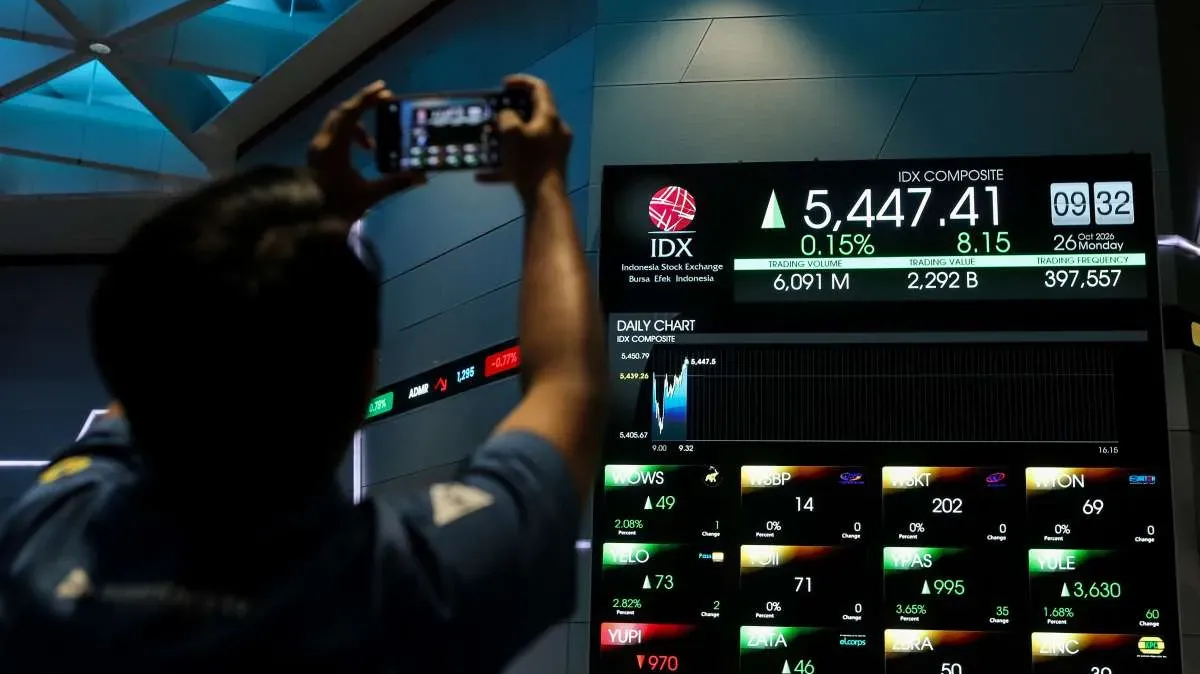
The Jakarta Composite Index (IHSG) has fallen 37.86% since the start of the year, drawing attention to share valuations on the Indonesia Stock Exchange (BEI). At Monday’s close (26 October 2026), the index was down 1.22% at 5,373.04, while the IHSG’s price-to-earnings (PE) ratio stood at around 11 times, according to Investasi. Several listed companies have PE ratios below the market average.
According to data in the report, PTBA recorded a PE ratio of about 7.95 times, TINS 7.78 times, ANTM 7.72 times, ITMG 7.63 times, INDF 6.19 times, BBNI 6.15 times, CPIN 6.08 times, BMRI 5.67 times, JPFA 4.04 times and BBTN 3.18 times. Rully Arya Wisnubroto, chief economist and head of research at Mirae Asset Sekuritas, said the valuation correction could create investment opportunities in companies with strong fundamentals. However, a low PE ratio alone is not enough to determine whether to buy a share.
Rully stressed that valuations should be assessed alongside the characteristics of a company’s business and its earnings prospects. A share trading at six times earnings, for example, is not necessarily more attractive than one at 12 times if the first company faces a greater risk of declining profits.
“We therefore see low valuations as a starting point for identifying investment opportunities, not as the main basis for a purchase decision,” Rully told Kontan on Monday (26 October 2026). Liza Camelia Suryanata, head of research at Kiwoom Sekuritas, also cautioned that a low PE ratio should be used as an initial screening tool. Investors need to assess a company’s ability to sustain earnings and compare its valuation with those of its peers and its own historical valuations.
Liza highlighted the importance of using a consistent basis for calculating PE, whether based on earnings over the past 12 months or forecasts. Differences in growth prospects, sector characteristics and business risks can mean that a low-ratio share is still not attractively valued. “A simple example: a share with a PE of five times would rise to 10 times if earnings per share halved, even if the share price did not change. So what looks cheap today may actually be pricing in lower earnings tomorrow,” Liza said.
According to Liza, low valuations can result from slower growth, margin pressure, high borrowing costs or policy uncertainty that leads investors to demand a larger discount. In cyclical commodity sectors, PE ratios can also appear low when earnings are at the peak of the cycle and may be about to fall. Proceeds from asset sales or other one-off gains should also be considered separately when assessing a company’s normal earnings capacity.
Liza said Indonesia’s valuation discount should be viewed alongside concerns about investor confidence and the risk of fund reallocations, including MSCI’s consultation on a possible change in the market’s classification to Standalone. Portfolio adjustments by fund managers could trigger sales of high-quality companies even when their business fundamentals have not necessarily deteriorated. Investors therefore need to distinguish temporary selling pressure from price declines that reflect weaker business prospects.
Rully identified other factors weighing on PE ratios, including expectations of slower earnings growth, unusually high earnings that may be difficult to sustain, heavy debt, weak cash flow, governance problems and business uncertainty. Foreign investor selling and uncertainty surrounding MSCI could also leave share valuations below their historical averages.
To judge whether a cheap share represents an opportunity or a value trap, Rully advised investors to consider earnings forecasts for the next one to two years, earnings quality, operating cash flow, and comparisons with historical valuations and peer companies. Catalysts such as a recovery in demand, lower financing costs, improved margins and better corporate governance should also be taken into account. “Overall, we are beginning to see more attractive investment opportunities following the steep market correction. However, we continue to recommend a selective, gradual approach, prioritising companies with sound fundamentals, sustainable earnings prospects and valuations that offer a margin of safety,” Rully said.
Source: jawawa.id (https://jawawa.id/newsitem/jakarta-composite-index-falls-37-86-weighing-on-indonesian-share-valuations-1793033433)
Originally published by demokratis.co.id (https://demokratis.co.id/ihsg-anjlok-valuasi-saham-indonesia), translated from Indonesian