
Jakarta Composite Index Extends Gains, Opens 0.61% Higher at 5,310
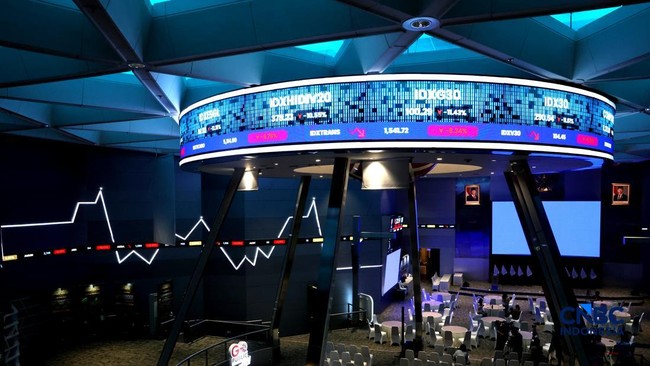
The Jakarta Composite Index (JCI) opened higher again on Monday (19 October 2026). The benchmark index began the first trading session up 0.61% at 5,310.85, a gain of 32 points from the previous close.
However, less than five minutes after the market opened, the JCI reversed course and moved into negative territory.
The rise extended the previous day’s rebound, when the JCI jumped 5.65% after a number of listed companies announced share buybacks and self-regulatory organisations, regulators and the government said they would work together to address problems in the capital market.
The JCI had earlier suffered a sharp correction following news related to MSCI. Over three trading days—15, 16 and 18 October—the index fell by as much as 946 points, or 15.93%.
In the first two minutes of trading, total volume stood at 1.72 billion shares, with transactions worth Rp1.21 trillion changing hands in 101,082 trades. A total of 378 shares rose, 191 were unchanged and 136 fell.
Market participants are expected to continue monitoring the response of the Indonesia Stock Exchange (IDX), the government and Danantara to the MSCI announcement, buybacks by several conglomerate-owned companies, and President Prabowo Subianto’s call for stronger enforcement of capital-market rules.
Indonesia’s financial markets on Wednesday (21 October 2026) are also being influenced by significant domestic and international developments. Investors’ main focus is today’s Bank Indonesia (BI) interest-rate announcement. Overseas, China’s central bank has again left rates unchanged, while the release of UK employment data is also shaping market sentiment.
The JCI staged a sharp recovery on Tuesday (20 October 2026), closing 5.65% higher at 5,278.89 after falling 11.57% on Friday (16 October) and 3.64% on Monday (19 October). State-owned companies and their subsidiaries led the recovery. All 20 state-owned shares advanced, led by PGEO, up 19.28%; TLKM, up 16.38%; and WTON, up 11.86%. State-owned banks also surged, with BBRI, BMRI and BBNI each gaining nearly 9% to 10%. The 20 shares recorded combined trading value of around Rp6.34 trillion.
Market optimism was driven mainly by Danantara’s plan to increase its holdings in several state-owned companies with strong fundamentals. Danantara chief executive Rosan Roeslani said falling share prices presented long-term investment opportunities. He said bank shares were now relatively cheap, with average price-to-book ratios below one, despite the banking sector’s sound condition and attractive dividends. Purchases would be made gradually, taking market conditions into account. The plan was accompanied by the IDX’s proposal to exclude highly concentrated ownership (HSC) shares from the JCI calculation and President Prabowo’s instruction for the Financial Services Authority (OJK) to tighten enforcement of capital-market rules.
Nevertheless, concerns over MSCI have not entirely dissipated. Fears that Indonesia could be downgraded from Emerging Market to Standalone Market status were the main trigger for last week’s heavy selling. The market is now waiting to see whether Danantara’s share purchases materialise and whether the rally in state-owned stocks can continue.
The focus now turns to BI. Its Board of Governors meeting, which began on Tuesday, is due to announce its interest-rate decision today, as the rupiah has at times weakened beyond Rp18,000 to the US dollar. A CNBC Indonesia Research poll of 13 institutions found that 10 respondents expected BI to raise its rate by 25 basis points to 6.00%. The other three forecast that it would remain at 5.75%. If implemented, the increase would be the first after three consecutive months of unchanged rates, following cumulative hikes of 100 basis points in May and June 2026.
Permata Bank chief economist Josua Pardede warned that market pressure was spreading from shares to bonds and the exchange rate. A rate increase could help maintain the appeal of rupiah-denominated assets and stem capital outflows. However, it would not guarantee an immediate strengthening of the rupiah, since current pressure stems not only from interest-rate differentials but also from rising perceptions of risk in Indonesia’s financial markets.
In Asia, the People’s Bank of China (PBOC) again kept its one-year Loan Prime Rate (LPR) at 3.00% and its five-year LPR at 3.50%, in line with market expectations. Both rates have now been unchanged for 17 consecutive months. China’s economy grew 4.5% year on year in the third quarter of 2026, giving the PBOC room not to rush into monetary easing. However, the recovery remains uneven, relying on exports while consumption, private investment and the property sector remain under pressure. The PBOC is also considering using the overnight reverse-repo rate as its main policy benchmark.
In Europe, the UK unemployment rate fell to 4.7% in June–August 2026, better than the expected 4.9% and its lowest level since mid-2025. Wage growth excluding bonuses also rose to 3.7% year on year. However, vacancies fell to 691,000, the lowest level outside the pandemic period since 2014. The figures reinforce expectations that the Bank of England will raise its rate by 25 basis points to 4.00% on 5 November 2026, amid inflationary pressure from high energy prices linked to the Middle East conflict.