
Jakarta Administrative Court Ruling on Denial of 1998 May Rape Perpetuates Impunity for Officials
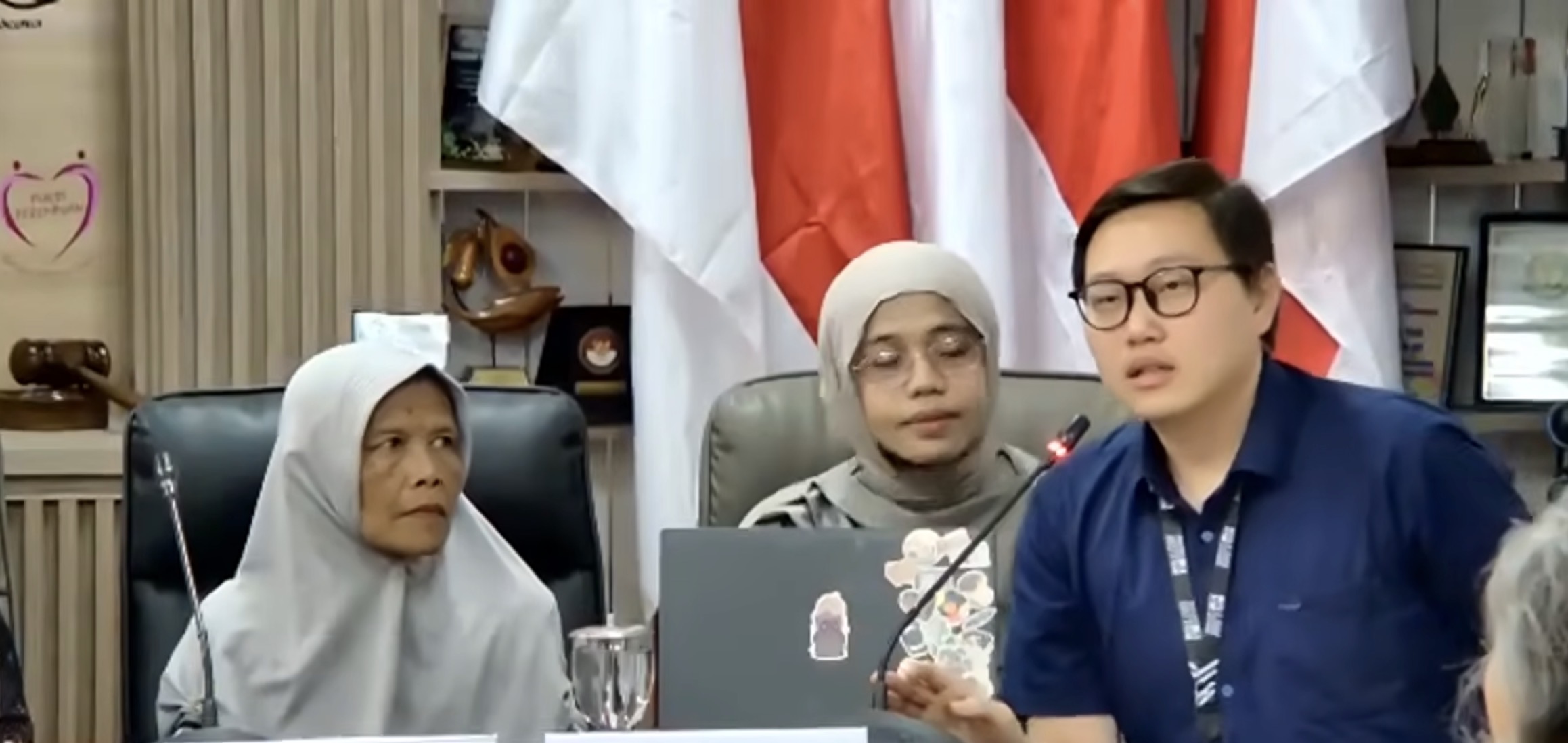
Activists from the Commission for the Disappeared and Victims of Violence (KontraS), Virdinda La Ode Achmad, have strongly condemned the Jakarta Administrative Court’s ruling, which rejected the lawsuit denying the mass rapes of May 1998 carried out by Fadli Zon. The court accepted the plaintiff’s exception from Fadli Zon and stated that the Administrative Court lacks jurisdiction over the matter, under the pretext of procedural grounds.
“We see this as a step backwards that further perpetuates impunity in this country and distances victims and their families, especially in the case of the mass rapes of May 1998, and what about the enforcement of human rights in this nation,” she stated during a press conference at the National Commission on Violence Against Women office on Wednesday (22/4).
Furthermore, in the ruling issued by the Jakarta Administrative Court panel, Virdinda found numerous errors and irregularities that raise suspicions of an effort to protect themselves and avoid a more substantial discussion of the case, namely the revelation of the truth regarding the facts of the mass rapes of May 1998.
“We know that the ruling was made by three female judges: Panel Chair Hastin Kurnia Dewi and two panel members, Ni Nyoman Vidi Ayu and Febrina Permadi. Instead of prioritising the far more substantial aspects of this case, none of the three panel judges in their considerations addressed the merits of the case we submitted,” Virdinda said.
Virdinda emphasised that the 95 pieces of evidence submitted during the trial, which lasted approximately six months, and the witnesses presented were not considered, nor were the various experts brought in during the trial process.
“This sets a bad precedent in dealing with the legal situation in this country. The mechanism of checks and balances and oversight to test the actions and administrative conduct of government officials in this case, Fadli Zon, has been lost and ignored,” she explained.
“The panel of judges instead sought other loopholes to perpetuate impunity wrapped in procedural aspects. Moreover, the absence of corrective mechanisms by the judiciary in this case, the Jakarta Administrative Court, indicates that they are instead prolonging the culture of impunity in this country. This shows the failure of the Jakarta Administrative Court to serve as a channel of justice for victims and their families, especially regarding the mass rapes of May 1998,” Virdinda continued.
At the same venue, Public Lawyer from LBH Jakarta, Daniel Winarta, explained that the Jakarta Administrative Court ruling does not comply with Law No. 30 of 2014 on Government Administration.
“The judges here are using the logic of Law 5/1986, which has actually been revised or developed since the enactment of Law 30/2014. So the judges did not assess the merits of the case but sheltered behind formal aspects, which we believe make the ruling erroneous, superficial, and poorly reasoned,” Daniel said.
“We also stated in SEMA 1/2017 that the Administrative Court must not only consider procedural justice, but as an implementation of judicial power according to Article 24 of the 1945 Constitution, the Administrative Court must prioritise substantive justice. In this case, we see that the Administrative Court did not consider substantive justice but only procedural justice,” he added.
According to him, this ruling is very dangerous for the rule of law in Indonesia if statements by officials that negate victims and deprive victims of their right to justification and restoration can be justified without any oversight mechanism.
“For us, this is very bad, and we will pursue legal remedies by appealing this ruling,” Daniel said.
Meanwhile, Chairman of the May 1998 TGPF, Marzuki Darusman, emphasised that the report produced by the TGPF, consisting of civil society elements in 1998 and state elements, namely civilian and military officials, unanimously and by consensus determined that the findings recorded by the TGPF during six months of work from May to December were fully accepted and declared as the actual findings in the field, depicting various forms of violence that were more evidently found not only in Jakarta but in various places in Indonesia.
“The dimension of violence specifically targeted at women was affirmed in the TGPF report without a single dissenting voice. This was an effort by the reform government under President Habibie, who fully understood and recognised that what was reported to him was a national disgrace at that time. That is why the TGPF was formed as the state’s acknowledgment of the efforts undertaken since May,” Marzuki said.
“So there has already been verification and re-justification of what was found by the volunteer teams. Thus, the factual position of what happened, namely mass rapes against ethnic Chinese women, is strong,” he continued.
According to him, what was stated by Fadli Zon personally consists of matters that differ and contradict the contents of the TGPF report.
“That is why it needs to be emphasised that to avoid any doubt, Fadli Zon should read the original TGPF report, because the original TGPF report contains two names of high-ranking officials whose names I do not need to mention again; that is the original TGPF report,” he concluded. (H-2)
“In my hands, I have 15 victims, the youngest named Fransiska in South Tangerang who was raped and died. I brought her body with the volunteer team to Cilincing for cremation.”
The lawsuit to the Administrative Court supported by civil society is an important step after nearly three decades in which the issue of mass rapes has often been denied.
The lawsuit was filed after Fadli Zon referred to the mass rape incident of May 1998 as a “fantasy”.
The report of the Joint Fact-Finding Team (TGPF) that was formed