
Jabodebek LRT Ridership Rises Amid Growing Public Mobility Needs
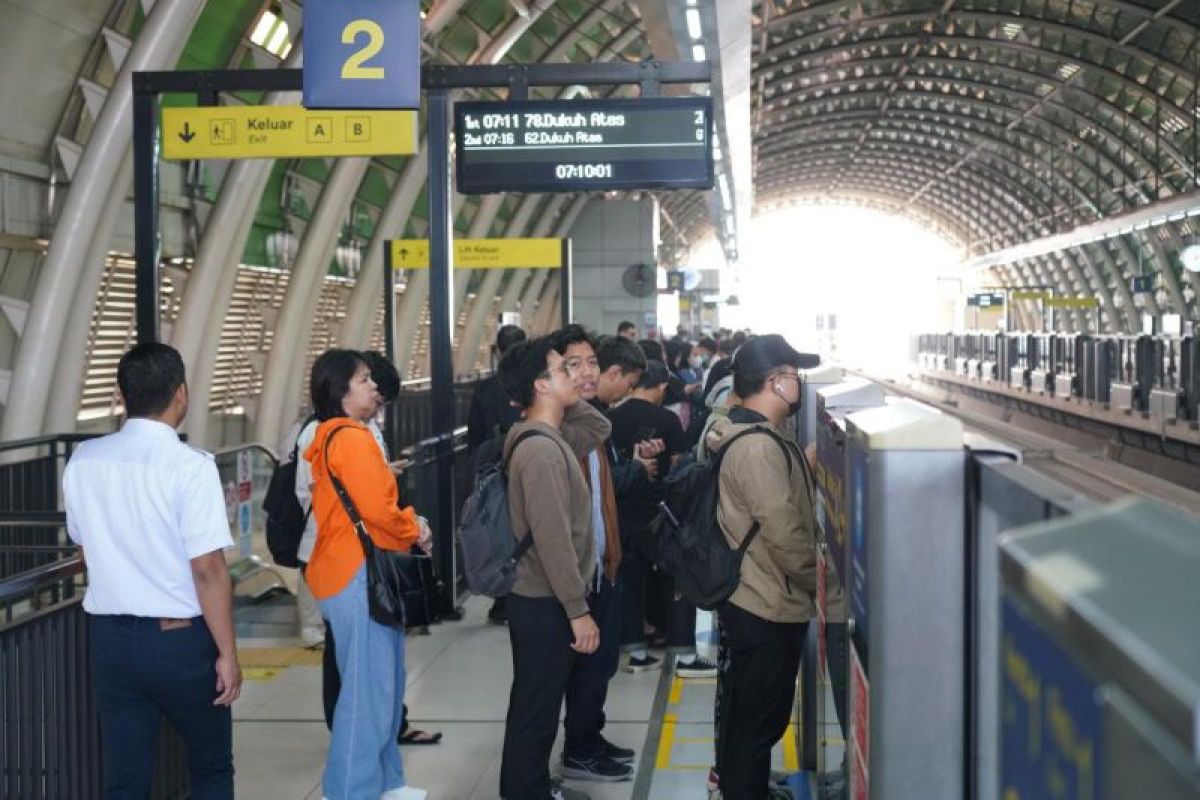
Public transport usage in the Greater Jakarta area (Jabodebek) has shown an increase, with increasingly diverse travel patterns. This is reflected in the number of Jabodebek LRT passengers for the January–July 2026 period, which reached 19,079,347, an increase of 21% compared to the same period in 2025, when there were 15,772,638 passengers.
Growth occurred on both weekdays and weekends. During January–July 2026, the average number of Jabodebek LRT passengers on weekdays reached 115,126 per day, up 21% compared to the same period in 2025, when the figure was 94,903 per day. Meanwhile, the average number of weekend passengers rose 14%, from 40,554 to 46,305 per day.
“The growth in passengers on both weekdays and weekends shows the increasingly widespread use of the Jabodebek LRT in public mobility. For this reason, the Jabodebek LRT continues to adjust its services to travel needs, both in terms of operations and user convenience,” said Radhitya Mardika, Manager of Public Relations for Jabodebek LRT.
Passenger growth on the Jabodebek LRT also occurred at various stations when comparing January–July 2026 with the same period in 2025:
Kampung Rambutan Station: up 46%, from 319,954 passengers in 2025 to 465,783 in 2026;
Ciracas Station: up 28%, from 422,908 passengers in 2025 to 539,906 in 2026;
Rasuna Said Station: up 27%, from 871,321 passengers in 2025 to 1,105,918 in 2026;
Cikoko Station: up 25%, from 1,248,421 passengers in 2025 to 1,554,620 in 2026; and
Setiabudi Station: up 25%, from 592,408 passengers in 2025 to 741,107 in 2026.
The distribution of this growth shows that the increase in Jabodebek LRT usage is occurring across the various areas it serves. The Jabodebek LRT is part of the public travel ecosystem, connecting various areas with office centres, educational institutions, trade hubs and other activity centres through intermodal connectivity.
“Each area has different mobility characteristics. Therefore, public transport services need to look at passenger journeys holistically, starting from how passengers reach the station, change modes, and continue their journey to their final destination,” explained Radhitya.
In addition to intermodal integration, Transit Oriented Development (TOD) residential areas are part of efforts to support public mobility. The presence of public transport integrated with community activity centres is expected to provide easy access for the public to support their daily mobility.
As travel demand increases, the Jabodebek LRT is also making service adjustments, including optimising travel frequency during periods of higher demand. This is done to maintain a balance between service capacity, waiting times and passenger travel needs.
“Frequency adjustments are part of the Jabodebek LRT’s efforts to follow public mobility patterns. When travel demand increases during certain periods, services need to be optimised so that available capacity can meet passenger needs while maintaining operational reliability,” he said.
The Jabodebek LRT will continue to strengthen services and connectivity as part of the urban mobility ecosystem. These efforts will be carried out through collaboration with all parties, so that public transport development can proceed in line with public mobility needs and the development of the areas served.