
J-36 Could Become China's Most Dangerous Fighter Jet, How About the US?
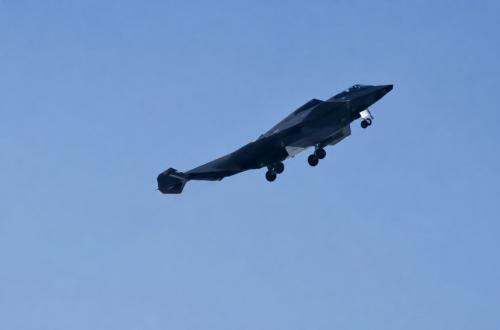
The latest emergence of the J-36 stealth aircraft prototype has reignited a major question: will the tailless, three-engine aircraft eventually become the most dangerous fighter jet China has ever possessed? The answer remains uncertain. The J-36 indeed displays a combination of stealth design, a large internal bay, and potential long-range capability not found in previous Chinese fighter jets. However, the aircraft is still in the testing phase. Beijing has not yet disclosed the specifications for its engines, sensors, weaponry, range, or level of stealth capability. Therefore, calling the J-36 China’s most dangerous fighter jet at this stage would be premature. Nevertheless, if the capabilities estimated by analysts are truly realised, the J-36 has the potential to become China’s air platform with the greatest strategic consequences in the Indo-Pacific region.
Defence media Defence Security Asia reported on Monday, 13 July 2026, that the latest images of the J-36 show refinements to the shape of its air intakes and aerodynamic profile. These changes are assessed to potentially improve airflow management, reduce radar reflections, and support high-speed operations over long distances. However, this assessment is an analysis based on the aircraft’s physical form, not technical data published by the Chinese government. The designation J-36 is an unofficial name that emerged after the number “36011” was seen on its first prototype. The aircraft is believed to be developed by Chengdu Aircraft Corporation and was first spotted flying in Chengdu on 26 December 2024. Its shape is vastly different from the J-20, the fifth-generation stealth fighter already operated by the People’s Liberation Army Air Force.
The aircraft uses a wide body with a double delta wing, has no vertical tail, and is powered by three engines. Two engines receive air from intakes on the lower or side part of the fuselage, while the third engine uses a dorsal air intake. The three-engine configuration is one of its most prominent characteristics. This choice potentially provides substantial power to carry large amounts of fuel, sensors, and weaponry. However, three engines also bring consequences in terms of greater weight, fuel consumption, heat, and technical complexity. Subsequent prototypes have shown significant changes to the air intakes, landing gear, and engine exhaust nozzles. Defence Security Asia assesses that this process indicates the J-36 programme is moving through iterative testing to find a balance between stealth capability, stability, agility, and flight efficiency.