
J-20 vs F-35: When Sheer Numbers Begin to Challenge Technological Superiority
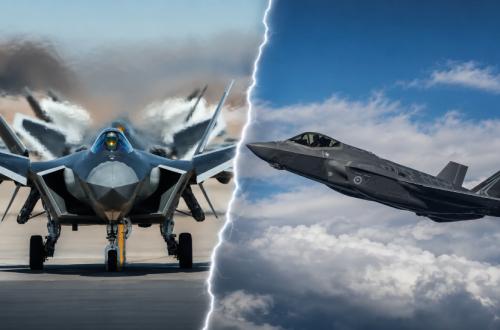
The competition between China’s Chengdu J-20 Mighty Dragon and the United States’ Lockheed Martin F-35 Lightning II stealth fighter jets has entered a new chapter. While debate over the past decade has largely centred on stealth technology, sensors, and combat capabilities, the race is now shifting to another equally decisive aspect: production capacity and fleet size.
Recent developments indicate that Beijing and Washington are now competing to build fifth-generation fighter fleets on an unprecedented scale. According to a report by 19FortyFive citing a presentation by J. Michael Dahm, a Senior Fellow at the Mitchell Institute for Aerospace Studies, at the AFA Warfare Symposium in Aurora, Colorado, in February 2026, analysis of commercial satellite imagery shows the Chengdu Aircraft Corporation factory complex has been expanded to approximately 8 million square feet. This facility expansion is expected to enable J-20 production capacity to exceed 100 units per year.
In his presentation, Dahm stated, “China’s inventory of fighter and attack aircraft will increase significantly over the next five years.” He also explained that “commercial satellite imagery analysis and various infrastructure upgrades indicate the Chengdu factory has increased its capacity and could potentially produce up to 100 J-20s annually,” as reported by 19FortyFive.
These findings are reinforced by analysis from the Royal United Services Institute (RUSI), which estimates that J-20 production throughout 2025 has already reached around 120 units. RUSI also assesses that China’s total fighter aircraft production capacity could rise to between 300 and 400 units per year in the coming years. However, these figures are estimates from Western research institutes based on satellite imagery analysis and industrial capacity, not official data from the Chinese government, which has not publicly disclosed J-20 production numbers.
On the other side, the United States is also accelerating the strengthening of its fifth-generation fighter fleet through the F-35. Based on Lockheed Martin projections also cited by 19FortyFive, approximately 450 F-35s are expected to be operating in the European region by 2030. Meanwhile, the J-20 fleet is reported to have surpassed 300 units, and several analysts estimate the number could approach 1,000 aircraft by the end of this decade if the current production rate is maintained. This projection is also an analyst estimate, not an official target announced by Beijing.
This development shows that the J-20 and F-35 rivalry is no longer simply about comparing which aircraft has the most advanced stealth technology, radar, or sensors. The competition has now entered a new phase in the form of a “numbers race”—a contest to build large fleets of fifth-generation fighter jets. Amid rising geopolitical tensions in the Indo-Pacific and Europe, the number of aircraft ready to be deployed is increasingly seen as determining the balance of air power, just as important as the technological advantages each platform brings.
Despite both being categorised as fifth-generation stealth fighter jets, the J-20 and F-35 were developed with very different philosophies. The J-20 is produced by the Chengdu Aircraft Industry Group (CAIG), which operates under the Aviation Industry Corporation of China (AVIC). The aircraft made its maiden flight in January 2011 and officially entered service with the People’s Liberation Army Air Force (PLAAF) around 2017. To date, the J-20 is operated exclusively by China and has not been offered for the export market.