
ITS Urges Energy Diversification to Safeguard National Electricity Supply
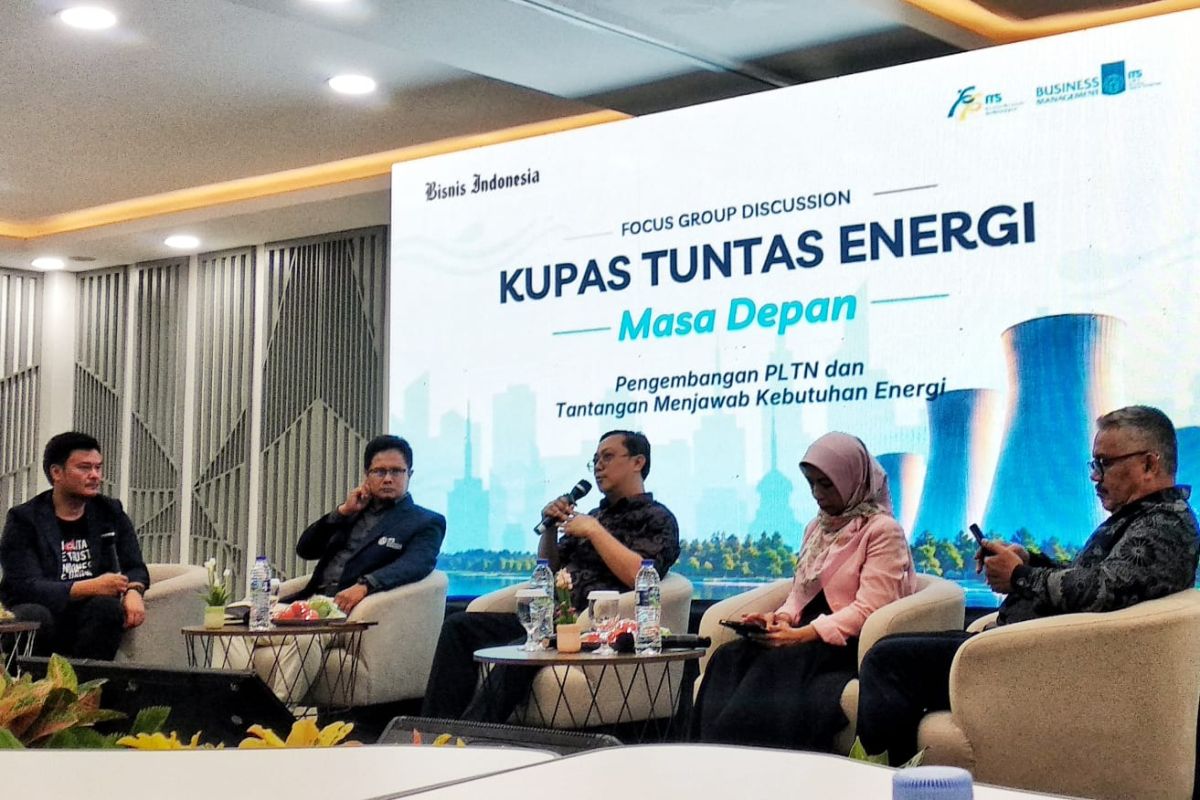
Surabaya, East Java (ANTARA) – Gogor Arif Handiwibowo, a lecturer in the Department of Business Management at the Sepuluh Nopember Institute of Technology (ITS), has called for the development of alternative energy sources, including nuclear power plants, to strengthen the resilience of Indonesia’s electricity supply.
Gogor said energy diversification could also help reduce dependence on fossil fuels over the long term.
“Diversification is necessary because around 60 per cent of the national electricity supply is currently still supported by coal-fired power plants,” he said in Surabaya, East Java, on Friday.
He explained that Indonesia’s coal reserves are expected to run out in about 30 years, making it necessary to develop other energy sources.
In his view, alternative energy sources should be planned for now so Indonesia has adequate power-generation options as the use of fossil fuels becomes increasingly limited, while also meeting growing electricity demand.
“Indonesia is also committed to achieving net-zero emissions by 2060. It is now 2026; in 30 years our coal will be gone. What will we do, and how will we account for that?” he said.
He also highlighted fluctuations in coal supplies for power plants, which are affected by market mechanisms, particularly when international commodity prices are more attractive than the domestic price, capped at US$70 per tonne.
To broaden the range of energy sources, Gogor said nuclear power plants could be considered as one option to complement Indonesia’s national electricity generation mix.
However, he cautioned that the choice of nuclear technology must take various long-term factors into account, as countries including Russia, Japan, South Korea, China, the United States and Canada are offering nuclear power technology to Indonesia.
He said the decision would involve more than building a power plant: it would also concern the sustainability of fuel supplies, financing arrangements and dependence on technological cooperation with partner countries.
“When we try to adopt a technology from a particular country, that inevitably raises questions about the future fuel supply and financing. From an economic perspective, consider the factors that could lock us in,” he said.
Gogor also cautioned that the development of small modular reactors (SMRs), with a capacity of around 250 megawatts (MW), requires comprehensive assessment, even though they are smaller than conventional nuclear power plants.
He said technological readiness, operating experience, the logistics ecosystem and the levelised cost of electricity (LCOE) were among the factors that needed to be considered before a choice was made.
“For example, if we choose a small modular reactor, it may be inexpensive because it is small, with a capacity of 250 megawatts. But its LCOE will certainly be high. It is a new technology, there are not many suppliers in the logistics chain, and it has not been widely proven. If a technology has not been widely proven, the economic ecosystem around it will certainly be costly,” he said.
Source: jawawa.id (https://jawawa.id/newsitem/its-urges-energy-diversification-to-safeguard-national-electricity-supply-1793361327)
Originally published by Antara (Indonesian) (https://www.antaranews.com/berita/5821895/its-dorong-diversifikasi-energi-untuk-jaga-pasokan-listrik-nasional), translated from Indonesian