
ITS Students Design 'Sanitary On The Go' for Public Sanitary Access
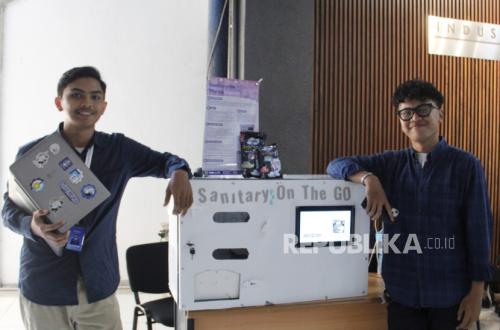
The availability of feminine sanitary products in public spaces still faces a number of challenges. Besides limited access, the purchasing process does not adequately support user privacy. Responding to this challenge, a team of students from Institut Teknologi Sepuluh Nopember (ITS) has developed Sanitary On The Go (SOTG), an automatic sanitary pad vending machine based on a smart system.
One member of the SOTG development team, Muhammad Fikri Kusumadinata, assessed that access to sanitary products in public spaces is not yet supported by a system that is fast and easy to reach. Seeing this condition, he initiated an innovation that combines automation technology with digital services. “Through SOTG, we are presenting a system that makes purchasing sanitary products easier without neglecting privacy,” said Fikri, as he is familiarly known.
Furthermore, Fikri explained that SOTG is designed as an automatic sanitary pad vending machine that integrates the Internet of Things (IoT). This system allows users to purchase sanitary pads via a touchscreen and then make payment using cashless methods. “The process is made simple so that users can obtain the product quickly,” explained the student from the Automation Electrical Engineering Department (DTEO), Faculty of Vocational Studies at ITS.
Technically, Fikri continued, the system is built using an architecture that connects the user interface, a local server, cloud services, and physical hardware. Fikri explained that all layers work in an interconnected manner. This allows transaction data, stock, and machine conditions to be monitored simultaneously and remotely.
Based on test results, the system showed relatively stable performance in the product dispensing process. Product dispensing time was recorded as taking place within a range of a few seconds with a good level of consistency. “In addition, data communication between subsystems also showed low latency,” he revealed.
Fikri assessed that the potential application of the innovation developed together with five colleagues is quite broad, particularly in educational environments, public facilities, and office areas. The presence of the machine can help provide easier access to sanitary pad products. “Especially in locations with high mobility,” he said.
Going forward, Fikri hopes that the development of SOTG can continue so that it has more adaptive features and is ready to be widely implemented. This innovation also supports the achievement of the Sustainable Development Goals (SDGs), particularly point 3 on Good Health and Well-being and point 9 on Industry, Innovation, and Infrastructure.