
ITB Welcomes 8,945 New Students from 38 Provinces and 21 Countries
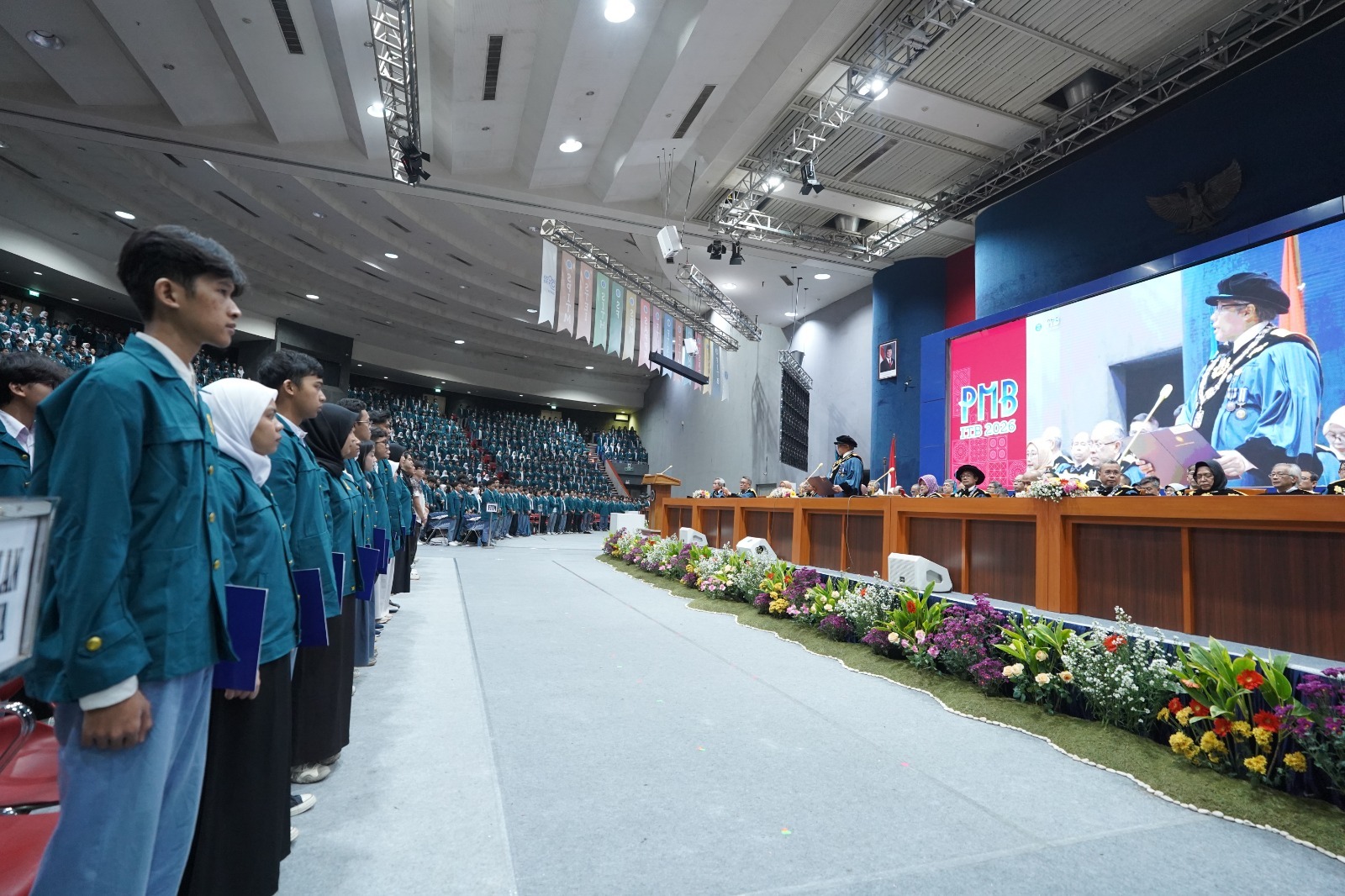
The Bandung Institute of Technology (ITB) has accepted 8,945 new students for the 2026/2027 academic year. The cohort comprises 5,468 undergraduate students, 1,947 master’s students, 563 doctoral students, and 967 professional programme students. The new student intake was announced during an open session at the Sasana Budaya Ganesa (Sabuga) in Bandung on Wednesday (5/8).
Vice Rector for Academic and Student Affairs, Prof. Dr. Irwan Meilano, stated that the new undergraduate students hail from all 38 provinces in Indonesia. He noted that ITB also admitted students through various affirmative action programmes to broaden access to higher education. ‘This year’s new ITB undergraduate students come from all 38 provinces in Indonesia. We also accepted 97 students from disadvantaged, frontier, and outermost regions, 10 students through the Higher Education Affirmation programme, and 28 Garuda Scholarship recipients,’ Irwan said. He added that 446 students are recipients of the Kartu Indonesia Pintar Kuliah (KIP-K) scholarship, with 198 of them coming from the lowest four economic deciles.
ITB also welcomed international students at both undergraduate and postgraduate levels. For the undergraduate programme, international students came from 21 countries, including the United States, China, India, Bangladesh, Pakistan, Nigeria, Kenya, Papua New Guinea, Timor-Leste, Yemen, Afghanistan, Angola, Myanmar, Somalia, Sudan, Tanzania, Tajikistan, Sierra Leone, Malawi, Madagascar, and South Sudan. Postgraduate international students originated from 20 countries, including Singapore, South Korea, Vietnam, the Philippines, Egypt, Chile, Ghana, Zimbabwe, and the Solomon Islands. Some of these students were accepted through the Developing Countries Partnership Scholarship and the Indonesian Aid Scholarship programmes.
Irwan explained that male students still dominate at the undergraduate, master’s, and doctoral levels. For the undergraduate programme, 57.7 percent are male and 42.3 percent are female, with a similar composition observed in the postgraduate programmes. ITB Rector Prof. Dr. Tatacipta Dirgantara welcomed all new students from diverse regions, cultures, and backgrounds. He emphasised that being accepted into ITB marks the beginning of a journey to develop academic abilities and build character. ‘I invite new students to think about what they will leave behind after completing their education at ITB. It should not be limited to a diploma or academic grades, but can be ideas, discoveries, works, or service that improve the lives of others,’ Tatacipta said.
He added that since its founding as Technische Hoogeschool te Bandoeng in 1920, ITB has aimed not only to produce graduates but also to nurture figures who make real contributions to the nation. This spirit, he noted, is reflected in the journeys of alumni such as Ir. Soekarno, Ir. Djuanda Kartawidjaja, Prof. Roosseno Soerjohadikoesoemo, Prof. Iskandar Alisyahbana, Prof. Subagyo, and Nyoman Nuarta. ‘I encourage new students to dare to learn, ask questions, try, face failure, and dream big. Every great history begins with someone deciding that their life must be useful to others throughout the ages,’ he said. The open session also featured scientific orations from SBM ITB lecturer Muhammad Yorga Permana, titled ‘Technology Changes, Humans Must Continue to Grow’, and SITH ITB lecturer Dr. Eng. Kamarisima, who presented ‘Cocoa Fermentation: The Secret Behind the Delight of Chocolate’.