
ITB Students Develop AI for Waste Recycling
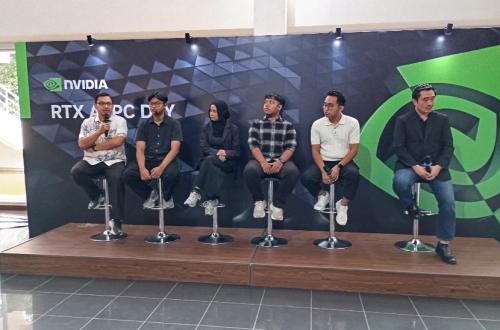
BANDUNG — Three students from the Bandung Institute of Technology (ITB) have developed artificial intelligence (AI) prototypes to address challenges in industry, ranging from waste recycling and worker safety to logistics. The technology is designed to detect contaminants during paper recycling, monitor workers’ ergonomic risks and anticipate temperature disruptions in the distribution of refrigerated goods.
The three projects use computing technology to develop AI models for industrial applications. They were developed using an ASUS ROG Strix G16 laptop equipped with an NVIDIA GeForce RTX 5070 Laptop GPU to accelerate model training and system testing.
ITB School of Electrical Engineering and Informatics student Izhar Alif Akbar developed REBA.ai, a computer vision system that uses CCTV footage to monitor ergonomic risks for factory workers. The technology is designed to assess workers’ postures against the Rapid Entire Body Assessment (REBA) standard.
The system enables potential risks arising from working positions to be monitored continuously. Although AI performs the analysis, final decisions on worker safety remain with human supervisors.
During development, GPU acceleration helped speed up model training and machine-learning experiments. Shorter processing times allowed the developers to conduct more tests and improve the system’s capabilities.
Meanwhile, ITB student Tsabita Khoirunnisa developed ColdTrack AI to help manage cold chains in the logistics sector. The system uses telemetry data from refrigerated trucks to forecast changes in cargo temperatures and detect potential disruptions during delivery.
ColdTrack AI is also designed to estimate how long it will take for cargo temperatures to exceed safe limits. Based on its analysis, the system produces a cargo risk index, determines the status of the load and recommends actions according to the level of risk.
In waste management, Muhammad Taufiq Al Fikri developed RecycledFiberAI to assist with paper recycling. The computer vision prototype is designed to detect and map contaminants, such as plastic and metal, in streams of recyclable paper materials in real time.
The technology is expected to help identify contaminants and make the processing of recycled materials more effective. GPU acceleration is also used in developing the AI model to support visual data processing.
NVIDIA Indonesia Country Consumer Business Lead Adrian Lesmono said AI computing technology could help students develop solutions to industrial problems. Access to computing hardware enables experimentation and model development to be carried out more efficiently.
“NVIDIA acts as a catalyst connecting industry and education to accelerate AI innovation,” Adrian said during a recent visit to ITB.
According to Adrian, proficiency in AI needs to be accompanied by an understanding of the problems it is intended to solve. The technology is not a substitute for human capabilities, but a means of developing solutions based on people’s knowledge and skills.
“Through technology support and access to AI computing, NVIDIA encourages students to experiment, develop their skills and transform from users into creators of AI solutions,” he said.
Adrian added that developing AI skills is important so students do not merely use existing technology, but can also build systems suited to the needs of society and businesses.
“We want to encourage more students to become AI builders capable of producing innovations relevant to society and industry,” he said.
The three prototypes were developed in connection with RTX AI PC Day, organised by NVIDIA, ITB and several computer-manufacturer partners. The event involved ASUS, Acer, Axioo, Colorful, Gainward, GIGABYTE, Lenovo, MSI and Palit to introduce students to the use of AI computing.
The event gave students the opportunity to explore AI applications for a range of industrial problems. The three projects demonstrate the technology’s potential to support workplace safety, logistics management and materials recycling.