
ITB Students Complete Exchange Programme at Central South University
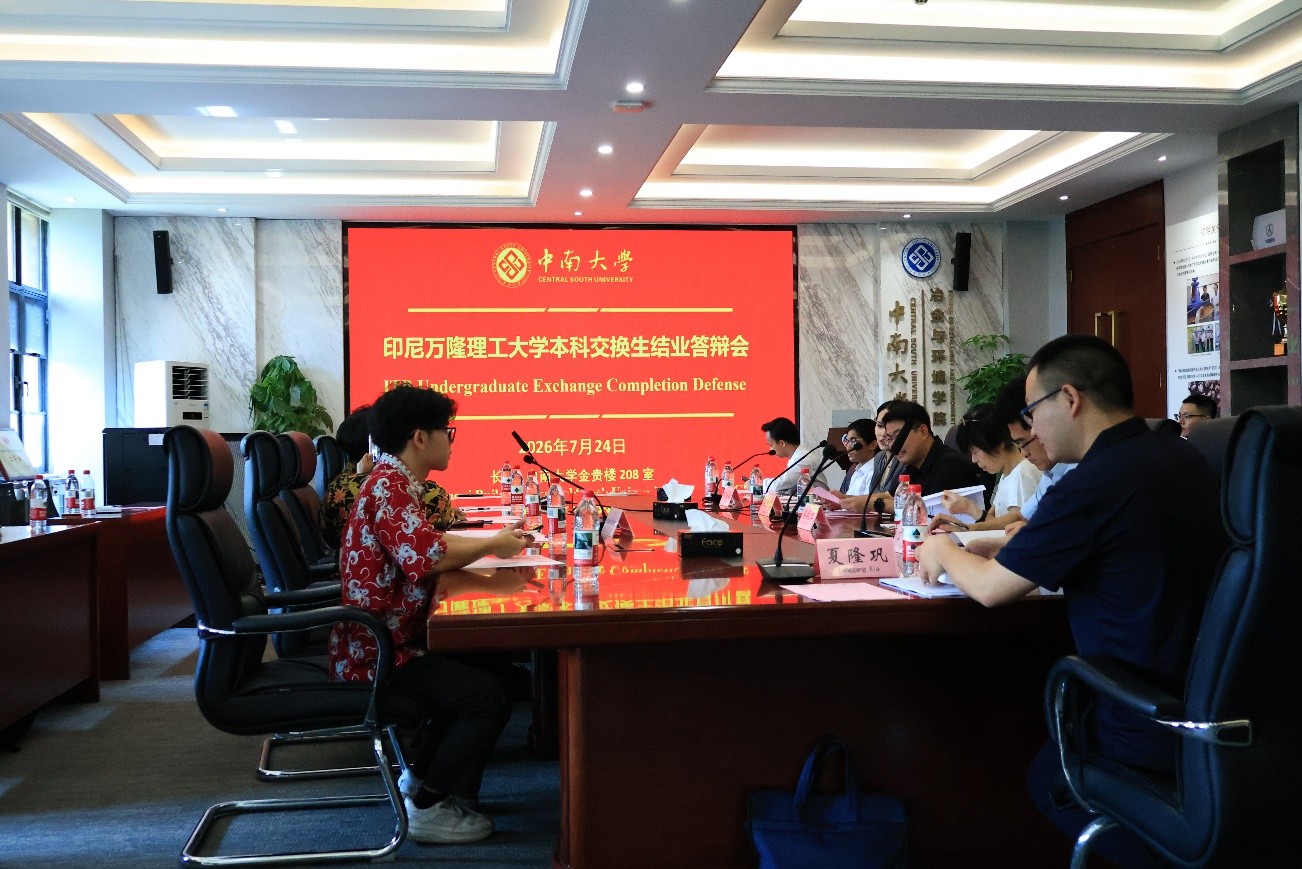
Two students from the Bandung Institute of Technology (ITB), Thaufik Widjaya and Mochammad Zakky Rayhan Zahrandany, have completed a five-month exchange programme, presenting their research findings at a final examination at the School of Metallurgy and Environment, Central South University (CSU), China’s leading metallurgy campus, on Friday (24 July).
The examination was attended by Qin Yihong, Head of the Undergraduate Education Supervisory Committee Development Group at CSU; Wang Qinmeng, Deputy Dean of the School of Metallurgy and Environment; and He Jiamin from the Academic Affairs Office, along with lecturers and student representatives from the Heavy Metallurgy Research Institute. Imam Santoso of ITB, accompanied by nine Indonesian students, attended as invited delegates. The event was supported by the CSU International College and led by Associate Professor Xia Longgong.
Imam Santoso, the supervising lecturer of Thaufik Widjaya and Mochammad Zakky Rayhan Zahrandany, on Tuesday (28 July) expressed his appreciation to CSU, the School of Metallurgy and Environment, and the Complex Materials Metallurgy and Slag Chemistry (CMSC) research group for their academic guidance, hospitality, and comprehensive support throughout the programme.
“This experience not only strengthened the students’ research capabilities and produced final projects and collaborative research outcomes, but also fostered independence, global insight, and cross-cultural teamwork skills,” he said.
Imam expressed hope that the achievements of this first cohort would form the foundation for a stable and mutually beneficial undergraduate exchange programme in the years ahead.
OPENING SPACE FOR COOPERATION
Wang Qinmeng noted that technological development and industrial transformation are opening up ever broader opportunities for international cooperation. ITB and CSU have significant potential to deepen their synergy in education, scientific innovation, and talent development in the field of metallurgical engineering.
Cooperation between ITB and CSU has been ongoing for eight years and has produced various achievements. The two universities, together with GEM Group, have established a joint research and development centre in the fields of hydrometallurgy and new energy materials.
“CSU has also educated more than 100 master’s and doctoral students in metallurgical engineering from Indonesia. This undergraduate exchange programme is an important step towards sustainably extending that cooperation to the undergraduate level,” he explained.
The two students delivered their academic presentations before responding to questions and feedback from an expert panel. Thaufik Widjaya presented research entitled “Fundamental and Technological Research on Self-Promoted Desulfurization of Complex Lead Sulfate-Calcium Sulfate Materials at 750 °C under Air Atmosphere”. Meanwhile, Mochammad Zakky Rayhan Zahrandany presented research entitled “Fundamental Research on a Novel Pyrometallurgical Process for Complex Tin-Lead Secondary Materials: A Regulation Strategy of Stepwise Fluxing and Gradual Reduction”.
Both presented their research in a coherent, logical, and systematic manner, and fielded the panel’s questions well. The presentations received positive appreciation from the assessment committee. To mark the completion of the programme, Prof. Wang Qinmeng and Prof. Qin Yihong presented certificates of completion for the exchange study to both students.
THE STRATEGIC VALUE OF COLLABORATION
Qin Yihong considered the programme to demonstrate the strategic value of ITB-CSU collaboration through the combination of academic excellence, research platforms, and academic resources. He expressed hope that cooperation between the two universities would continue to expand through student mobility, lecturer exchanges, joint research, and the development of young talent in the field of metallurgy.
“The conclusion of this first exchange cohort does not mark the end of ITB-CSU educational and research cooperation, but rather a new beginning for deeper, more concrete, and more sustained collaboration,” he explained.