
ITB Peduli NTT Builds Emergency Shelters and Maps Post-Earthquake Needs
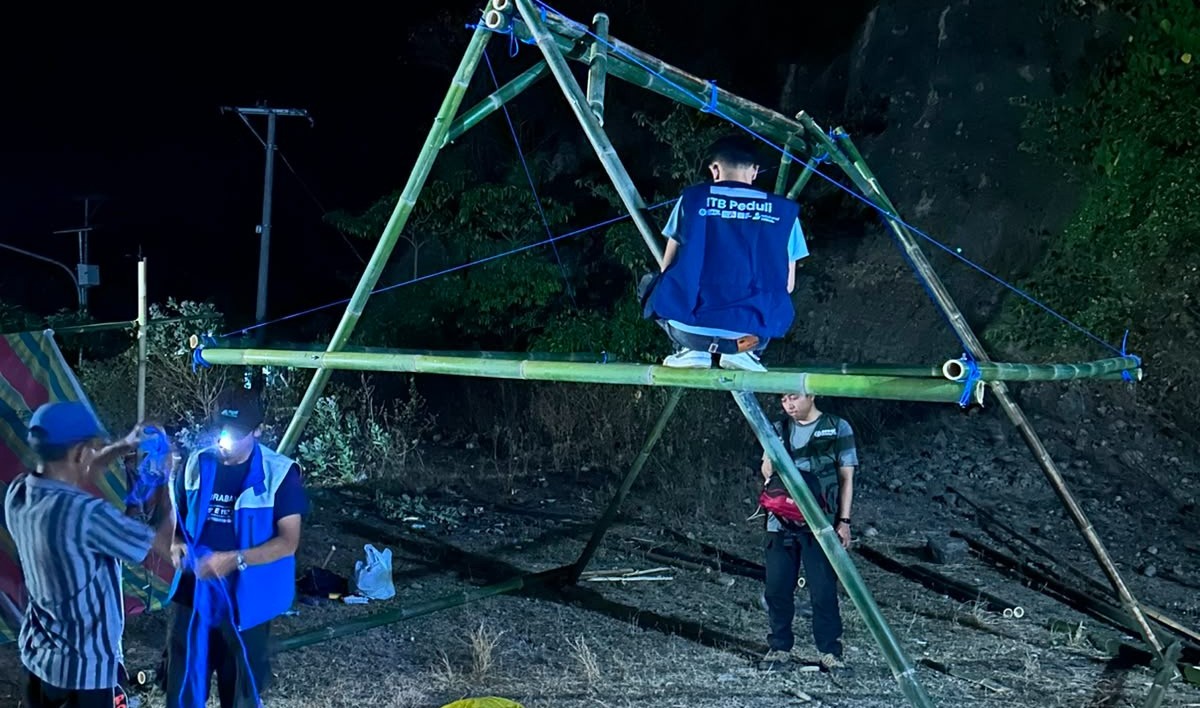
Institut Teknologi Bandung (ITB), through its ITB Peduli programme, carried out a humanitarian mission in several earthquake-affected areas of Nusa Tenggara Timur (NTT) from 17 to 21 August 2026. The team assessed the condition of the region and its infrastructure, built ten emergency family shelters, and distributed tents and logistical aid to affected residents in Manggarai and Manggarai Timur regencies.
Director of Community Service and Expertise Services Prof. Dr.-Ing. Zulfiadi explained that the mission was undertaken to assist communities still facing the impact of the earthquake and thousands of aftershocks. These impacts range from damage to buildings and public facilities, limited temporary housing, a clean water crisis, scarcity of fuel oil, to disrupted transport access due to landslides.
The programme involved collaboration among various elements, namely the Directorate of Community Service and Expertise Services (DPMK) ITB, the ITB Alumni Association (IA ITB), the ITB Parents Association (IOM ITB), the ITB Student Family (KM ITB), the Salman Mosque Development Foundation ITB, and Rumah Amal Salman.
‘The delegation that went directly to the affected areas consisted of Dr.rer.nat. David Prambudi Sahara, Awal Wahyu Rahmadi from DPMK ITB, as well as Ir. H. Mipi Ananta Kusuma, Wahid Satria Y., and Jajang from Rumah Amal Salman,’ he explained on Monday (24/8).
According to Zulfiadi, on site the team coordinated with the Central Command Post of the National Disaster Management Agency (BNPB). This coordination was carried out to map priority areas requiring immediate handling while aligning aid distribution in the field. From Labuan Bajo, the team travelled overland to Reo District in Manggarai Regency and the Roting area in Manggarai Timur Regency.
‘At these locations, the rapid response team led by Ir. H. Mipi Ananta Kusuma together with Wahid Satria Y. and Jajang built ten units of emergency family shelters or tents with bamboo structures,’ he said.
Zulfiadi stated that the shelters adapted a rapid-build design by Dr.-Ing. Andry Widyowijatnoko from the School of Architecture, Planning and Policy Development (SAPPK) ITB. The design utilises local bamboo so that it can be built relatively quickly while also allowing for independent replication by communities together with BNPB, the Regional Disaster Management Agency (BPBD), and volunteers.
‘In addition to providing direct assistance, the ITB team conducted an assessment of the condition of the affected areas. From field observations, the team found that the level of damage caused by the earthquake is not always directly proportional to a region’s distance from the main epicentre,’ he stressed.
Zulfiadi added that a number of severe damages were found on the north coast of Manggarai and Manggarai Timur regencies, which are relatively far from the centre of the M7.7 earthquake around Mbay. In Reo and Roting districts, the series of aftershocks occurring thousands of times has meant residents still have to live in emergency tents.
‘The series of missions on 17–21 August 2026 is the first step of the ITB Peduli NTT programme. The assessment data and field findings will subsequently be used as a basis for determining the form of follow-up support, particularly regarding shelter rehabilitation, clean water provision, and the restoration of public facilities for the Flores community on a sustainable basis,’ he continued.