
ITB Holds CDT Carnival 2026 to Develop New Students' Character
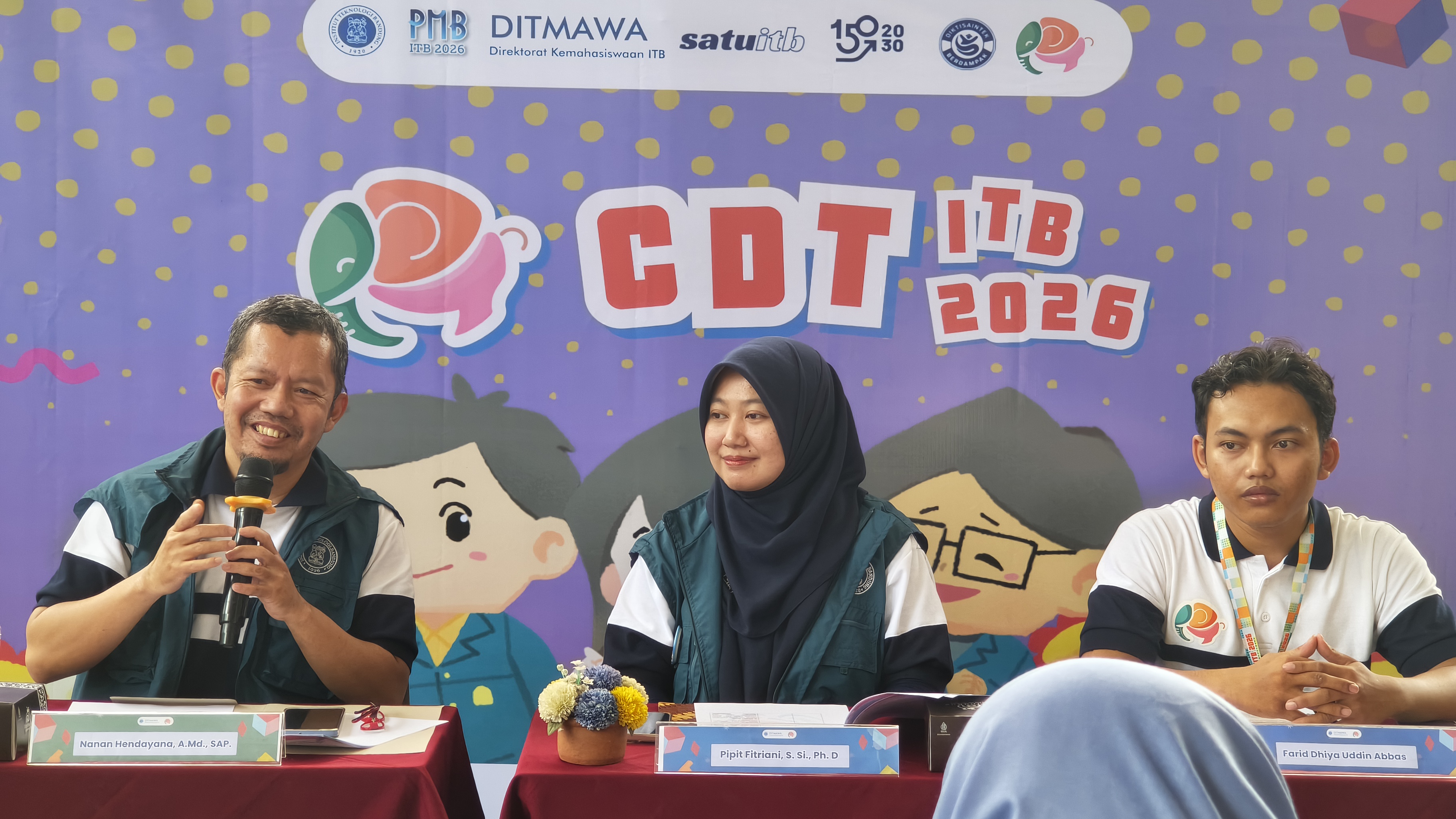
Institut Teknologi Bandung (ITB) considers the AIR character values, comprising Adaptive, Integrity, and Resilience, to remain relevant for students amid the development of artificial intelligence (AI), social media, and increasingly rapid technological change.
Head of the ITB Student Character Development Sub-directorate, Pipit Fitriani, at the Character Development Training (CDT) Carnival for new ITB 2026 students at the Jatinangor Campus on Saturday (15/8), explained that the AIR values were formulated through a process involving various stakeholders, ranging from lecturers with an interest in student activities and character development, to coaching teams, partners, and student representatives.
“In conceptualising AIR, we invited stakeholders at the time, such as lecturers who genuinely have an interest in student activities and character development. Then also from the coaching team, partners, including student representatives,” she explained.
Pipit said the formulation was carried out to identify character values that are not only relevant today but also capable of withstanding changing times. “We tried to formulate what values are most important and will always be relevant going forward. These three values emerged, namely AIR,” she asserted.
According to Pipit, technological developments such as AI do not diminish the relevance of these values. On the contrary, technological change means the application of AIR values needs to be interpreted more broadly. In the context of AI use, for example, students are required to be able to adapt to technological advances. This ability does not only mean being able to use AI, but also being able to utilise it responsibly.
“This means adaptation involves being able to use it, being able to utilise it, but still having integrity so that its use remains for good purposes and can be accounted for,” she said.
Pipit added that changing times affect how AIR values are applied rather than altering the substance of the values themselves. “So fundamentally, the AIR values remain relevant. The context remains the same even though times have changed. However, we can define them more broadly.”
Pipit further noted that in addition to running character development programmes, ITB is also developing instruments to measure the extent to which these programmes succeed in shaping student character. The number of students involved in an activity can indeed serve as one indicator of success. However, participation figures cannot yet illustrate whether students have truly experienced character development, such as becoming more adaptive.
“If we hold a large event like this, one parameter of success might be how many students are involved. But from the perspective of character values, whether they have truly become adaptive or not, we do not yet know,” she added.
For this reason, Pipit said ITB is collaborating with psychologists to develop tools for measuring student character. These instruments are expected to provide a more measurable picture of participants’ character development.
Measurement is not only conducted through main activities but also through monitoring stages after activities take place. At the assessment stage, student character development will be measured in a more quantified manner, particularly for undergraduate (S1) students.
“This approach is important so that the success of character development programmes is not only seen from the implementation of activities or the number of participants, but also from measurable character changes. With the development of these instruments, ITB hopes that the implementation of AIR values can continue to be adapted to the challenges facing the younger generation, including addressing the development of AI and increasingly dynamic technological change, without losing the character foundation that is the main goal of the programme,” she continued. (E-2)