
ITB Geological Engineering Team Wins Imperial Barrel Award
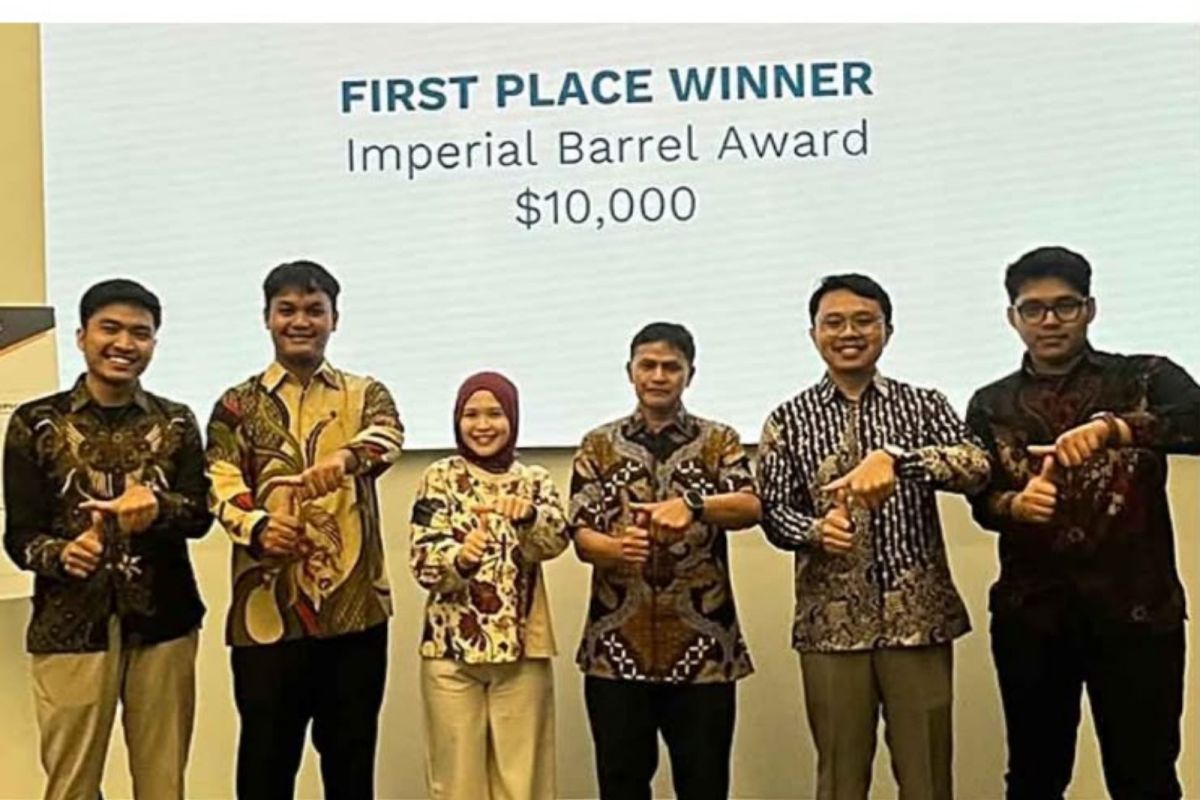
A team from the Geological Engineering programme at Institut Teknologi Bandung (ITB) has won the Imperial Barrel Award (IBA) 2026, a prestigious international competition organised by the American Association of Petroleum Geologists (AAPG). According to a press release from the Embassy of the Republic of Indonesia in Washington received on Thursday (20/8), the award was presented on Monday, 17 August 2026, coinciding with the celebration of Indonesia’s Independence Day, during the AAPG IMAGE 2026 conference in Houston, Texas, USA. In addition to the title, the ITB team received a prize of USD 1,000 (approximately Rp17.8 million).
Indonesia’s Ambassador to the United States, Indroyono Soesilo, who is also an alumnus of ITB’s Geological Engineering programme, welcomed the victory. ‘May this win inspire other Indonesian students and serve as a gateway to success and brilliant professional careers in Indonesian petroleum geology,’ said Indroyono.
The ITB Geological Engineering team consisted of five postgraduate students: Arieq Bagus Putradinanti, Dinda Putri Khamisah, Mohammad Maghanthis Taqy, Fathan Khoiri Nujaih Siregar, and Hammam Muhammad, under the supervision of Prof. Benyamin Sapiie. The victory is regarded as evidence that Indonesian students have the capacity to compete on the world’s academic and professional stage.
The Imperial Barrel Award demands not only mastery of geological theory but also analytical sharpness, the ability to read and integrate subsurface data, teamwork, and the capacity to present scientific arguments effectively before experts and industry practitioners. The award was established in 1976 by Imperial College London, one of the world’s leading institutions in science, technology, and engineering. The term ‘Imperial’ refers to that institution, while ‘barrel’ is a unit closely associated with the oil and gas industry.
From the outset, the competition has been designed to hone geoscience students’ abilities in evaluating subsurface energy resource potential. Participants from various universities receive a subsurface data package that may include seismic data, oil and gas well information, regional geology, and geochemical elements. This data must then be analysed to produce interpretations regarding resource potential, geological risks, and development recommendations.
The challenge requires participants to work like a professional team. They must divide roles, integrate various types of data, construct technical arguments, draw conclusions within a limited time, and present them convincingly before a jury of experts and practitioners. The IBA is therefore considered important for shaping future geoscientists entering various energy sectors. The competencies honed in this competition are relevant not only to the oil and gas industry but are also increasingly important in geothermal development, carbon capture and storage (CCS), and other fields requiring deep understanding of subsurface conditions.
The ITB team’s victory also carries broader significance for Indonesia. As a country with extraordinary geological complexity, Indonesia has numerous sedimentary basins, hydrocarbon resources, geothermal potential, and tectonic dynamics that require excellent human resources. These natural riches cannot be supported by physical resources alone. Indonesia needs a generation of scientists and professionals capable of understanding theory, processing data accurately, assessing opportunities and risks, and making science-based decisions. ITB’s achievement in Houston demonstrates that such capacity is growing in Indonesia. Indonesian students have proven able to read subsurface structures, evaluate resource potential and exploration risks, and communicate their analytical results in an international forum that brings together the best talents from various countries.