
ITB Expert Optimistic That 2027 Oil Lifting Target is Achievable, Community Wells Could Provide Support
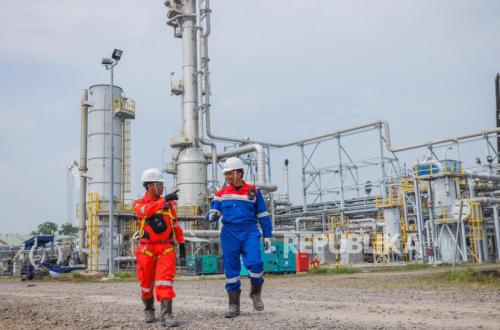
Bonar Tua Halomoan Marbun, a Professor at the Faculty of Mining and Petroleum Engineering, Bandung Institute of Technology (ITB), believes that the national oil lifting target of 612,500 barrels of oil per day (bopd) by 2027 is a realistic goal. According to Bonar, this target can be achieved provided that production increases follow the standards, experience, and best practices prevalent in the international oil and gas industry.
“If asked whether the target to increase lifting to around 612,000 barrels of oil per day is sensible, the answer is yes, it makes sense,” Bonar stated when contacted on Thursday (3/9/2026).
The government has proposed an oil lifting target of 612,500 bopd for 2027, an increase from the 2026 target of 610,000 bopd. Meanwhile, the gas lifting target for 2027 is set at 954,000 barrels of oil equivalent per day (boepd), a decrease from the 2026 target of 984,000 boepd.
Optimism regarding the increase in lifting is supported, in part, by the programme to organise and optimise community oil wells. The Chairman of Commission XII of the Indonesian House of Representatives (DPR RI), Bambang Patijaya, previously estimated that production from community wells could increase by up to approximately 30,000 bopd if the programme, which began in 2026, can be optimised in 2027.
Bonar noted that community wells could indeed serve as an additional source of national oil production. Currently, he noted, production from active community wells is around 2,000 bopd. Although its contribution remains relatively small compared to national production, increasing output from this sector remains a positive step.
“If asked whether this programme is good, it is certainly good from a generally positive perspective,” said Bonar.
According to Bonar, opportunities to increase lifting also remain open in mature or ‘brownfield’ oil fields. Several national oil and gas fields have experienced declining reserves, but such conditions are common in the global oil and gas industry and do not mean that their production potential has been exhausted.
He assessed that old fields still possess reserves that can be optimised through proper technology, governance, and production practices. Increasing production from brownfields can run alongside the optimisation of community wells and the implementation of new technologies.
This aligns with the strategy of the government and the DPR, which encourages the application of Enhanced Oilting Recovery (EOR), workover activities on old wells, and the resolution of operational constraints in several oil and gas working areas. Bambang Patijaya mentioned that several production issues, including those at Pertamina Hulu Rokan, are being resolved to ensure more optimal production in 2027.
Previously, the Chairman of Commission XII of the DPR RI, Bambang Patijaya, revealed that the optimism regarding the 2027 oil lifting target is supported by a series of government acceleration programmes. He noted that one of the key strategies relied upon to boost national oil production is through the optimisation of the management and organisation of community oil wells.
“Essentially, the government has programmes to accelerate this lifting, including the empowerment of community wells. These community wells were activated in 2026. Based on current developments and planning, these community wells could be optimised in 2027, with an estimated increase of perhaps 30,000 barrels,” said Bambang.
Bambang believes the target is realistic as various technical and operational obstacles that previously hindered production in several major oil and gas Working Areas (WK) are being resolved. He noted that the handling of operational issues, such as those at Pertamina Hulu Rokan (PHR), is proceeding according to the resolution plan for this year.
“Furthermore, several obstacles, such as those in PHR related to gas issues and so on, have been overcome, so there will be optimisation in 2027,” he explained.
In addition to the optimisation of community wells, Bambang mentioned that the application of the latest technology continues to be expanded by production sharing contract contractors (KKKS). The implementation of Enhanced Oil Recovery (EOR) methods and workover activities on old wells are being intensified to significantly boost lifting achievements.
“Additionally, several technological innovations, such as EOR and workovers, are being increased in implementation. Therefore, it is hoped that this will relate to increasing our lifting in 2027,” he concluded.