
ITB Expert: Modern Underground Mining More Environmentally Friendly
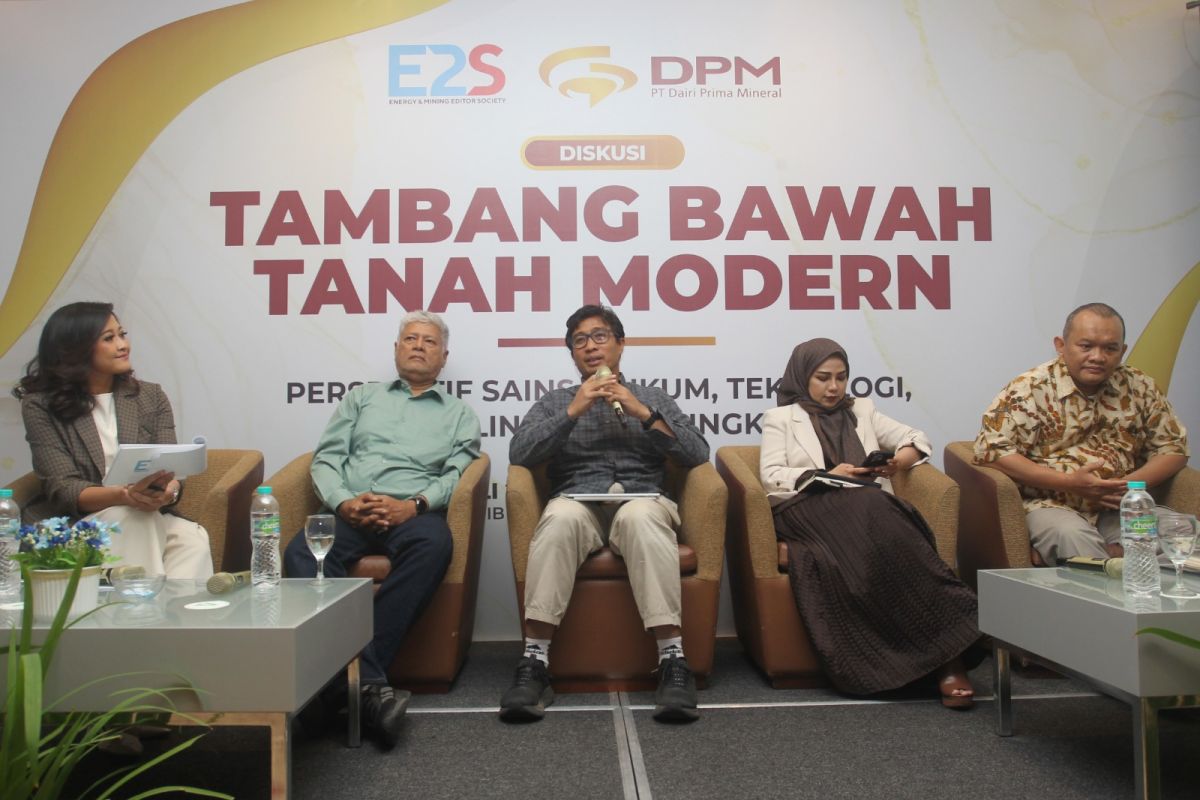
Jakarta (ANTARA) - Dr Irwan Iskandar, an expert from the Institute of Affiliation for Researchers and Industry (LAPI) at the Bandung Institute of Technology (ITB), considers modern underground mining advantageous because it requires far less surface space than open-pit mining, making it more environmentally friendly.
“The positive aspect of underground mining is that the footprint of damage or disturbance on the surface is small. We need surface space for housing, agriculture and other activities, and with underground mining the disruption is far smaller. This is a positive step that can be described as modern underground mining,” Irwan said at a discussion on underground mining organised by the Energy Editor Society (E2S) in Jakarta on Monday.
According to Irwan, another aspect that distinguishes modern mining practice is the management of processing residue (tailings). Whereas tailings were previously placed in tailing dumps, underground mining companies now return them to former mine voids (backfill).
“The modern and tactical approach is that processing residue is placed back into the mine rather than in a tailing dump. Tailing dumps carry risks because after mining ends, the material remains there indefinitely. We have learned from various mining disasters around the world, including the one in Brazil in 2019,” he said.
Irwan stressed that all mining activities inevitably have an environmental impact. However, he said the most important thing is how that impact is managed through the application of appropriate technology and oversight.
“Mining has impacts. They must be understood, but they must also be manageable. One of the most important issues is water, both surface water and groundwater,” he said.
He explained that in underground mining, the main concern is no longer the existence of tailing dumps or mine openings at the surface, but rather groundwater management. One of the biggest changes in environmental documentation, Irwan added, is the decision to convert tailing disposal systems to backfill systems.
According to him, this step provides significant benefits in reducing the potential formation of acid mine drainage.
“The significant change is converting the system from tailing dump to backfill. In addition, around 32 per cent of sulphur was successfully recovered. If that sulphur were not extracted, it would potentially form acid mine drainage,” Irwan explained.
Even so, around seven per cent of sulphur content remains. To prevent oxidation that could trigger acid mine drainage, the material is mixed with cement and lime before being returned to the mine tunnels.
Irwan said the global mining industry is also beginning to move away from conventional tailing dumps following a number of tailing dam failures in various countries.
Many companies have now switched to dry stack tailing technology or backfill systems, which are considered safer and have a smaller land footprint. There are indeed additional costs and technology involved, but the area footprint is far smaller. This technological shift represents a transition from the old system to a more efficient one.
Another speaker, Widianto, Technical Manager of PT Dairi Prima Mineral (DPM), said the mining company has already applied the backfilling mining concept in its underground operations, prioritising worker safety and environmental protection.
The main advantage of this mining concept is the minimal land clearing at the surface, so forests and ecosystems remain preserved.
He emphasised that the backfill tailing system at the mine, located in Dairi Regency, North Sumatra, not only serves to maintain the stability of the mining area but also supports environmental protection and regulatory compliance.
Through this system, backfill material is used to fill empty voids left by mining in order to strengthen rock mass, reduce the risk of collapse, ensure worker safety, and protect groundwater quality through regular monitoring and documented reporting.
“All these efforts are undertaken to ensure that mining activities run safely, comply with regulations, and support the sustainability of mine operations,” Widianto said.