
ITB Expert: Geothermal Development Must Be Matched by Public Education
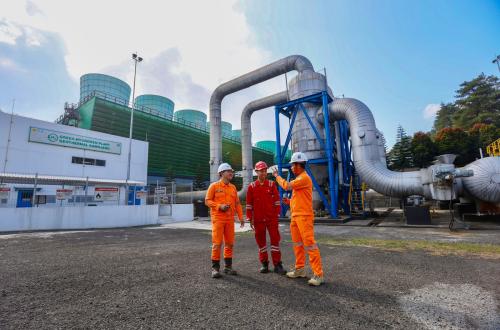
JAKARTA — Geothermal energy use in Indonesia remains far below the country’s available potential. Of an estimated 23.2 gigawatts (GW), only about 2.78 GW of geothermal power plant (PLTP) capacity is in operation. Prof. Lambok M. Hutasoit, a hydrogeology expert at the Bandung Institute of Technology (ITB), said geothermal development should go hand in hand with public education about safety and environmental management.
Lambok said Indonesia had substantial geothermal potential because it lies in the Pacific Ring of Fire. West Java is one of the regions with abundant geothermal resources, although several other provinces also have similar potential.
“Indonesia’s geothermal potential is enormous. West Java is one of the regions with the greatest potential. Other provinces also have geothermal resources, so there is still a great deal that can be developed,” Lambok said in an interview on Friday (16 October 2026).
He said public education was an important part of developing geothermal power plants, particularly in addressing concerns about the impact of geothermal activity on groundwater availability. Geothermal reservoirs, which provide the energy source, are generally located in rock layers separate from the shallow aquifers that supply water for household use.
“Geothermal reservoirs and groundwater aquifers are mostly not directly connected. So it cannot simply be assumed that using a geothermal reservoir will automatically draw away the groundwater above it,” Lambok said.
Nevertheless, he stressed that any connection between geothermal reservoirs and aquifers should be investigated in light of the geological conditions in each area. Underground rock formations vary: some allow water to pass through, while others impede the movement of fluids.
Developers therefore need to understand local geology and explain the geothermal system to the public. This should include the arrangement of rock layers, the location of the reservoir being used and environmental management measures to minimise risks.
Lambok also said geothermal drilling to depths of around 2,000 metres still takes place within the Earth’s crust. That is relatively shallow compared with the distance to the Earth’s core, which is thousands of kilometres.
“Compared with the structure of the Earth as a whole, a depth of 2,000 metres is insignificant. The distance to the Earth’s core is thousands of kilometres,” he said.
Geothermal developers also use reinjection, returning the fluid left over from production to the reservoir. This helps maintain reservoir pressure so that energy production can continue sustainably.
“That method is very helpful. It is recommended and should be carried out by geothermal developers to maintain reservoir pressure — what is known as pressure maintenance,” Lambok said.
He also emphasised the importance of protecting water recharge areas. In his research at Wayang Windu, West Java, Lambok used water-isotope analysis to identify recharge zones. The findings can help developers understand the hydrological system around geothermal operations.
Geothermal power development in Indonesia includes the Kamojang site in West Java. The plant has operated commercially since 1983 and now has five units with a total installed capacity of 235 megawatts (MW).
Tina Talisa, Special Staff to the Vice-President and a commissioner at Pertamina Patra Niaga, previously visited the Kamojang site to observe geothermal electricity production, including water management and drilling systems.
In a post on her personal Instagram account, Tina said Kamojang showed that geothermal energy development could coexist with nearby communities and the environment.
“Kamojang is not just a story about a power plant. For decades, geothermal development here has grown alongside the surrounding community and environment,” Tina wrote.
Lambok estimated that Indonesia currently uses around 10 per cent of its total geothermal potential. He said the scale of the resource offered an opportunity to increase geothermal energy’s contribution to the national energy supply.
However, expanding geothermal power capacity must be accompanied by transparent information about geological characteristics, production processes and environmental risk management. With sufficient understanding, communities should be able to assess geothermal development based on the conditions and technical studies for each area.