
ITB Expert Explains How Ash from Anak Krakatau Eruption Reaches Bandung
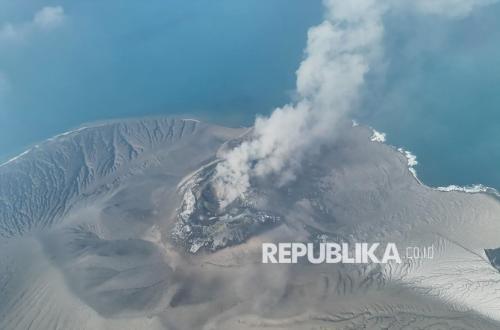
Professor Asep Saepuloh, a Professor at the Bandung Institute of Technology (ITB), has highlighted several unique characteristics of Mount Anak Krakatau, which has been erupting since last week. One notable feature is that a large portion of the volcano’s structure is submerged in the sea.
Furthermore, the magma source within the volcano remains active and operates on an open system. He noted that this condition differs from other volcanoes, such as Mount Merapi, which possesses a volcanic plug or blockage at its summit.
“Krakatau generally operates on an open system, so as soon as there is a magma supply from below, new magma exits immediately. It is therefore unsurprising that the eruption type reported by the PVMBG and eyewitnesses is Strombolian,” Professor Asep stated during a recent interview.
He explained that the Strombolian type is an eruption caused by magma that is fluid or medium-viscosity rather than thick. Professor Asep noted that dangerous eruptions typically involve thick magma, which struggles to flow to the surface and must instead destroy the volcanic cap above it.
“Theoretically, what comes from below flows directly out. Because the gas content in Krakatau’s magma is quite high, the discharge resembles a fountain, known as a lava fountain. It jets out like a fountain because the supply is continuous, allowing eruptions to occur periodically as energy is released from below,” he said.
He mentioned that Strombolian-type eruptions usually carry low to moderate risks because they are not accompanied by highly destructive explosive events. Additionally, the height of Strombolian eruptions can be predicted.
“Usually, it erupts slightly at first, gradually reaching its highest peak before ceasing, only to potentially resume in a different phase, perhaps in the following year,” he added.
However, he questioned why the current eruption of Anak Krakatau reached a height of 15 kilometres, whereas Strombolian types typically only reach hundreds of metres or up to two kilometres. “Upon further study, Krakatau grows on the seabed with much of its body submerged in water, which is a fascinating factor. Water is highly reactive when in contact with heat. This is the key: water reacts intensely to heat. The heat comes from the fluid magma, which can reach temperatures of 1,000 to 1,200 degrees Celsius—intense enough to melt materials,” he explained.