
ITB and IPB Develop Portable FADs to Boost Toli-Toli Fishermen's Catch
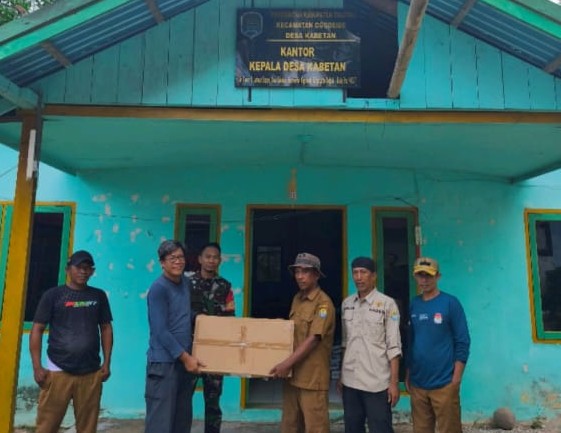
Institut Teknologi Bandung (ITB) together with IPB University have developed portable fish aggregating device (FAD) technology based on sound attractors to increase the catch of fishermen in Kabetan Village, Toli-Toli Regency, Central Sulawesi. The technology was implemented through a community service programme running from October 2025 to July 2026. The programme, titled Intensification of Portable FAD Technology and Fishing Gear Application to Increase Fishermen’s Catch in Kabetan Village, was funded by ITB’s Directorate of Community Service and Expertise Services (DPMK). The activity was led by Sri Raharno from the Faculty of Mechanical and Aerospace Engineering (FTMD) ITB together with Indria Herman, and collaborated with Roza Yusfiandayani from the Department of Fisheries Resource Utilisation, Faculty of Fisheries and Marine Science, IPB University. The programme also involved doctoral and undergraduate students from ITB’s Mechanical Engineering programme. Kabetan Village is an island area where the majority of residents work as fishermen. Until now, fishing activities have still used simple technology and been carried out in shallow waters, so the catch is dominated by reef fish with relatively low economic value. Meanwhile, the potential for pelagic fish with higher economic value has not been optimally utilised. To overcome this problem, the team developed a portable FAD based on a sound attractor designed to gather pelagic fish around the fishing location. This device is made to be easy to assemble and maintain, and capable of operating at depths of up to 30 metres, making it suitable for the needs of fishermen in island regions. Before being implemented in Kabetan Village, the technology first underwent field tests. The test results showed that the use of portable FADs was able to increase the quantity of catch while expanding the variety of fish species obtained by fishermen. These findings became the basis for design improvements before wider implementation. In June 2026, the team carried out the technology implementation in Kabetan Village through the handover of fishing equipment assistance, training on the use of portable FADs, mentoring for fishermen, and the installation of supporting facilities for the community. The assistance distributed included six units of portable FADs based on sound attractors, 23 packages of monofilament gill nets, 10 packages of hand lines, and five units of solar-powered street lamps. In addition to receiving equipment assistance, fishermen also received training on the installation, operation, and maintenance of portable FADs, including the use of more effective and environmentally friendly fishing gear. Mentoring was provided so that the introduced technology could be utilised independently and sustainably. The Head of the Implementation Team, Dr. Sri Raharno, said the programme not only aims to increase fish catches but also to strengthen the community’s ability to utilise technology to support their welfare. “The technology we develop must be usable by the community in real conditions. Therefore, this activity is not only about handing over tools, but also training, mentoring, and direct implementation in the field so that the benefits can be felt in the long term,” said Sri. According to him, the programme also encourages the use of renewable energy through the installation of solar-powered street lamps. The presence of these facilities is expected to improve community safety and comfort while introducing the use of clean energy in areas that still have limited access to electricity. Sri added that the collaboration between universities, the village government, and the fishing community proves that research results on campus can be applied to answer community needs. “From technology development in the laboratory to implementation at sea, the portable FAD is an example of how engineering can provide direct benefits to coastal communities,” he said. He added that the programme supports sustainable development through improving the welfare of coastal communities, strengthening food security, utilising clean energy, and more responsible management of marine resources. The mentoring model applied in Kabetan Village is also expected to be replicated in various other coastal villages facing similar challenges.