
Italy to Ban Niqab in Schools and Limit Number of Foreign Students
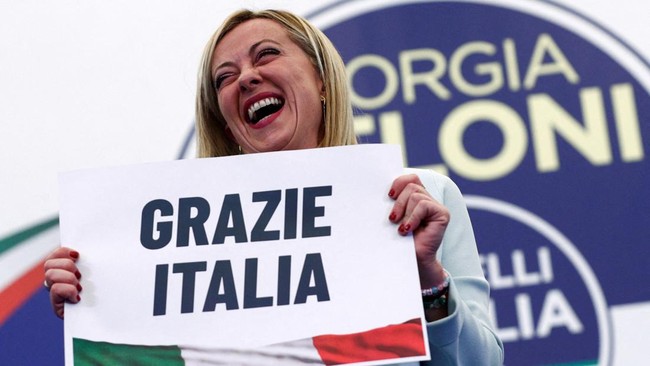
The Italian government is preparing a package of educational policies that includes a ban on the use of the burqa and niqab within school environments, alongside a limit on the number of foreign students in each class. The plan was directly announced by Prime Minister Giorgia Meloni.
According to Meloni, as reported by Euronews on Monday (21/9/2026), the package will soon be brought to a cabinet meeting. In addition to the niqab ban, the regulation will also require parents whose children are deemed to be experiencing “serious difficulties in integrating” into the national school system to learn the Italian language. Quotas for foreign student seats will also be restricted.
Several European countries have already banned face coverings in public spaces, including France and Belgium. Austria has implemented similar restrictions in schools.
Conversely, in countries such as Spain and Poland, freedom of religion and belief is constitutionally protected.
The announcement comes ahead of the Italian general election next year. Competition on the right wing of Meloni’s party is intensifying following the entry of retired General Roberto Vannacci, who is pushing for much harsher migration policies. The issue of migration itself remains one of the most divisive topics on the Italian political stage.
Speaking at an event organised by Gioventù Nazionale, the youth wing of her party, Fratelli d’Italia, Meloni stated that Italian children are currently being marginalised. “It is unacceptable that in Italian classrooms, the children who feel marginalised are the Italian children themselves because they are becoming a minority. This must not be allowed to continue,” she said.
“To call all of this integration is another lie—a comfortable lie for those who live off ideology, those who lecture us from their living rooms while sending their own children to schools that do not face such problems,” she added.
This is not a new discourse. In early August, Minister of Education and Merit Giuseppe Valditara proposed regulations regarding the niqab through an amendment to the Security Bill. In late July, Futuro Nazionale—a party formed by far-right MEP Roberto Vannacci, who supports Meloni’s proposal—submitted a resolution to reject the niqab in the Cultural Committee of the House of Representatives. The resolution passed thanks to the votes of the centre-right coalition after the text was rewritten at the government’s request.
Previously, in March, the Lega Party submitted a bill to the Senate to revise Article 5 of the 1975 Reale Law. That law was enacted by the Minister of Justice at the time, Oronzo Reale, during the ‘Years of Lead’ to prohibit face coverings in public places. The proposed revision would create a new offence of forcing someone to cover their face, carrying a prison sentence of one to two years and fines ranging from 10,000 to 30,000 euros. Perpetrators found guilty would also lose the opportunity to obtain Italian citizenship.
Regarding niqab regulations in various European nations: France has enforced a national ban on face coverings in public spaces since April 2011, a policy recently upheld by the European Court of Human Rights. Belgium followed in July 2011 with fines and prison sentences. Bulgaria has prohibited face coverings in state institutions, administration, and education since September 2016. Austria passed anti-mask laws in October 2017, requiring faces to remain visible in public. From September 2026, girls up to the age of 14 will also be prohibited from wearing head coverings in schools that “cover the head according to Islamic tradition.” Denmark has implemented a national ban since August 2018, with increasing fines for repeat offenders. The Netherlands introduced a partial ban in August 2019, applicable to schools, hospitals, government offices, and public transport. Switzerland passed a federal ban via national referendum, with implementation rules active since 2023. Portugal finalised its process in August 2026 through legislation banning face coverings in public spaces accompanied by fines. Germany has no national ban, but federal regulations prohibit public officials, judges, military members, and drivers from covering their faces while driving. Some states also limit niqabs in schools and universities for both students and teachers.
Regarding the quota for foreign students in classrooms: If the rule for the maximum number of foreign students per class is passed, Italy will become the first European country to have such a provision. In fact, Italy has previously recognised a 30% limit on non-Italian students through a 2010 ministerial circular from the then Minister of Education, Mariastella Gelmini. However, this rule often failed to be implemented due to local demographic conditions and a lack of flexibility, particularly in suburban areas.
Other European nations take different approaches. Denmark is among the strictest: the government allows upper secondary schools to set quotas of up to 50% for students “from non-Western backgrounds” or from disadvantaged environments. Schools there are also permitted to organise classes based on parental income to encourage social and ethnic integration, a model currently being closely observed by the Italian government. In France, quotas based on origin actually contradict the constitution because the state does not collect statistical data based on ethnic or religious identity. Instead, authorities use “zoning” methods to reorganise school catchment areas so that working-class areas are linked with affluent residential areas. In areas with high migrant concentrations, the number of students per class is reduced.
Criticism is widespread. Meloni’s plan has received support from within the governing coalition but has also faced opposition from the opposition and legal academics. Speaking to ANSA, Salvatore Curreri, a professor of constitutional law at the University of Enna, pointed to Article 34 of the Constitution, which asserts that “schools are open to everyone,” including the children of foreign nationals. “If that rule is so…
Source: jawawa.id (https://jawawa.id/newsitem/italy-to-ban-niqab-in-schools-and-limit-number-of-foreign-students-1789973734)
Originally published by CNBC Indonesia (https://www.cnbcindonesia.com/news/20260921124004-4-769538/italia-bakal-larang-cadar-di-sekolah-jumlah-murid-asing-dibatasi), translated from Indonesian