
It Turns Out This Is the Type of Wood Most Produced in Indonesia
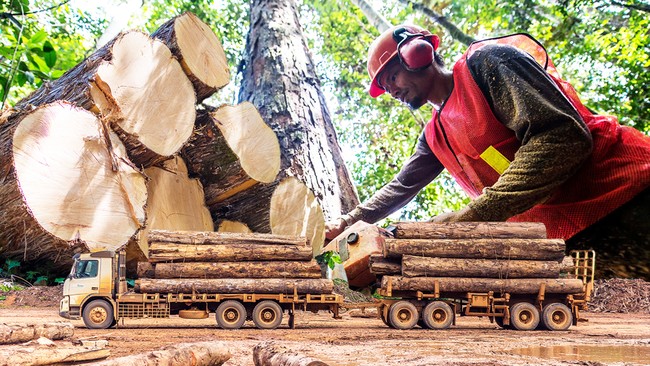
Jakarta, CNBC Indonesia - Indonesia’s roundwood production throughout 2024 demonstrates a strong dominance by several forestry plant types, particularly acacia and the mixed forest group.
Based on quarterly roundwood production data for 2024, the national total reached 64.83 million m³. Of this amount, two wood groups significantly dominate.
Acacia and Mixed Forest Dominate
The Mixed Forest Group recorded the largest production at 32.03 million m³, or nearly half of the national total.
Wood classified in the Mixed Forest Group encompasses 55 types, making it reasonable for this category to lead in production volume. The forest wood types included in this group are, among others, Kecapi, Sengon, Eucalyptus, and Jabon.
In second place, Acacia follows with production of 27.56 million m³.
Combined, these two types contribute more than 90% of Indonesia’s total roundwood production, indicating they are the most cultivated and managed tree species in the national forestry industry.
Why Is Acacia a Favourite?
Acacia has become a favourite due to its superior characteristics. This species grows quickly in tropical climates and can be harvested in a relatively short time, around 5 to 6 years.
Additionally, acacia wood strongly supports industrial needs, particularly as raw material for pulp and paper. Therefore, acacia is widely developed by large forestry companies to meet the demands of the paper industry and its derivatives.
Not only that, acacia is also frequently used in reforestation projects due to its good adaptability on critical lands.
Other Types Lag Far Behind
Meanwhile, other wood types have much smaller contributions:
From the list, ebony is the wood type with the lowest production in Indonesia. Nevertheless, this wood has high economic value.
Its sturdy, durable characteristics, along with its deep black colour, make it a premium raw material for luxury furniture. Its value increases further due to scarcity, as ebony trees grow relatively slowly.
In the global market, its average price can reach around US$7,000 to US$10,000 per cubic metre.
As an endemic flora of Sulawesi, its distribution is limited, with the southernmost area in Maros, South Sulawesi, and in the north covering Tomini and Toli-Toli, Central Sulawesi.
Locally, the Bugis tribe knows ebony as aju lotong, while the Kaili tribe calls it moutong. Nevertheless, this plant is also found growing in some areas of Papua.