
Israel’s Power Struggle Puts Islamic Heritage at Stake
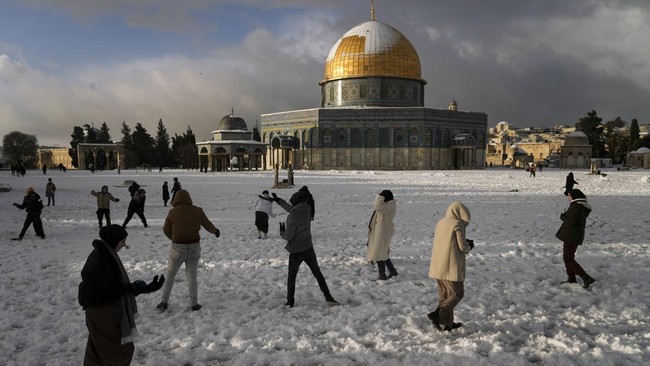
Jakarta, CNBC Indonesia – The political struggle for power in Israel will determine not only who leads the country, but could also affect the future of its Islamic heritage, including one of the holiest sites, Al-Aqsa Mosque in Jerusalem.
Israel’s election on 27 October 2026 did not produce a winner able to secure a parliamentary majority.
The Likud party led by Prime Minister Benjamin Netanyahu won 27 of the 120 parliamentary seats, while the bloc supporting him secured only 53. Meanwhile, the opposition camp led by Gadi Eisenkot received the backing of 48 seats, with Arab parties holding 19. President Isaac Herzog is scheduled to nominate a candidate to form a government on 8 November 2026.
The uncertainty has drawn attention to the direction of the next government’s policies, including those concerning Jerusalem and the Al-Aqsa compound.
The make-up of the governing coalition could influence Israel’s policies on security, worshippers’ access and arrangements for religious activities at the Al-Aqsa compound.
The future of this heritage is tied to public access, the maintenance of historic buildings, renovation permits and protection of the site from damage. Political tensions could complicate preservation efforts if access is restricted or management decisions become part of a wider conflict.
The Al-Aqsa compound is in the Old City of East Jerusalem and holds an important place in Islamic history. It contains Al-Aqsa Mosque and the Dome of the Rock, both important symbols of Islamic architecture.
Israel took control of East Jerusalem in 1967 and later annexed it, a move not recognised by most of the international community. Religious administration of the Al-Aqsa compound is carried out by an Islamic waqf institution linked to Jordan, while Israel controls security and access in the area.
Al-Aqsa and dozens of Islamic cultural heritage sites in Israel
Al-Aqsa Mosque is one of the traces of Islamic civilisation that have endured for centuries in the territory now within Israel.
Beyond the mosque, Islamic heritage can still be found in various historic buildings, from mosque complexes in Jerusalem to Ottoman-era architecture in coastal cities.
The history of Islam in the area began in the seventh century, when Muslim forces took Jerusalem from the Byzantine Empire around 637–638 AD, during the caliphate of Umar ibn al-Khattab. This marked the beginning of a long period of Islamic rule in the region.
Islamic civilisation developed further under the Umayyad dynasty (661–750 AD). Jerusalem received considerable attention as a religious centre, including through the construction of the Dome of the Rock in 691–692 AD, ordered by Caliph Abd al-Malik ibn Marwan.
The Haram al-Sharif compound was also built up and developed as an important centre for Muslims.
After the Umayyad period, the area came under the rule of various Islamic dynasties, including the Abbasids, Ayyubids and Mamluks.
In 1187, Salahuddin al-Ayyubi recaptured Jerusalem from the Crusaders. The region subsequently remained under Ottoman rule from 1517 until the First World War.
Successive governments over the centuries left an architectural and cultural legacy. This heritage comprises not only places of worship, but also public buildings, commercial facilities and historic monuments.
A number of buildings that remain today bear witness to the development of Islamic civilisation in the region.
One of the best-known landmarks is the Dome of the Rock in Jerusalem. Built in the late seventh century under the Umayyad dynasty, it is known for its gold-covered dome and Islamic mosaics and calligraphy. It stands within the Haram al-Sharif compound, which is also home to Al-Aqsa Mosque.
Al-Aqsa Mosque itself is one of the most important sites in Islamic history because of its association with the Isra and Mi‘raj.
The compound comprises a number of religious buildings and facilities that have been developed and renovated over the centuries.
Outside Jerusalem, early Islamic heritage can also be found in Ramla at the White Mosque. Construction began around 715 AD under Caliph Sulayman ibn Abd al-Malik and was completed during the rule of Umar ibn Abd al-Aziz. Its minaret remains one of the site’s distinctive features.
During the Ottoman period, other historic buildings were established in cities such as Acre and Jaffa.
In Acre, the Al-Jazzar Mosque was built in 1781 on the orders of Ahmad Pasha al-Jazzar. Its domes, minaret and spacious courtyard display Ottoman architectural characteristics.
In Jaffa, the Mahmoudiya Mosque underwent major construction in the early 19th century under the rule of Muhammad Abu Nabbut. The complex also includes Sabil Abu Nabbut, a public fountain that once supplied water to residents and passers-by.
Islamic heritage is represented not only by religious buildings, but also by Khan al-Umdan in Acre.
Built and completed under Ottoman rule in the 18th century, the structure served as a resting place for merchants and a storage facility for goods. It illustrates the role of Islamic civilisation in the development of trade along the coast.
These landmarks show that the history of Islam in the region is reflected not only in religious buildings, but also in architecture, public facilities and the economic activities of communities over many centuries.
Source: jawawa.id (https://jawawa.id/newsitem/israels-power-struggle-puts-islamic-heritage-at-stake-1793965846)
Originally published by CNBC Indonesia (https://www.cnbcindonesia.com/research/20261106165800-128-783079/israel-berebut-kekuasaan-jejak-peradaban-islam-jadi-taruhan), translated from Indonesian